

Folders |
Jane Hedengren Outlasts Doris Lemngole To Win NCAA 5,000 MetersPublished by
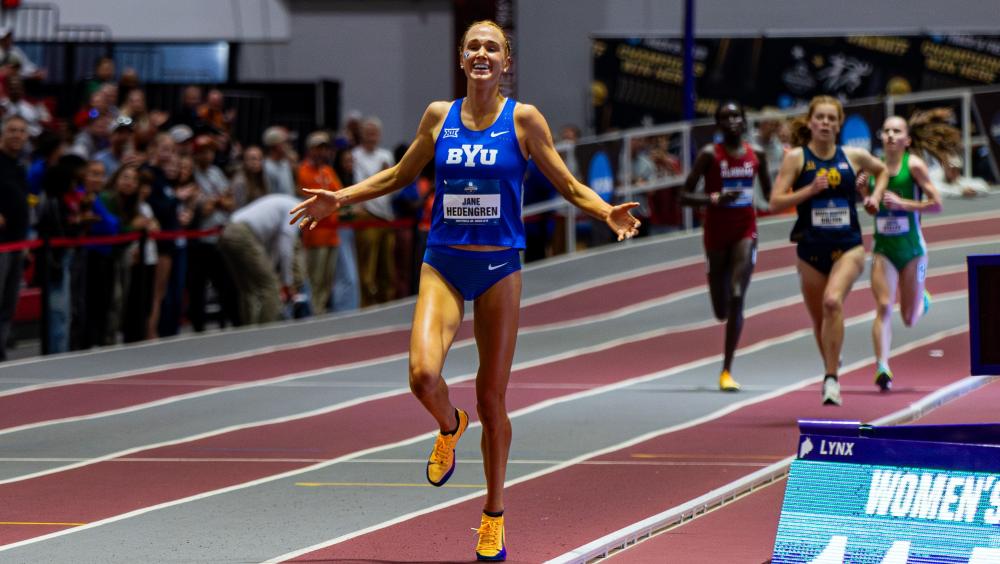
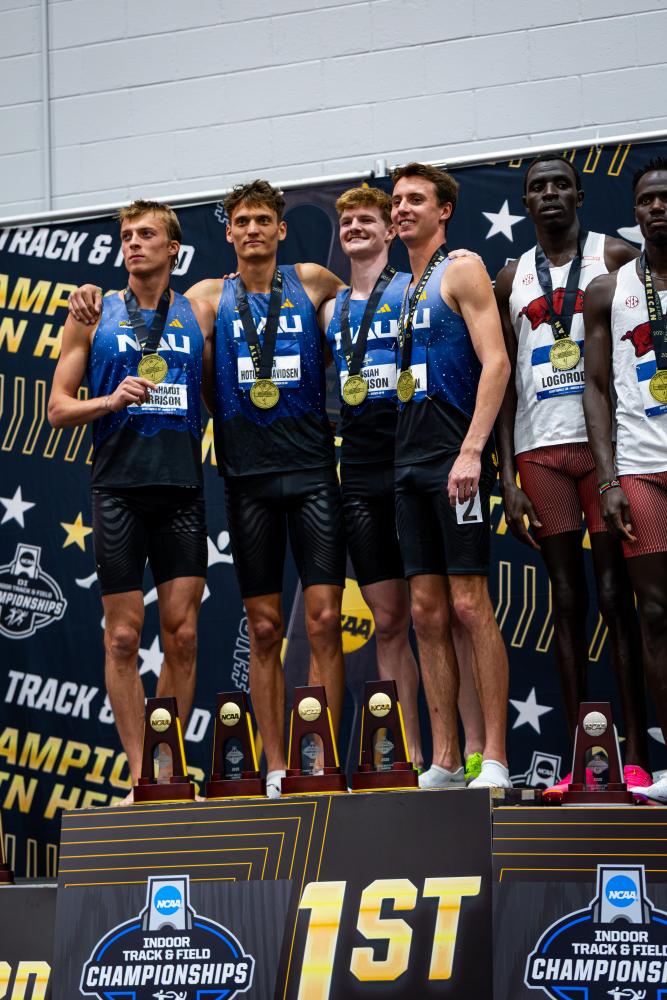
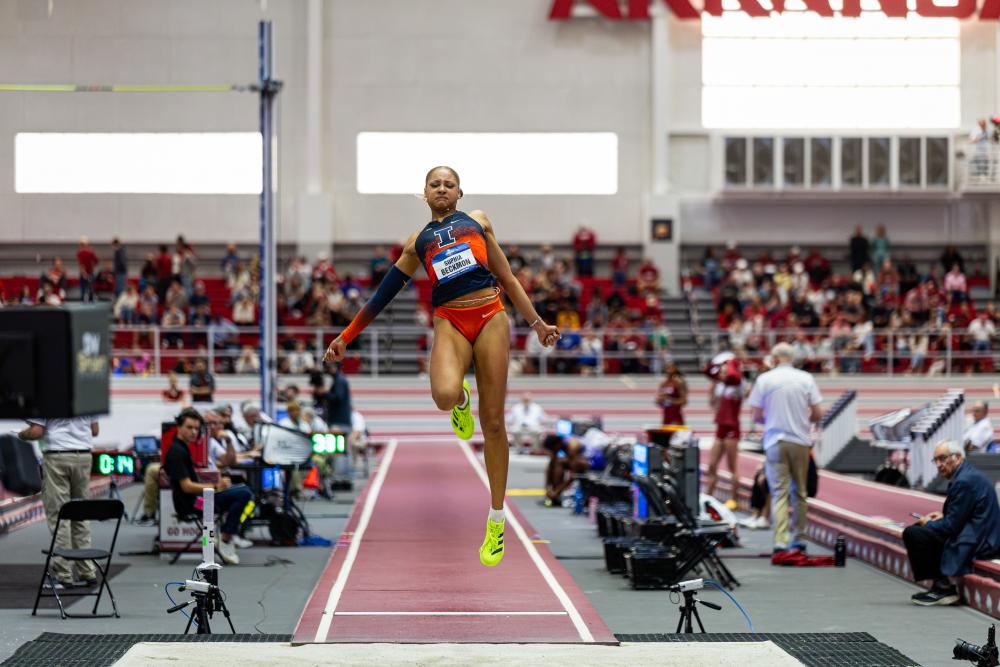
Friday Recap: Women's Team Race Draws Tighter Between Illinois And Oregon; NAU Wins Men's DMR; Habtom Samuel Beats Marco Langon In 5,000; Peyton Bair On Record Pace In Multi By David Woods for DyeStat Corbin Smith Photos FAYETTEVILLE, Ark. – The NCAA Indoor Championships are a worlds-style meet featuring athletes from 45 countries. Yet on a night when the world list was revised and four collegiate records nearly fell, it was a 19-year-old Utah woman who elevated this meet to majestic. BYU freshman Jane Hedengren, a generational talent refusing to concede to older rivals, won her first NCAA title Friday. In doing so, she beat Alabama’s Doris Lemngole, who has the best resume of anyone at this track and field meet. Lemnogle, the 2025 Bowerman Award winner, had twice beaten Hedengren, and decisively -- in NCAA cross country Nov. 25 and the Millrose Games 3,000 meters Feb. 1. On Friday the 13th, Hedengren’s luck changed. No luck involved, though. Hedengren won the 5,000 with a bold, grinding, stay-with-me-if-you-can finish. She did not come near the collegiate record of 14:44.79 she set Dec. 7, but her time of 15:00.12 left Lemnogle more than three seconds behind. Hedengren ran the last 600 in 1:37.65, which might not be fast enough for a global medal but is evidence she is on her way. Hedengreen conceded it had been “discouraging” to be left behind by Lemnogle before. “It was pretty instinctual,” Hedengren said of her move. “I just wanted to take the race as it comes today. I feel like there are a lot of ways to win races. It’s cool to see and watch film and learn from some of the best.” She said she simulated the finish in workouts and suggested this 5,000 felt like practice. After Hedengren, the next six were Kenyans. The 24-year-old Lemngole was second in 15:03.42. New Mexico’s Pamela Kosgei, 21, the NCAA champion at 5,000 and 10,000 last June, was third in 15:07.76. Hedengren and Lemnogle are to meet again in Saturday’s 3,000. Before that race, stat geeks can occupy their time charting and projecting and predicting a race for the team championship. Through five of 17 events, Illinois has 30 points and defending champion Oregon 20. The DyeStat form chart had the Illini outscoring Oregon 16-0 in the pentathlon. Instead, Oregon outscored Illinois 10-8. That 18-point swing has turned NCAAs into a rematch of the Big Ten, in which Oregon beat Illinois 101-93. The flashresults.com website projects Illinois over Oregon 45.1 to 45 – yes, by one-tenth of a point. BYU (36), Arkansas (34.83) and Georgia (34.5) remain in the mix, too. Oregon’s Liisa-Maria Lusti, a 22-year-old Estonian who was fourth in the Big Ten, scored 4,498 points to become the first freshman to win the pentathlon since Kendell Williams of Georgia. Williams set what was then a collegiate record of 4,635 in 2014. Second was another freshman, Illinois’ JaiCieonna Gero-Holt, who had personal bests in the three closing events to finish with a Big Ten record of 4,466 points. Previous Big Ten record was 4,459 by teammate Meagan Humphries, who came here as the collegiate leader and came away with nothing. Humphries’ score of 4,267 had seemingly given her eighth. She was disqualified for stepping on the rail in the 800 meters, and Illinois lost a precious point. A third freshman, Vanderbilt’s Janie Ford, scored 4,405 and was fourth behind Cincinnati’s Juliette Laracuente-Huebner, 4,442. Sophia Beckmon of Illinois became the first Big Ten athlete to win any of the three jumping events at indoor NCAAs (excludes pole vault). She is just the fourth Illini woman to win at indoor NCAAs. Beckmon had the three longest marks of the competition: 22-5.25 (6.84m), 22-0.75 (6.72m) and 21-11.75 (6.70m)). The latter was also recorded by runner-up Alyssa Jones of Stanford. “I knew this was coming,” Beckmon said. “But again, I still wanted that 7 meters.” If Illinois does win its first team championship, a turning point will be the 20-pound weight, in which South Africa’s Phetisang Makhethe climbed from fourth place to second in the fourth round. She became the ninth collegian to exceed 80 feet. Winner was also an African, Minnesota’s Anthonett Nabwe, a Liberian whose distance of 82-5.5 (25.13) made her No. 3 on the all-time collegiate list. In the only other final, anchor Wilma Nielsen gave Oregon victory in the distance medley relay in 10:48.76. South Carolina, anchored by Salma Elbadra’s 4:26.50 for 1,600, was second in 10:49.69. BYU, without Hedengren or Riley Chamberlain, was sixth in 10:52.14. In women’s trials, Georgia freshman Adeajah Hodge, on her 20th birthday, lowered her world lead in the 200 to 22.28. Shenese Walker of Florida State ran a collegiate-leading 7.07 in the 60. Men’s recap: Samuel beats Langon (again) in 5,000 The 5,000 for men was as compelling as it was for the women. The race was won by New Mexico’s Habtom Samuel over Villanova’s Marco Langon, 13:36.58 to 13:36.98. It was a rematch of a Dec. 6 race at Boston in which Samuel beat Langon, both timed in 13:05.21. They meet again in Saturday’s 3,000. Samuel, a 22-year-old Eritrean, is 10-0 this season against collegians (cross-country and indoors). Langon conceded he got too far behind Samuel. Their respective last 200s were 26.55 and 26.64. With 50 meters left, Langon said, he thought he would win. “I thought it was going to be a little easier to get up on Habtom’s shoulder,” Langon said. “I know I close faster and harder. I gave him too much space at the end. “I mean, he’s an African. So he’s strong as hell and was born at altitude, and he knows how to play the game.” Samuel said he has trained for faster finishes. In championship racing, he said, “You have to be more smart, understand the game and speed as well.” In team scoring, Arkansas leads with 14 points, followed by Kansas and Virginia with 13 each. Projections: Arkansas 49.5, Florida 31, Kansas State 30.5, Penn State 27.5, Oregon 26. Joining Samuel and Langon in the 3,000 will be Colin Sahlman. He was swinging an imaginary baseball beat as he crossed the finish to give Northern Arizona its first NCAA title in the DMR. The Lumberjacks gathered at the top of the banked oval to embrace afterward. Sahlman scratched out of the 800 and mile so he could be fresh for the DMR. “First time I’ve crossed the line first at this event,” Sahlman said. “I wasn’t really thinking. I was just super happy.” Northern Arizona’s time was 9:19.95. Arkansas was second in 9:21.42. Virginia Tech was third in 9:21.69, helped by Christian Jackson’s 800 leg of 1:44.60. Michigan, anchored by Trent McFarland, was fourth in 9:22.77. Oregon, in last place after the opening 1,200 and 11th before the anchor, was seventh in 9:27.49 after Simeon Birnbaum’s 3:52.07 anchor. Birnbaum is coming back in the 3,000. Those almost-collegiate-records: >> Auburn’s Ja’Kobe Tharp ran trials of the 60-meter hurdles in 7.36. He climbed into a tie for No. 4 on the all-time world list and No. 2 in U.S. history behind Grant Holloway’s world record of 7.27 in 2024. Holloway set a collegiate record of 7.35 at the 2019 NCAAs. Texas Tech’s Malachi Snow, who also made the 60-meter final, was second in that semifinal in 7.43. Samford sophomore Bradley Franklin won the other semifinal in 7.42. >> Arkansas’ Jelani Watkins clocked 6.46 in trials of the 60, or .01 off the collegiate record. Snow was fifth overall at 6.54. >> Watkins nearly set another collegiate record in the 200. USC’s Garrett Kaalund beat him by one-thousandth of a second, 20.105 to 20.106, in a heat. Houston’s Elijah Hall set a meet, collegiate and American record of 20.02 in 2018. Arkansas’ Wallace Spearmon set the facility record of 20.10 in 2005, but that likely won’t last past Saturday’s final. Texas A&M sprinter Auhmad Robinson endured an apparent leg injury in his heat, falling off the track along the straightaway. >> In the 35-pound weight, Iowa’s Ryan Johnson threw 84-1.5 (25.64m), or two centimeters off the collegiate record of 84-2.25 he set Feb. 28 at the Big Ten meet. Previous meet record was 82-3.5 (25.08m) by Wyoming’s Daniel Reynolds last year. >>In the pole vault, Kansas’ Ashton Barkdull beat the deepest NCAA field ever assembled. Barkdull, a former walk-on who has improved 29 inches since high school, cleared a PB of 19-0.25 (5.80m) on his second attempt to beat Russian vaulter Aleksandr Solovev of Texas A&M. Solovev relegated Barkdull to second at last June’s outdoor NCAAs. “Ever since that moment, I’ve been saying, ‘It’s not happening again. I’m winning,’ “ Barkdull said. “I don’t care what people say. I don’t care how I’m jumping. I’m going up here and doing what I have to do to win.” Before the meet, he received a text of encouragement from Kansas record-holder Zach Bradford, the reigning U.S. indoor champion. Solovev was second, also at 19-0.25. It was the first NCAA meet with as many as six men over 18-8.25 (5.70m). Meet records for place were set in third, fourth, fifth, sixth and ninth (18-4.5/5.60m). >> In the heptathlon, Peyton Bair is approaching an Oregon school record. That wouldn’t matter much, except the record belongs to Ashton Eaton, winner of seven global gold medals. Bair finished day 1 with 3,675 points and projects to 6,488. Eaton’s school record is 6,499, then a world record and now No. 3 on the all-time collegiate list. Only five men, including Eaton, have ever exceeded 6,500. Bair set a heptathlon collegiate record of 6.67 in the opening 60 meters, breaking his own record of 6.70. (His overall PB is 6.61 from Albuquerque.) Then he won the long jump and shot put with PBs of 25-3.25 (7.70m) and 52-8.75 (16.07m), respectively. His high jump of 6-8 (2.93m) was just a centimeter off his best.. Contact David Woods at dwoods1411@gmail.com. |