
Folders |
Cooper Lutkenhaus' High School Peers React To Jaw-Dropping PerformancePublished by
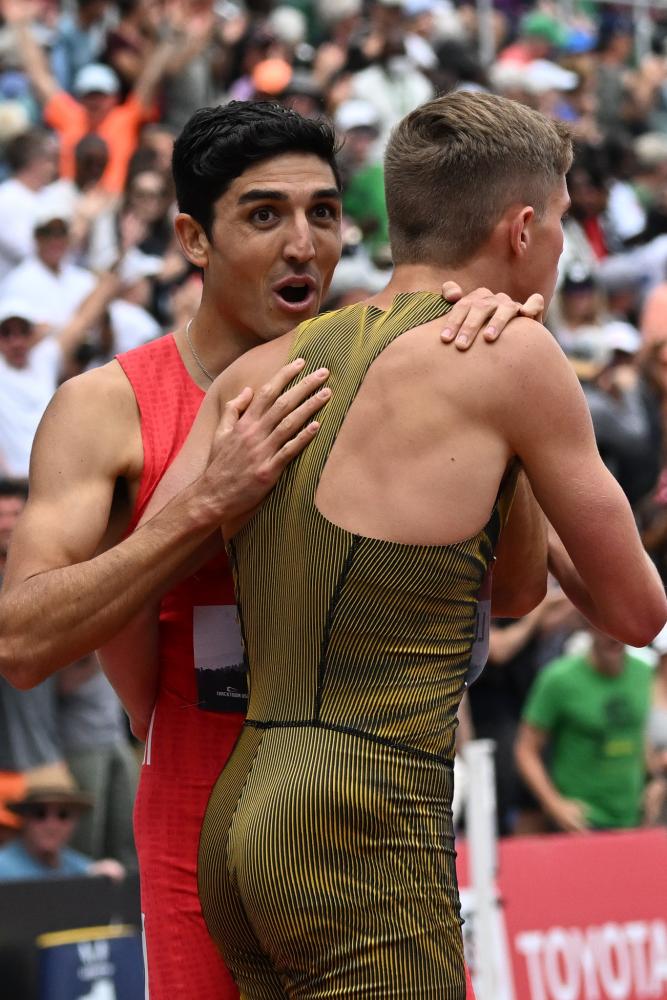
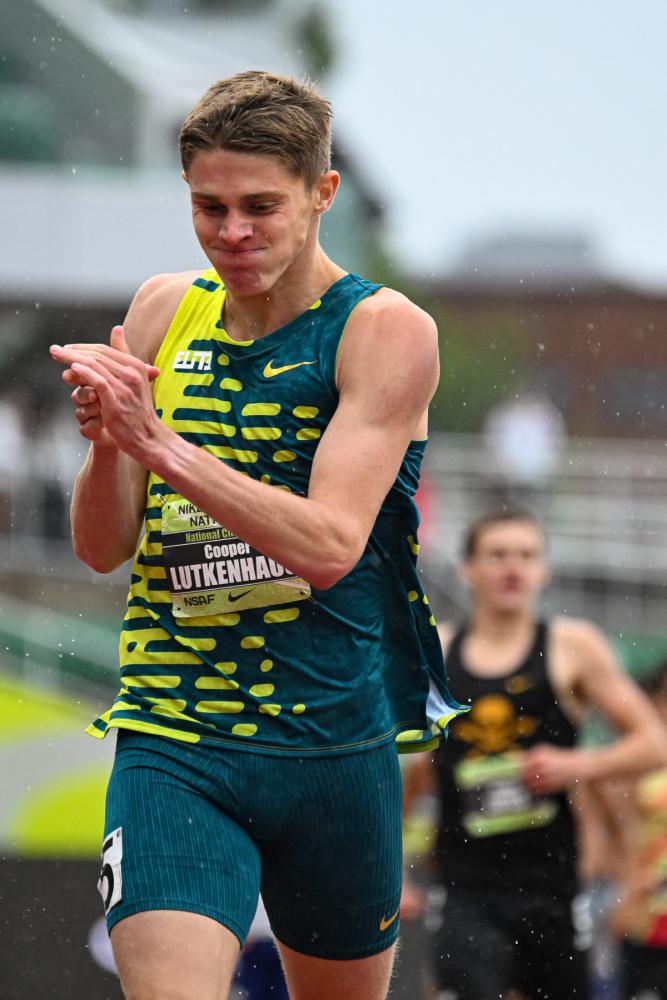
Owen Powell, Lucien Bone IV, Bodey Lutes And Quentin Nauman All Raced Lutkenhaus This Year And Offer Perspective On Seeing Someone So Young Achieve Greatness By Oliver Hinson of DyeStat Becky Holbrook photos Whether they were watching in real-time or not, the fastest high school half-milers in the country knew within a few minutes what Cooper Lutkenhaus had done in the men's 800 meters final at the USATF Outdoor Championships on Aug. 3. Text messages pinged them, punctuated by expletives to capture the level of shock and disbelief over what just happened. Owen Powell, Lucien Bone IV, Bodey Lutes and Quentin Nauman all raced against Lutkenhaus this season and were part of an incredible crop of 34 boys who broke 1:50 in the 800 meters this year across the country (in comparison to the 19 who did it in 2024 and 18 in 2023). Lutes, from nearby Marshfield High in Oregon, was in the crowd at Hayward Field when Lutkenhaus finished second and smashed the U18 world record with 1:42.27. Back in June, Lutes has finished second to Lutkenahus at Nike Outdoor Nationals. As Lutes watched the final, he was one of many who expected a top three of Donavan Brazier, Josh Hoey and Bryce Hoppel to make the U.S. team. “Don’t get me wrong, I wanted Cooper to win,” Lutes said. But he had to be realistic. Brazier, Hoppel and Hoey had all run 1:43.08 or faster at that point in the season. Lutkenhaus was a 16-year-old who could maybe break 1:45. The high schooler drew lane 1 for the final, and he didn’t make any effort to get to the front of the pack by the break-in point. He knew the top pros were going to start exceptionally fast, and he was content to sit back and run his own race. While Hoey led the pack through 400 meters in a blazing 49.29 seconds, Lutkenhaus came through in 50.66 — still fast for someone with his credentials, but not quite a suicide pace. Heading into the back stretch on the second lap, it was clearly a four-man race between Hoey, Hoppel, Brazier and Brandon Miller, so much so that the camera zoomed in on them exclusively. Lutkenhaus was in seventh place, far out of frame. With 100 meters left, that four-man pack was still intact. At that point, Lutes was looking for Brazier to break free, which he did with 60 left. “I was like, ‘Oh, my god, this is awesome, Brazier is back,’” Lutes said. “I had been waiting forever.” Lutes wasn’t the only one. Thousands of track and field fans who had seen Brazier struggle with injuries in the early years of the decade were ecstatic to see his triumphant return on one of the biggest stages. That moment was fleeting. Almost in tandem with Brazier, Lutkenhaus surged, passing Miller, Hoey and Hoppel. The moment was almost too quick to process. All Lutes could think was: Oh my gosh, Cooper! When Brazier crossed the line first, Lutes saw the winning time — 1:42.16. He saw Lutkenhaus finish just behind him. Unthinkable. No 16-year-old had ever qualified for Team USA for the World Championships in an open event. But Lutes and the nearly everyone in the crowd turned to watch the scoreboard to see Lutkenhaus’ time. “We were waiting, and it took so long,” Lutes said. “I say ‘so long,’ but it was probably about 30 seconds for the time to pop up. When it popped up, that place just started freaking out. It was electric.” Powell of Mercer Island WA, who ran US#2 1:46.63 behind Lutkenhaus at the Brooks PR Invitational, was on a beach enjoying some vacation time. “I don’t know why I wasn’t watching that day,” Powell said. His phone buzzed with a text from future University of Washington teammate Josiah Tostenson, with a screenshot of the result. “I genuinely thought he was just trolling,” Powell said. “I thought he was messing with me at first. And then I looked up the results and I’m like, ‘Oh, that’s… how did he do that?’” Nauman, who broke the junior class mile record for Epworth Western of Dubuque, Iowa, was working his six-hour shift at the local Hy-Vee supermarket as the race unfolded in Eugene. He, too, found out by text. A message from his Nike Elite program group chat that read simply, “WTF.” “I go immediately on my phone,” Nauman said. “I look at DyeStat, I look at everything running-related. And I notice (Cooper) runs 1:42.27, and I’m like, ‘Holy s***.’” Nauman’s coworkers at Hy-Vee couldn't understand why he was freaking out. “They knew it was definitely a fast time,” he said, “but they didn’t pay much attention to it.”
For Nauman his peers, what Lutkenhaus had just done was beyond comprehension. The kid from Justin Northwest near Dallas has instantly become a member of the global elite in track and field. He had just run four seconds faster than any other high schooler, ever. Bone, of Austin High in Texas, who had finished second to Lutkenhaus in the UIL Class 6A final and run 1:49.23, was glued to the television coverage of the USATF 800 final. He could barely believe it. “I feel like every expectation I set for him,” Bone said, “he just smashed.” Bone finished the season at US#4 with 1:46.87 for second place at the USATF U20 Championships. Bone and many others have sought to put Lutkenhaus' performance into perspective. “I think the numbers speak for themselves,” he said. “That’s one of the most impressive things I’ve ever seen done on a track.” Others have made even bolder claims. Coach and author Steve Magness called Lutkenhaus’s performance “the most impressive athletic feat in history.”
Powell saw that post, and he agreed. “I’d be surprised if anything like that is ever replicated,” he said. The Build Up About 400 meters into his semifinal race in the men’s 800 meters at the USATF Championships, Lutkenhaus got tripped up and fell to seventh place, barely managing to stay on his feet. Up in the stands, Lutes looked at his friend and resigned himself to reality. “Okay, this might be it,” he said. Lutes, a recent commit to Oregon after running US#6 1:47.74 behind Lutkenhaus six week earlier, was present for all of Lutkenhaus’ races. In the first round, he watched the national high school record holder cruise to a second-place finish against a slew of pros and collegians. “I was like, ‘Whoa, he made that look easy,’” Lutes said. With a little less than a lap to go in his semifinal race, though, it looked like the dream was coming to an end. It would take a special kind of racer to not only survive a near-fall but crawl back from a substantial deficit. A 16-year-old wasn’t supposed to be able to do that. And then he did. With a final 200 meters of 26.33 seconds, Lutkenhaus stormed back from the dead and out-leaned Isaiah Jewett, a Tokyo 2021 Olympian, at the finish line to snag the last qualifying spot from his heat into the final, running 1:45.57. “That’s when I was like, ‘Okay, this is crazy,’” Lutes said. But did anyone see it coming? With the benefit of hindsight, Lutes could see that there were signs that Lutkenhaus could do something spectacular. At Nike Outdoor Nationals, Lutkenhaus didn’t rush to the front. After the break-in point, he sat behind Lutes and Bryson Nielsen (Mesa AZ) for about 200 meters. On the home stretch of the first lap, he passed Lutes, and Lutes followed. Heading into the back stretch, they passed Nielsen. “I was on his shoulder at 300 (to go),” Lutes said. “He made his move, and I made it with him.” With about 200 meters left, Lutes thought, Okay, here we go. With a personal best of 21.62 in the 200, he knew he had serious closing speed. Lutkenhaus better get on it, he thought. Lutkenhaus did, in fact, get on it. As he would do six weeks later, he closed in about 26.5 seconds, leaving Lutes behind and shattering his own high school record with a time of 1:45.45. Lutes PR'd by almost three seconds. “He just pulled away,” Lutes said. To make it even more impressive, Lutkenhaus did that in cold, rainy weather. Nauman definitely knew it. Like Lutes, Nauman, was in that race — he finished ninth in 1:50.44 — and he was Lutkenhaus’ roommate in Eugene for the weekend. The two were also roommates for Nike Indoor Nationals in March. Nauman noticed something striking about Lutkenhaus during both of those weekends: he didn’t really get nervous. At 16, he had higher expectations placed on him than nearly every other runner in the country, but he never let it get to him. “He was actually very composed,” Nauman said. “He never really gave me a set goal or time.” Nauman said Lutkenhaus “never really seemed exhausted” after any of his high school races, either. He was clearly capable of more. Powell and Bone echoed that sentiment. Powell and Bone, a Texas Tech commit, both raced Lutkenhaus in the 800 at the Brooks PR Invitational in Seattle on June 8 — a race that saw Lutkenhaus break Michael Granville’s national record of 1:46.45 for the first time. At that time, Lutkenhaus had been chasing Granville’s record, which had stood since 1996, for several months. He had run 1:46.86 in February to claim the indoor record, but in the first few months of the outdoor season, he hadn’t run against national-level competition. When he lined up in Seattle, there was an expectation that he would finally get the record. Powell and Bone observed a few things about Lutkenhaus in that race. For one, despite the expectations surrounding his performance, the nerves were hardly detectable. “Some people are always overstressed or too nervous,” Powell said. “They’re not talking at breakfast before the race. But he seemed pretty much like himself. Like, obviously, there’s the hint of nerves because he, you know, he cares. But it wasn’t so much that he was going to shut down… it was this nerve that’s gonna fire him up.” Second, and more obvious, they observed his dominance. Lutkenhaus ran 1:46.26 in that race with negative splits — he ran his first lap in 53.59 seconds and his second in 52.67. The 800 isn’t supposed to happen like that. Most coaches and scientists agree that the optimal strategy is a slightly positive split, where the first lap is about two seconds faster than the second. A 1:46.26 performance with a negative split signaled that there was more on the horizon. So did a 1:45.45 in the rain, as well as a 1:45.57 with a near-fall. For the athletes who had been watching Lutkenhaus dominate all season, the idea of him breaking 1:45 in the final at USAs seemed probable. “I always thought he’d run 1:44,” Powell said. “Maybe 1:43 by the end of high school.” Nauman and Lutes agreed — 1:44 seemed doable. Lutes said 1:44 seemed like the “end-all be-all.” Bone didn’t have a specific expectation, but he knew that Lutkenhaus would try to close hard in the last 200. A fellow Texan, Bone had raced against the sophomore phenom three times, and each time, Lutkenhaus had made the same demoralizing move. “You can see the exact moment when he switches,” Bone said. “When everybody else is on the pain train and you feel like you’ve got nothing left, he just switches gears like that and finds some more speed.” Doing that against high schoolers was one thing, though. Bone knew kicking against the pros would be a tall order. What's Next? Lutkenhaus is far from done. One of the more intriguing parts of the conversation surrounding his performance is where does he go from here? In an immediate sense, it’s the World Championships, which will kick off about a month from now in Tokyo. There is plenty of speculation around what he could do at that meet. On one hand, it seems almost impossible that he could ascend any further, but given the rapid nature of his progression, it also seems unlikely that he would stagnate. Nauman, for one, is entertaining the idea that he could break 1:42. “You just gotta keep going for what’s next,” he said. “One-forty-one? I don’t know. I mean, he’s doing things that a lot of high schoolers could dream about doing at 25, and he’s 16.” In fact, when Lutkenhaus is in his prime, Nauman believes he’ll be a candidate to not only break the world record, but break the 1:40 barrier. “It’s definitely possible,” Nauman said. “When you have a 16-year-old running 1:42 and most people say their prime is 25 to 28, it’s there.” Breaking 1:40 would, of course, be one of the most spectacular athletic feats of all time. But if anyone is in the business of producing those performances, it’s Lutkenhaus. His race at Hayward Field will serve as evidence of that for quite some time. “I feel like if you were a director and you were making a movie, and that was the script,” Lutes said, referring to Lutkenhaus’s race, “you would rewrite it. You’d be like, ‘Let’s make this more realistic.’” |