

Folders |
Olympic Hopefuls Adaejah Hodge, Michelle Smith Part of Montverde Academy's 4x200 Lineup at MillrosePublished by
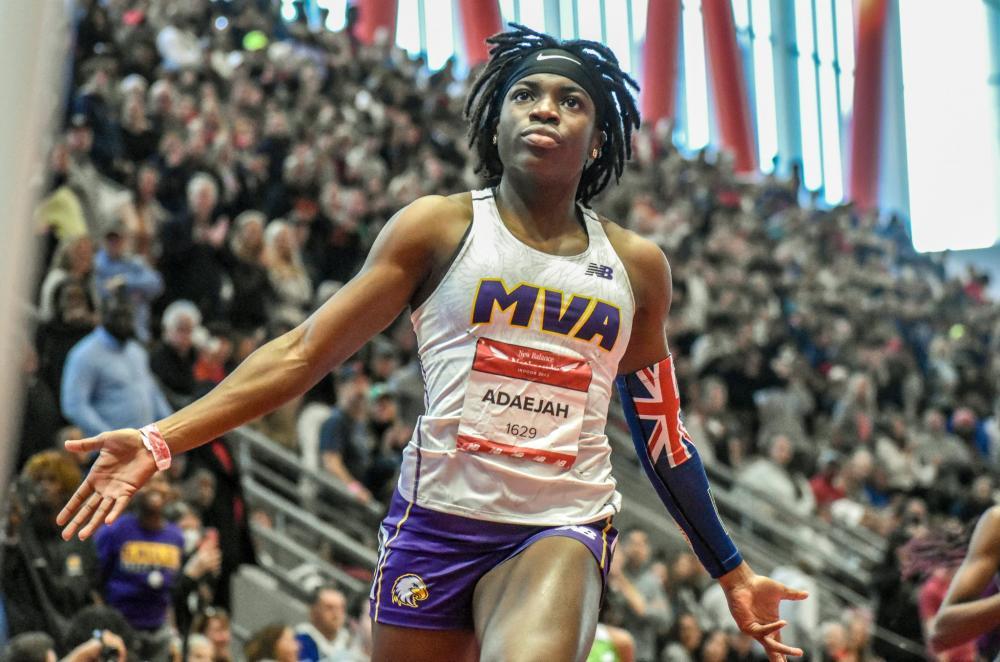
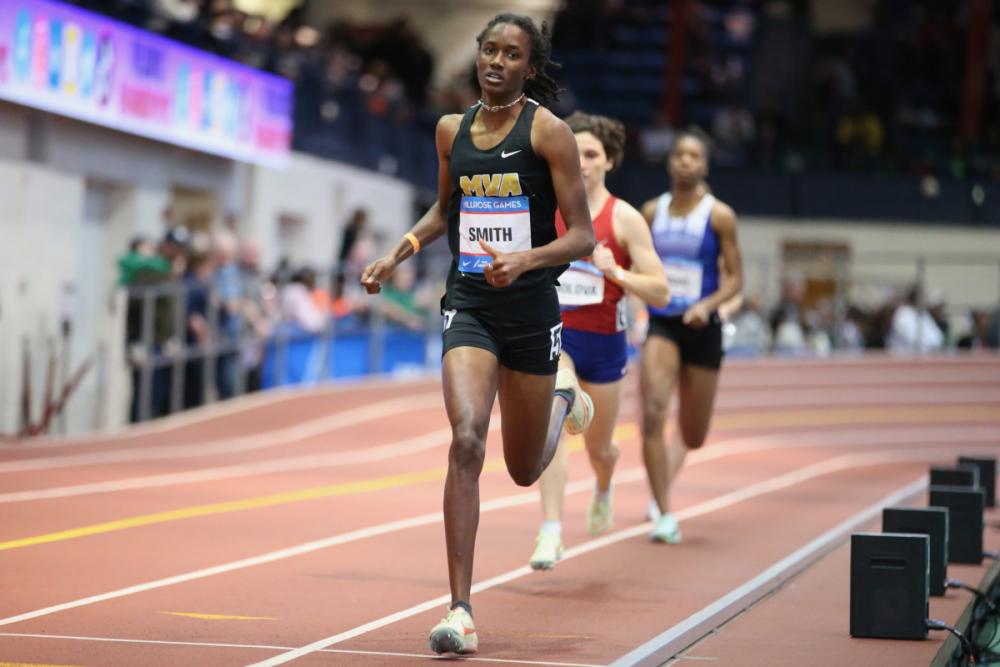
Montverde Academy Quartet That Already Took Down The 4x400 National Record Will Face Top Teams In 4x200 Showdown At The Armory By Todd Grasley for DyeStat DyeStat Photos by Keenan Gray (Adaejah Hodge) and John Nepolitan (Michelle Smith) The Montverde Academy track team's stellar roster features a pair of seniors, Adaejah Hodge and Michelle Smith, who have a couple of things in common. They have both signed to compete collegiately for the University of Georgia. And they are both focused on one big goal in 2024: Competing at the Olympic Games in Paris. This weekend in New York, however, they will compete together on a 4x200 relay that could make history at the Millrose Games. The race is at 1:51 p.m., which is in the NBC telecast window. MILLROSE GAMES VIEWING INFO | SCHEDULE/ENTRIES The same lineup that broke the national record in the indoor 4x400 relay at the VA Showcase last month is targeting the 4x200 record of 1:34.75 by Bullis MD in 2018: Hodge, Smith, Alivia Williams and Skyler Franklin. Current US#1 Archbishop Carroll DC and US#2 Bullis are also in the race. Hodge, the reigning indoor high school national record holder in the 200 meters with her PR of 22.33 at New Balances Nationals Indoor last March, competes internationally for the British Virgin Islands. She reached the semifinals of the women's 200 meters at the World Athletics Championships in Budapest last summer. Smith's versatility ranges from the 400-meter hurdles, where she won the New Balance Nationals Outdoor title last year and has a best of 56.66 seconds, to the 800 meters, where she has run 2:07.95. She competes for the Virgin Islands. Montverde coach Gerald Phiri said Hodge will continue the high school season but has an eye on reaching the 200-meter finals in Paris this summer. "Last year she started fall training on September 6," Phiri noted. "This year started we started on October 23. We will likely focus on the 400 meters indoors. If training is progressing well, we’ll see what she can do at 200 meters. Otherwise, do not expect Adaejah to run an indoor 200 this season." Phiri, a 2012 Olympian for Zambia, is quick to point out that breaking her record of 22.33 is not the primary goal. "When an athlete produces such incredible performances, there is self-imposed pressure as well as the world’s expectations," Phiri said. "My goal is to protect the young athlete. If I think she’s ready to produce another unworldly performance, I’ll let her loose. Otherwise, we will focus on the 400 and/or maybe the 60 for the indoor season." The 400-meter prowess was already on display at the VA Showcase, where Hodge helped Montverde break Long Beach Poly CA's 20-year-old national record by more than a second (3:37.63). Smith has larger aspirations as well. "The Olympics and World U20 Championships are our goals for the year." Phiri said. "I’m sure most people want to know the outcome goals. For Michelle, indoors is simply an opportunity to break up the training year. We are looking to improve her proficiency over the short hurdles. We are also looking at improving her open 400 ahead of the outdoor season when we switch back to her beloved 400-meter hurdles." Another key member of the relay lineup is Franklin, who transferred from Western High in South Florida after a stellar freshman year in 2023. She was fifth nationally in the 400 meters, running 52.52 seconds. "Our new athletes are progressing well," Phiri said. "Changing schools and training styles comes with its challenges but we are overall in a good place. Our focus this (past) fall has been on acceleration development, but we are moving into more specific work." Phiri called Franklin perhaps the most "talented" high school runner he has worked with. "We need to continue refining her running posture, and maybe we will see something special this year," the coach said. The fourth member of the lineup, Williams, has run 53.47 in the 400 meters indoors this month and 23.98 in the 200. Inside The Program With Gerald Phiri What is your training theory? I have a strong understanding of various training theories and I try my best to approach my work with a healthy balance of science and art. I am not a one size fits all kind of guy, I do not believe that 10 athletes can or should do the exact training year-round. As the year progresses we move to very individualized programming. What does your training program consist of? Each year we start training the Tuesday after Labor Day. We have eight weeks of “General Preparation” followed by eight weeks of “Specific Preparation.” Indoor is never the focus though we have had some success over the past few seasons. The indoor season falls during our “Pre-Competition” phase. We use these competitions to refine individual technical models for the outdoor season. With the exception of Adaejah, everyone else is at the end of the specific preparation phase. Monday is mainly an acceleration development day (Blocks, Acceleration Ladders, Multi Throws, and Multi Jumps), Tuesday is focused on Lactic Tolerance (“Special Endurance 2”) and Anaerobic Power (“Special Endurance 1”), Thursday is a speed development day (ex. Flys, Ins & Outs, Assisted Speed) and Friday is focused on Aerobic Capacity and/or Anaerobic Capacity. How is each athlete's personalized strength and power program structured? We are using “Neurotyping” to determine what kind of athlete we are serving. Understanding an athlete’s neurological balance and psychological profile to select the best training system for that person. When an athlete’s neurological profile matches training the better the results, because the athlete likes the training and we see increased motivation. And also, their stress response is much lower which will optimize their neurological balance. Some athletes are ‘Neuro Dominant,’ others are ‘Muscular Dominant’ and some are more built for endurance. Typically these athletes rely on structure (tendons & ligaments). Exercise selection and rep schemes are influenced by their neurological profile. Some athletes respond well to traditional bodybuilding methods, while others respond best to Olympic lifts and plyometrics. What works for one might crush the other. Typically, athletes recover best from their dominant trait. More news |