
Folders |
Mr. Moussa Goes To Washington - Driving Back To D.C., Ammar Moussa Details His Foray Into National PoliticsPublished by
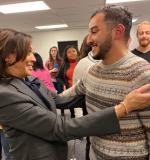
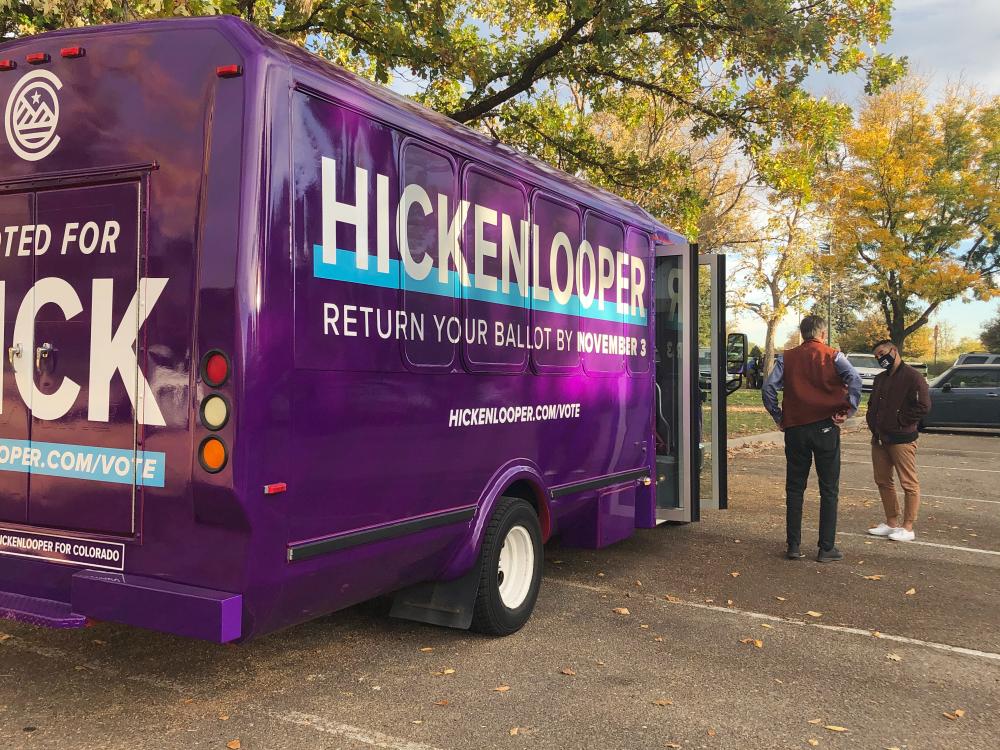
Mr. Moussa Goes to WashingtonFormer Arcadia and Colorado National Champion Helped Flip Two Senate Seats A DyeStat story by Dave Devine ___ Ammar Moussa is driving toward a fortified city. It’s a quiet Sunday morning, less than two weeks after rioters stormed the U.S Capitol building and three days before President-elect Joe Biden’s inauguration, and Moussa is moving to Washington, D.C. More precisely, the 27-year old is moving back to D.C., returning to a city he first called home a few months after his 2016 graduation from the University of Colorado, but where he hasn’t lived for almost two years. His rented Nissan Pathfinder is packed back-to-front with all of the belongings he’s carried on a 720-day political odyssey that took him from D.C. to Baltimore to Denver to his most recent stop — and his point of departure this morning — Atlanta. Now it’s back to Washington. After a collegiate running career that featured personal bests of 13:41 for 5,000 meters and 29:29 for 10,000 meters, along with a pair of NCAA cross country team titles in 2013 and 2014, Moussa decided to trade the trails of Boulder for a series of increasingly significant campaign trails. He started as a field organizer for Hillary Clinton’s 2016 presidential bid in the months immediately after graduation, then moved to D.C. that fall to intern in Michigan Congressman John Conyers' office. That internship became a full-time position, and Moussa spent almost a year and a half with Conyers before an eight-month stint as press secretary for the Democratic Governors Association. In January 2019, when Senator Kamala Harris entered the Democratic primary, Moussa was on the move again, departing D.C. to join her presidential campaign in Baltimore. After Harris ended her campaign the following December, Moussa returned to Colorado to become a press secretary for Gov. John Hickenlooper’s 2020 Senate campaign. After Hickenlooper won that Senate seat in the Nov. 3 general election, Moussa signed on with one of the few campaigns continuing into 2021: Senate hopeful Jon Ossoff’s run-off effort in Georgia. Joining that campaign was like jumping on a moving train. “I packed up my life,” Moussa says, “moved down to Atlanta, and I’ve spent the last two months there.” The culmination of those months was a narrow Ossoff victory, early in the morning of Jan. 6. The outcome of that contest left the U.S. Senate evenly split among the country's two political parties. A few hours after it happened, the Capitol assault began. And 11 days after that, with a nation still picking through the debris — physical and spiritual — Moussa packed up that rented Nissan and pointed north. The fact that his once and future home might be described as a fortified city remains stunning. He’s heard about the 7-foot-tall, unscalable fence that encircles the Capitol. The razor-wire and the street closures and the “hardened perimeter” surrounding the downtown core. The National Guard troops garrisoned on marble floors he used to walk. The closed bridges and shuttered Metro stations. He still can’t quite believe it. “Reporters have likened it to the Green Zone in Baghdad during the Iraq War,” Moussa says. “Just seeing the pictures that my friends are sending, it’s really scary.”
One of Ammar Moussa’s earliest political memories involves fear. He was 7 years old when the September 11th attacks occurred in 2001. He still remembers the shock, the uncertainty, and the surge of anti-Muslim sentiment that convulsed the United States in the months after that awful day. “I was in third grade,” he says, “aware enough to know what was happening.” His father, Ameer Moussa, emigrated from Egypt, and his mother, Malika Bouchama, came to the U.S. from Morocco. At the time of the 9/11 attacks the family was living in a small, rural town in Washington State. “The backlash to people that looked like me, and my mom who wears a scarf, that was real,” Moussa says. “And it was scary. I’ve always been hyper-aware of the role that government plays in the lives of people who look like me.” He vividly recalls departing the mosque after Eid prayers, suddenly realizing the extent to which his family, and families like his, were being targeted. “You would see two law enforcement agents in a car,” he says, “photographing everybody who was coming out of the mosque. I was only in third or fourth grade, right? But I knew the role the government was playing in our lives.” Those childhood experiences fueled an interest in politics that eventually led Moussa to major in political science at Colorado. But it was another event, unfolding as he was wrapping up studies in Boulder, that cemented his resolve to enter politics at a professional, grassroots level. “The rise of Donald Trump,” Moussa says. The Republican candidate’s unlikely ascent in 2016 altered Moussa’s own trajectory in ways the two-time All-American might never have imagined. Trump’s anti-Muslim rhetoric and hardline immigration stance represented more than objectionable political views to the then-college senior; they were a direct threat to his Muslim family and friends. He thought of his mother, the scarf she wears on her head as a tenet of her faith, and how easily that might leave her targeted in Trump’s America. “Muslim women in 2015 were getting jumped in New York City,” Moussa says. “That was terrifying for me as this young kid, and it was big factor for me getting into politics.” Rather than pursue the dream of a pro running career after graduation, Moussa joined the Clinton campaign as a field organizer in Longmont, Colo. His days were filled with the basic, unspectacular work of democracy: knocking on doors, making phone calls, registering voters. When Trump eventually defeated Clinton in 2016, Moussa put off another dream — graduate school in Italy — and turned his focus to domestic political issues. His long-term goal, inspired by a childhood in an Arab immigrant home, had been to work for the U.S. state department as a foreign service officer. An international relations program in Siena, Italy, that he’d been accepted to was the next step in achieving that goal. “But I kept deferring,” he says, “until I ended up pulling out entirely. The fight was too important.”
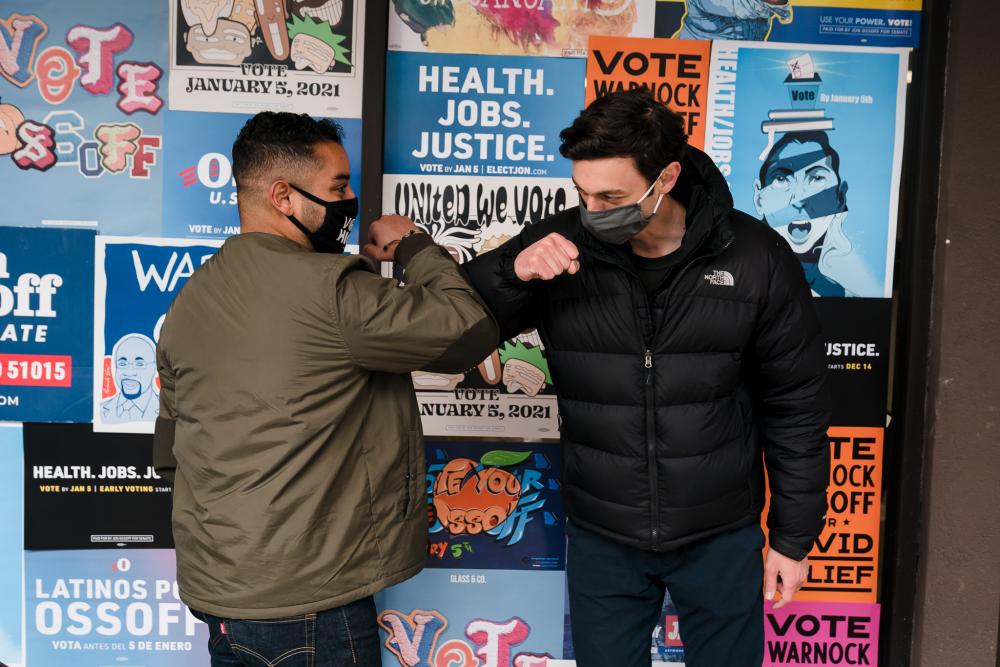
When Moussa attempts to articulate how a recent college graduate might advance from one political staff to another, from one campaign to the next, he draws on words common to any post-grad job search: Résumé, application, interview, offer. Describing how one opportunity leads to the next. How closely the Beltway connections intersect and overlap. “It’s a small world,” he says, “and your résumé is around. People know each other. If somebody thinks you’re a great fit for a role, you go through the application and interview process.” That was certainly the case with the Harris campaign in Baltimore, and again for Hickenlooper’s Senate bid in Colorado. The Georgia run-off was a different story. “The Jon Ossoff campaign was unique,” Moussa says. “It just happened so quickly.” Ossoff earned the run-off after neither he nor the Republican incumbent, David Perdue, achieved a 50 percent vote threshold in the Nov. 3 general election. A similar run-off was triggered in the state’s other Senate race, between the Democratic challenger Rev. Raphael Warnock and incumbent Republican Kelly Loeffler. It meant the state of Georgia had become ground zero for determining which party would control the U.S. Senate in 2021. Two days after helping Hickenlooper turn one Senate seat blue, Moussa sent a text to a friend on the Ossoff campaign, hoping to help flip another. “I asked her if they needed some help for the run-off,” he says. It turned out they did. And so, in mid-November, Moussa’s political odyssey angled toward Atlanta. One more race. “Most people who worked on campaigns in 2020 took a well-deserved break because it was a really tough year for a lot of people,” he says. “But I saw an opportunity that we could do something special.”
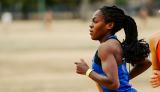
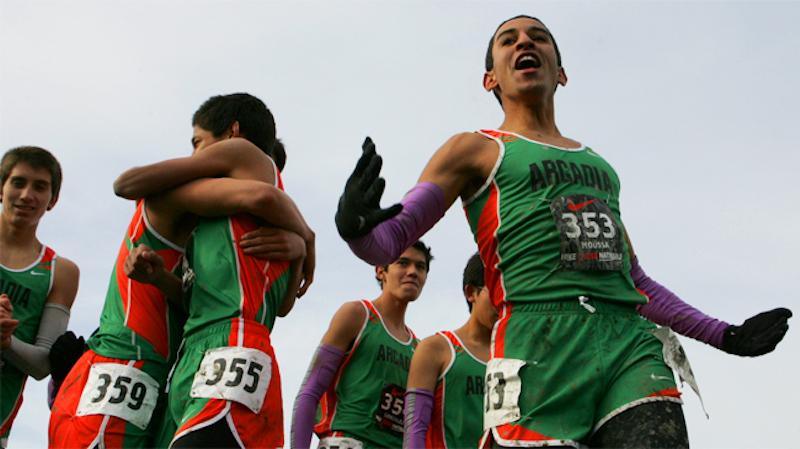
Almost exactly 10 years earlier, on a blustery December day, Moussa and his teammates from Arcadia High (Arcadia, Calif.) arrived at the Nike Cross Nationals (NXN) in Portland, Oregon with a similar scenario in mind. A chance to do something special. Nike’s national cross country meet had welcomed highly ranked teams from the talent-rich state of California every year since its 2004 inception, but heading into 2010, a Golden State squad had never left with the championship trophy. The best California finishes had been runner-up performances by the 2006 Simi Valley boys and the Saugus girls in 2007 and 2008. Message board skeptics crowed: California kids might manage historic marks on flat, fast courses, but they couldn’t hang with national peers on a muddy, rugged layout like the one at Portland Meadows. Moussa, fourth at NXN a year earlier for a 20th-place Arcadia team, was keenly aware of the criticism. And with the 2010 version of his team elevated to favorite status by “all-timer” chatter and a lofty national ranking, he departed the bus determined to silence the critics. “Every year there’s always an excuse,” Moussa said back then. “People saying the mud and the cold bothered us. But we set out to change that, to be the team that shows California can win national championships.” On a windswept, bog-like course, grinding through daunting ankle-deep mud, Moussa threw down an effort that helped flip the script. He matched his 2009 showing with a fourth-place finish behind individual champion Lukas Verzbicas, notching two points for a team that supported his effort with a 14-16-27-33 scoring line — low enough to comfortably claim the national crown, 92 to 135, over New York’s Fayetteville-Manlius. “Going into the race,” Moussa said, “I wanted to score as low as possible. Just hammering, trying to put my team in a good enough position that they can do what they need to, and we can still win. I let them do their job, and I made sure I took care of my business.” For a young runner who was, by his own admission, brash and cocky when he arrived to Arcadia as a freshman, the euphoric post-race podium only cemented an important, hard-earned truth: All of this was better with a team.
Another December race, 10 years later. A different bus, with another team. Still aiming to pull off the improbable. Still seeking to silence the doubters. Not a scrappy band of California teenagers attempting to win a national cross country title, but a bleary-eyed campaign staff striving to help a 33-year-old relative newcomer pull off an implausible upset: ousting a deep-pocketed, incumbent Republican in a state that hadn’t elected a Democratic senator in 20 years. The same fierce belief that carried Moussa across Portland Meadows all those years ago sustained him in Georgia, too. It was mirrored back by the accomplished team he’d joined midstream. “Nobody upends their life and works these absurd hours” he says, “unless you totally believe that you can win. And the campaign already had this unshakeable belief that we could win.” The campaign made a calculated decision in early December to embark on a week-long bus tour. Georgia’s big cities and sprawling metropolitan areas were on the itinerary, but so were the small, rural towns that might typically have been neglected in a high-profile race like this. Each day brought the bus to a different destination; at some of them, the team wasn’t necessarily expecting a warm welcome. “But then,” Moussa says, “you’re rolling into town and you see some Jon Ossoff signs, and you go to the event and there’s like, a hundred people in masks, just fired up…People would be talking to us, saying, ‘We’ve never seen anything like this. Democrats don’t usually come through here.’” The energy grew as they crisscrossed the state. “That whole week was just so special,” Moussa says. “It was brutal too — you’re going to every corner and you’re on the road and you’re up early — but it was just incredibly energizing to see.” As the Jan. 5 run-off election approached, Moussa fell back on an important lesson from his running days. “I was obviously anxious,” he says, “but there was a feeling that we had done literally everything possible to win this race.” It was like stepping to the line at NXN. Or at the NCAA championship, where he’d twice won with the Buffaloes. The Ossoff team had exhaustively prepared, covered the details, attended to the minutiae that makes for a victorious effort. It was time to trust, and accept the outcome. “We’d done everything you could do to win a senate race in Georgia in 2021, and so then it was up to the voters. Whatever happened…happened.”
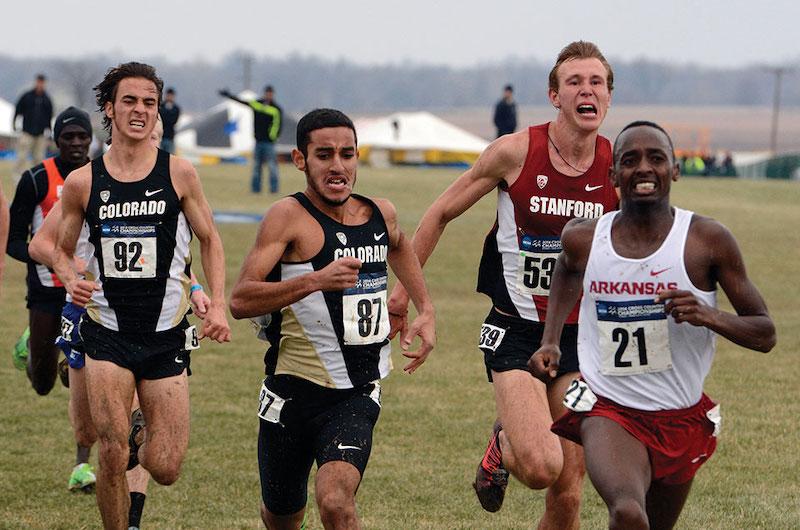
When Moussa looks back on his time at the University of Colorado, he sometimes thinks about a mosque. And a car parked outside. Not the mosque from that small town in Washington. And not the car with law enforcement officers inside, photographing families. This mosque was one he’d never attended before. And the car? It belonged to Colorado’s longtime coach, Mark Wetmore. Moussa had arrived in Boulder on a Friday for his recruiting visit. The start of the trip coincided with Friday prayers, so Wetmore drove the recruit there himself. “I was 17 years old,” Moussa recalls, “and Mark Wetmore drove me to the mosque to make Friday prayers. He sat outside waiting in his car while I prayed, and then took me back for the rest of my trip.” The gesture spoke volumes to a high school senior trying to discern his next step. A top distance talent in the class of 2011, Moussa was wrapping up a high school career that included two California individual cross country titles, the NXN team championship, two appearances on U.S. junior teams at the IAAF World Cross Country Championships and a 2011 New Balance Nationals Outdoor 2-mile victory. And Colorado, one of the nation’s traditional distance powers, seemed the perfect match. After he committed and joined the Buffaloes, Moussa’s appreciation for Wetmore’s mentorship only deepened. “I’ve been lucky,” he says, “to have a lot of good people in my life who believed in me when I didn’t believe in myself, but chief among them is Mark Wetmore.” Through the inevitable ups and downs of a five-year collegiate career, Moussa drew strength and support from that belief. It came not from only Wetmore, he says, but from Colorado’s associate head coach, Heather Burroughs, and assistant coach, Billy Nelson, too. The team culture in Boulder sustained him. He experienced the elation of those NCAA team titles in 2013 and 2014, including a sterling fifth-place individual finish in 2014, alongside the crushing disappointment of an attempted three-peat that fell short in 2015, when the Buffs lost to Syracuse by nine points and Moussa struggled across in 42nd place. Wetmore was there for him, through it all. The coach, Moussa says, deserves all the credit he receives for leading distance runners to elite performances, “but he imparted so many lessons on me, beyond going out for a Sunday morning long run on Magnolia Road. I am forever indebted to him, and I’m not here without him.”
On the tension-filled night of Jan. 5, as returns began streaming in for the two Georgia senate run-offs, it was clear, fairly early in the evening, that Warnock would win his Senate seat. Ossoff’s race appeared much tighter. As the clock crossed midnight without a declared winner, citizens around the country went to bed, figuring they’d learn the outcome in the morning. Moussa wasn’t one of them. “I didn’t go to sleep at all that night,” he says. “Didn’t sleep a single second.” Watching the turnout numbers throughout the night, he realized the encouraging patterns he was seeing weren’t breaking. “I started getting more and more confident.” Several outlets began calling the race in the early hours of Jan. 6. By dawn the next morning, Ossoff had released a videotaped victory speech. Another two days would pass before Perdue, the Republican incumbent, officially conceded, but it didn’t matter. The young upstart and his disciplined, media-savvy campaign team had pulled a stunning upset. “I always like to win,” Moussa says, “but this one was incredibly special because there was so much at stake for so many people. In Georgia, but also outside of Georgia.” But even as the exultation of a hard-fought victory washed over Moussa and his fellow staffers, another drama was beginning to unfold, 600 miles away. One that would drain the day of its much of its joy and render Ossoff’s win an historic footnote. By 1 p.m. Eastern time, televisions and computer screens around the country were broadcasting the horror of the U.S. Capitol being overrun by a massive, violent mob. Moussa, who had worked in the Capitol building before hitting the trail in 2019, struggled to process the images. “My first apartment in D.C. was three blocks from the Capitol,” he says. “My daily walk was right past where all those rioters were…it was insane to watch.” His mind raced to friends who might be in the line of attack. “I had friends who were in lockdown,” he says. “Friends who had to be evacuated from the well of the House of Representatives. It was genuinely surreal and terrifying to see that happen in real time.” In the days after, as the initial shock dissipated, Moussa found hope in the idea that the people he helped get elected would be involved in healing the country and moving it forward. “It’s going to take a lot of work,” he says, “years and years, but I’d rather start this process with those people in power than anyone else.” The thought brings him back to the parallels between politics and running. How his training as a distance runner prepared him for this new life. “I think that’s helped me get through the tough stuff in this business,” he says. “The idea that it’s not always glamorous, it’s actually never glamorous, but it’s all for that one day. That’s when the dividends come out.” He marvels at the similarity: How sustained effort, over many months, culminates on a single autumn day. “You put in 100 miles a week, and it’s all for that one November day in Terre Haute. It really is the same thing.”
Atlanta is in the rearview mirror now. The Georgia state line — a memory. A bruised city awaits, still several hours away. He’s moving back with the hopes of finding a position with the new administration. He still has an apartment in the District, the life he created there before the whirlwind of these last two years. And just as it did during those two years, he knows the next step will come down, primarily, to people. Connections he’s made. The trust that’s cemented in campaign trenches. “I’ve been lucky to be around some incredibly talented people,” he says. “Lucky to work for incredible candidates. That’s been my north star: working for people I personally believe in.” Running, which once occupied such a prominent place in his life, has largely fallen by the wayside. He’s hoping to get back into a routine after he’s settled in Washington, but if he does start putting in the miles again, if he allows his mind to wander back to competition, there’s one race he has no intention of running. The kind that would elect him to public office. “Absolutely not,” he says, laughing. “I can’t imagine anything worse. I very much admire people who are selfless enough to do that, but there are a lot of good people out there who are incredible public servants. I want to do my best to get as many of them as possible elected.” At the moment, of course, he’s still between things. Figuratively and literally. He’s a 27-year old, traveling in a car on a highway with all of his belongings. But there’s a sense the liminality won’t last long. A new Washington — one he’s had a hand in authoring — is within reach. More news |