
Folders |
DyeStat Big Board - Oregon Hits On All Cylinders To Win Title - NCAA Division 1 Men's Indoor Championships 2021Published by
Oregon Men Win 5th Title With Whopping 79 Points! JuVaughn Harrison PRs Twice To Secure HJ/LJ Double; Oregon DMR Pulls Through Again; Turner Washington Claims Shot Put Title With Five Best Throws; Tilga-Garland Go 1-2 For Georgia In Heptathlon Follow the DyeStat Big Board for updated news and content throughout the NCAA D1 Indoor Championships. PREVIEW - 10 Storylines TEAM SCORES - (Final) Oregon 79, LSU 56, Georgia 35, Florida 34, North Carolina A&T 30 TEAM PROJECTION Going Into Saturday: Oregon 65, LSU 57
Saturday, March 13 Pole Vault Final College record holder K.C. Lightfoot of Baylor took attempts at breaking his own personal best but settled for the win at 19-5.50 (5.93m). That was a meet and facility record. Zach Bradford of Kansas cleared a lifetime best 19-0.25 (5.80m) to take second. Lightfoot needed three attempts to make 5.80, but then he did and got 5.85m (19-2.25) on his first try. Lightfoot tried 19-9 (6.02m) but appeared tired. WINNER: K.C. Lightfoot, Baylor, 19-5.50 (5.93m) What He Said: POST-RACE INTERVIEW
Triple Jump Final With four lifetime best jumps in the series, redshirt freshman Emmanuel Ihemeje produced a stunning victory with 56-7.50 (17.26m) to jump-star the Ducks' day with 10 points. That fourth round jump was a lifetime best and school record by three feet. LSU pulled four points out of the event with a fifth-place finish for true freshman Sean Dixon-Bodie, who went 54-5.25 (16.59m) for a new PR. WINNER: Emmanuel Ihemeje, Oregon, 56-7.50 What He Said: POST-RACE INTERVIEW
Mile Final Building on the team's success in the triple jump, sophomore Cole Hocker dominated the men's mile and broke the meet record with 3:53.71. He was two seconds clear of Alabama's Eliud Kipsang (3:55.93) at the finish. Hocker's teammate Reed Brown placed fifth in 3:57.62 and the Ducks pulled 14 points out of the event. It's the second indoor mile title for Oregon, who also had Edward Cheserek take the title in 2015. WINNER: Cole Hocker, Oregon, 3:53.71 What He Said: POST-RACE INTERVIEW
60m Final Freshman Micah Williams lived up to the big expectations of being the top seed in the dash and never flinched. He thundered down Lane 4 and hit the finish in 6.49 seconds to match his collegiate-leading time. Two years ago this weekend, Williams won the New Balance Nationals Indoor high school championship 60 meters at The Armory in New York. Ten more points for the Ducks and the competition for a team trophy is turning into a rout. Teammate Gaston Bouchereau finished fifth in 6.65 to give Oregon 38 points in a matter of 30 minutes. WINNER: Micah Williams, Oregon, 6.49 What He Said: POST-RACE INTERVIEW
400m Final Noah Williams of LSU knew the time to beat and then supplanted first section winner North Carolina A&T's Randolph Ross by running 44.71 seconds for a personal best and the fastest time in the NCAA this year. It's also No. 3 all-time. Ross had clocked 44.99 in the first section and that held up for second place overall and that moved him to No. 9 all-time. WINNER: Noah Williams, LSU, 44.71 What He Said: POST-RACE INTERVIEW 60m Hurdles Final LSU is not giving this up without a fight. The Tigers' Damion Thomas won a very close hurdles final in 7.51 seconds, with Jamal Britt of Iowa (7.52) and pre-meet favorite Trey Cunningham of Florida State (7.53) and Phillip Lemonius of Arkansas (7.54) all very close. LSU picked up additional points from Eric Edwards Jr., who was fifth in 7.58. Oregon's margin is just three points with four events left. It's the first indoor hurdles title for LSU since Allen Minsher won the 55-meter hurdles in 1976. WINNER: Damion Thomas, LSU, 7.51 What He Said: POST-RACE INTERVIEW
800m Final It's all going Oregon's way. Charlie Hunter caught Finley McLear of Miami (Ohio) in the final inch of the race and won by .01 seconds. Hunter had to chased down McLear over the final 100 meters and barely got there first. Hunter won it in 1:45.90 and McLear ran a lifetime best for 1:45.91. Takieddine Hedeilli of Texas Tech was out of the picture at the end but got third with 1:46.84. Hunter is the first Duck to win the indoor 800 since Elijah Greer in 2013. WINNER: Charlie Hunter, Oregon, 1:45.90 What He Said: POST-RACE INTERVIEW
200m Final Matthew Boling of Georgia, running in lane 6, held off the charge from favorite Terrance Laird to win the title in the 200 meters, 20.19 to 20.20. Boling, who was a high school sensation in Texas in the spring of 2019, had previously placed seventh in the long jump. He had DQ'd in the 200 at the SEC Championships. Florida's Joe Fahnbulleh won the first section in 20.38, which held up for third place. It was a high quality final, with Boling moving to No. 5 on the all-time college list and Laird ascending to No. 7. WINNER: Matthew Boling, Georgia, 20.19 What He Said: POST-RACE INTERVIEW
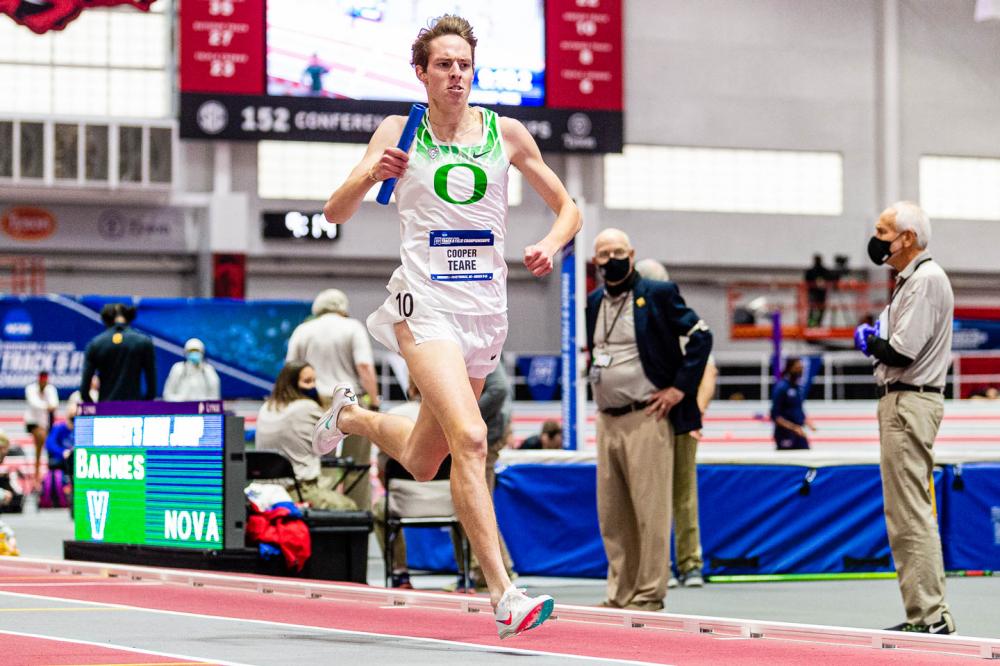
3,000m Final Cole Hocker and Cooper Teare tore away from all pursuers in the final 300 meters and salted the title away for the Ducks. Hocker's second win of the day was timed in 7:46.15 and he grabbed the victory from Teare, who was in front rounding the final curve. Teare was second in 7:46.23. The duo clinched Oregon's fifth men's indoor title, which have all come since 2009. It's Oregon's 32nd NCAA title in track (indoor/outdoor) and cross country. WINNER: Cole Hocker, Oregon, 7:46.15 What He Said: POST-RACE INTERVIEW
4x400m Relay Final North Carolina A&T became the first HBCU since Morgan State more than 50 years ago (1965-66) to win the the indoor 4x400 relay. With standout Randolph Ross splittling 44.67, the Aggies won the third and fastest section in 3:03.16, holding off Kentucky (3:03.61) and Tennessee (3:04.10). It's the first indoor championship victory for North Carolina A&T and it brought the team to fifth place in the standings. WINNER: North Carolina A&T, 3:03.16 What He Said: POST-RACE INTERVIEW (Trevor Stewart)
Friday, March 12 Shot Put Final Arizona State's Turner Washington, who broke the collegiate record this season, had the five longest throws of the competiton, including a best of 70-1 (21.36m), for a dominating victory in his first NCAA finals appearance in the shot put. Back in 2018, while attending Arizona, he placed 18th in the NCAA discus competition. Washington joins Jordan Clarke (2012-13) and Ryan Whiting (2008-10) as indoor shot put champions for Arizona State. Turner opened with 67-11 (20.70m) and led the whole way, getting his best mark in the fifth round. Texas standout Tripp Piperi, the 2019 NCAA outdoor champion, and Arizona's Jordan Geist, were unable to advance to the final. . WINNER - Turner Washington, Arizona State, 70-1 (21.36m) What He Said: "We were really working on staying level out of the back and getting a hold in the middle. My first three or four throws, I really wasn't holding at all, I just kind of felt like a deer still in headlights. Going into those last two rounds, I was like, 'Come on, it's got to be Turner Time right about now,' and then I hit that hold."
On joining Ryan Whiting and Jordan Clarke as Arizona State indoor shot put champions:
"It feels great to be part of the tradition and following in those guys' footsteps and keeping it alive for another couple of years until we get the next person in here. It feels awesome." On achieving a pair of 21-meter throws and surpassing 70 feet in the final two rounds:
"For sure. If I didn't throw 70, I was probably going to be pretty upset with myself, just because I knew that anyone in the meet, like McKay (Johnson) could have easily thrown 70, and a healthy Tripp (Piperi), he could have thrown 70, as we've seen.
Going into those last two rounds, I've got to prove it to myself, and pretty much just that, that I can still (do it), that I am still the man.
Those throws, they felt really close. I still kind of missed them, kind of like at Air Force, but moving into outdoors, we'll take some time off from the shot and just really hammer out that technique and work out the kinks and hopefully become a lot more consistent."
On being the fifth NCAA men's indoor champion to surpass 70 feet:
"It means everything. It's just kind of like seeing all my hard work pay off, like all the sacrifices and transferring, and just everything coming together. If you would have told me four years ago that I would be a national champion in the shot put, I would have said, 'You're crazy, like, I don't throw shot.' But it's amazing."
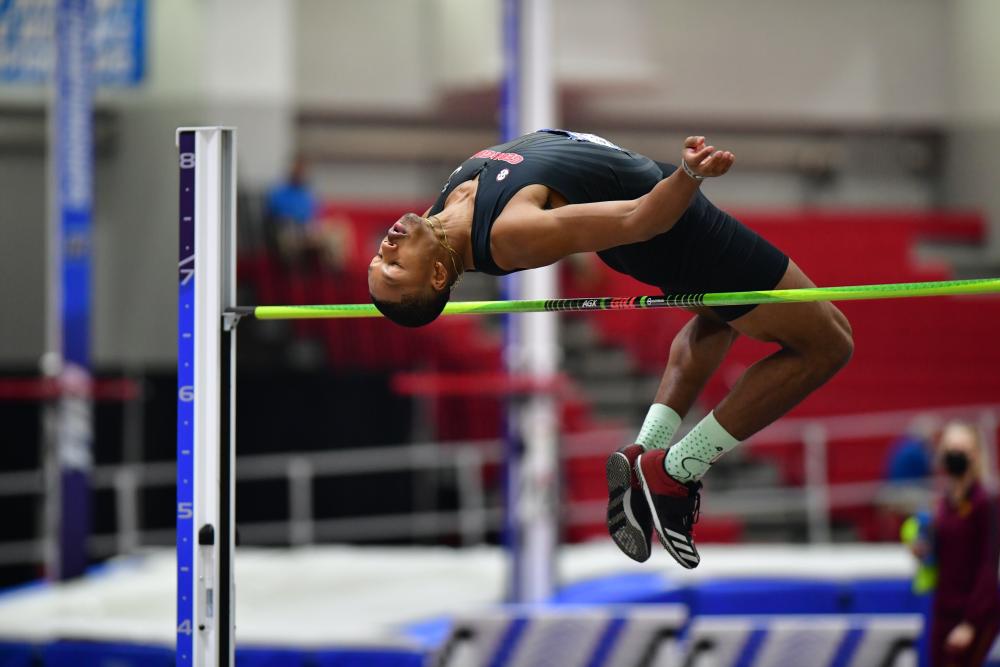
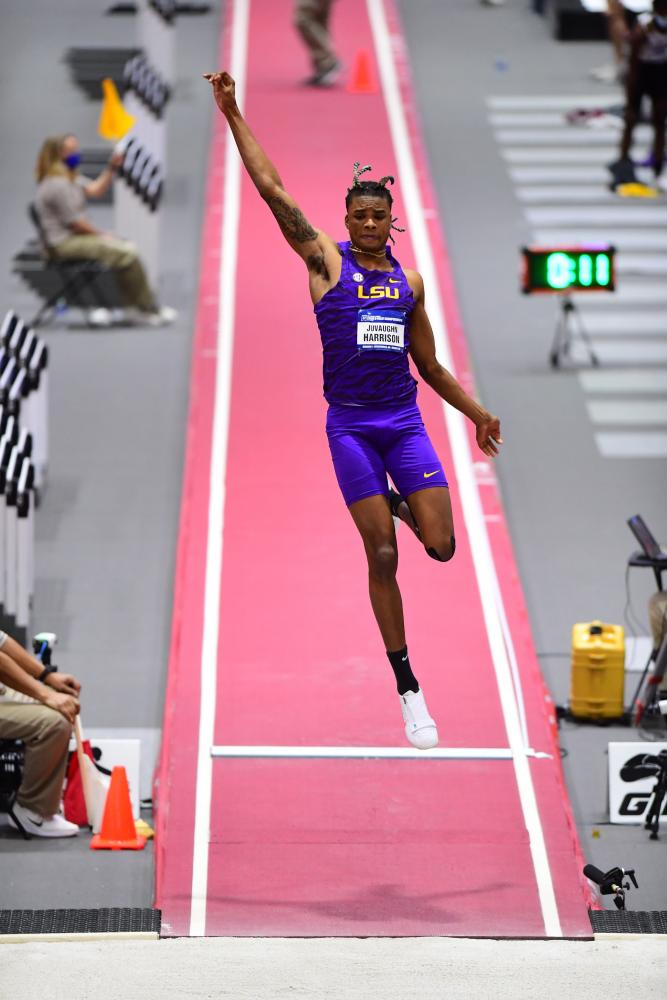
LSU's JuVaughn Harrison won his third NCAA title, and first indoors, with his clearance at 7-6.50 (2.30m), which is a new career best. Harrison actually won with his first-attempt make at 7-5.25 (2.27m), when USC's Earnie Sears and Kansas State's Tejaswin Shankar both missed twice at that height and then passed to the next bar. Neither of them were able to overtake Harrison, who finished second indoors in 2019 before claiming both the high jump and long jump wins at the Outdoor championships in Austin later that year. Sears finished second and Shankar third based on earlier misses in the competition. WINNER - JuVaughn Harrison, LSU, 7-6.50 (2.30m) Long Jump Final JuVaughn Harrison hit a big one on his fifth attempt, with a world-leading mark of 27-8.75 (8.45m). That sling-shotted him into the lead and put him in position to pull off a jumps double again. His second lifetime best of the day moves him to No. 3 on the all-time American list behind Carl Lewis and Miguel Pate and No. 8 all-time in world history. His is the best combo high/long jumper in history as a result of Friday's marks. Florida State's Isaac Grimes is out to a strong start, leading through the first two rounds with a jump of 26-11.75 (8.21m). He improved to 27-4.75 (8.35m) to hang on to second. Carey McLeod of Tennesse was third with 27-1.25 (8.26m) and Ja'Mari Ward of Missouri took fourth with 26-7.25 (8.11m). WINNER - JuVaughn Harrison, LSU, 27-8.75 (8.45m) What He Said (About Both Things): On surpassing Germany's Henry Lauterbach as the greatest combination long jumper and high jumper in the world:
"It's a great feeling and a great title to have. I look forward to just pushing out the marks even more, so that it's going to be harder to beat. I beat somebody and now everybody is going to be gunning for me who does high jump and long jump, so I just need to push the marks out further to show them that I really am the greatest." On the transition from high jump to long jump, and taking a little while to get into a good flow in the long jump:
"It took me a little while to get my rhythm in the long jump, purely because I had hurt my hamstring a little bit at SECs, so we were doing a lot of work on my hamstring before we got to nationals and then at nationals. If you were able to watch, you would see me going over to my trainer and get a little bit of work done in between jumps because it was bugging me, so it took me a little while to get going, but once I got going it felt good."
On being in fourth place following the first three rounds, and being forced to deliver a big jump in the fifth round to win the title:
"It brought a little something out of me because I'm very competitive, and to be down early, it was really bothering me, because I was so far behind. I finally was able to get my step together and get my run together, and once I was able to get on the board and was able to get everything together, the mark spoke for itself.
"I love it and live for it. I love competition, and it's what pushes me to keep going further. I love having good competition, because it's only going to make me jump further and better."
Mile Prelims The big news came in the second heat, where NCAA 1,500 meters record holder Sam Tanner of Washington was aced out of the fourth and final spot by BYU's Lucas Bons. After a fast first heat in which every finisher ran 3:58.5 or faster (won by Oregon's Cole Hocker), the second heat was tactical, slow and physical. Tanner wasn't able to accelerate enough to hold on to a top-four automatic position, losing out on a spot in the finals by .01 seconds.
60m Hurdles Prelims Damion Thomas of LSU (7.56), Trey Cunningham of Florida State (7.57) and Jamal Britt of Iowa (7.58) got through to the final with the fastest times. Arizona State's standout freshman Jamar Marshall hit the first hurdle in the second heat and tumbled off the track before he could get to the second. LSU and Arkansas both advanced two to the final, so this event will be important in the team race.
400m Prelims It took sub-46 to advance to the finals. Noah Williams of LSU (45.34), Bryce Deadmon of Texas A&M (45.37), Randolph Ross of North Carolina A&M (45.53) and Jacory Patterson of Virginia Tech (45.64) were all heat winner and ran the four fastest times.
60m Prelims Oregon freshman Micah Williams made a splashy NCAA debut by running 6.52 and making it look easy in the semifinal. Rikkoi Brathwaite of Indiana (6.55) won the other heat and North Carolina A&T's Tavarius Wright was with him in 6.56.
800m Prelims As with the mile, the first heat went faster and produced the two extra qualifiers on time. Iowa State's Jason Gomez ran 1:47.65 to win the first heat and had the fastest time overall. Oregon's Charlie Hunter won the second heat in 1:48.47.
5,000m Final Iowa State's Wesley Kiptoo ran off by himsellf and pushed to a national title in the 5,000 meters. His time of 13:23.77 was also a meet record. Kiptoo will try to ride the momentum from Friday's win into Monday's cross country championships. Eric Hamer of Colorado State finished strong for second in 13:29.60 and Michigan State's Morgan Beadlescomb was third in 13:29.96. The top 11 finishers all ran personal best times. WINNER - Wesley Kiptoo, Iowa State, 12:23.77 What He Said: On the recovery after today to get ready to run the 10-kilometer race at cross country nationals Monday:
"It's good when you just run, and now we have like three days. It's just like a long run and then you do the workout the following day, so it's not that hard.I know I have tomorrow and Sunday, so I'll be good." On eventually being tested in a race, and what he feels his potential is in the 5,000 meters:
"It would depend on if all those guys come, and how we attack the race, after 800 or a mile. Sometimes, in a race, people run as a group, and after some time, they slow down or they run faster or maintain the same pace, and toward the end, they run a good time or whatever time they run. But it depends on if all those guys come and we work together, then it's good. But if they come and we start splitting, then maybe it could be harder to run a good time. If I have guys next to me, it's fine, because I like working with them. We are runners and if they come close to me, then we work together. And if nobody is coming, then I can just do it by myself."
On setting the championship meet record and running the Iowa State program record, faster than Edwin Kurgat's 13:24.04 in 2019
"That was special because I was ready for it. I prepared for it and I worked with my coach and my teammates, and did all the hard workouts, and I was ready for it. Even if I had won in 13:50, I was ready for that. Sometimes you wake up, and if it's your day, then it's your day, and today, I felt good."
200m Prelims Terrance Laird of LSU (20.49), Matthew Boling of Georgia (20.49), Joe Fahnbulleh of Florida (20.53) and Micaiah Harris from Texas (20.62) were the four heat winners and produced the four fastest times to advance to Saturday's final. A disqualification for JoVaughn Martin of Florida State allowed Clemson's Terryon Conwell to grab the final spot in Saturday's finals. Conwell's Clemson program will be lost due to cuts announced last fall, but a class action lawsuit filed Friday aims to prevent that from happening.
Distance Medley Relay Final Oregon switched up its lineup but ran close to its collegiate record to win the event and put 10 points on the board. Reed Brown replaced Cole Hocker on the lead-off 1,200 leg and he passed off to Xavier Nairne in the lead (2:52.73). Charlie Hunter used a burst late in the 800-meter leg to take the lead and he passed to baton to Cooper Teare in first place. Teare seemed to take it easy early in the 1,600 meters leg and four teams lined up behind him. But over the final three laps, Teare shed pursuers by shifting gears. Into the final lap, only Ole Miss was in contact. Teare went into a full sprint and brought it home in 9:19.98 to smash the meet record. His split was 3:52.99. Ole Miss was second in 9:20.75, and the second-fastest in collegiate history, as the top four teams dove under the meet record (Oregon 2016). WINNER - Oregon, 9:19.98
WHAT HE SAID (Cooper Teare): On having the lead entering the anchor leg and being comfortable working from the front all season:
"Going from the front, that's kind of what we've been doing all season, so I definitely felt comfortable up there, but I knew there were a lot of really talented guys and a lot of fresh guys as well. We had a team of not necessarily fully fresh guys, so it was a really good opportunity to get the baton in the lead and I've been really comfortable up there for the whole season." "We've really been working on our close lately, so it was kind of just make it as far as I can while pressing the pace and making everyone else hurt, and from there just closing it down and covering moves. But nobody really made a move and I got to 400 to go, and that's kind of been our bread and butter the last two weeks. It was kind of just about closing it down and making sure for the last 400 that each 100 gets faster and faster. We've been closing really well in practice, so I was really confident once I got to that last 150, last 100 meters, if anyone was there, I could hold them off. I think I put a gap in that last 100 meters, so I'm really excited about how our closes have been coming along. That was kind of the plan, just to hold them off as late as possible and run through the line."
On beating Ole Miss, the second-fastest program in NCAA indoor history, and having to run sub-9:20 again to win the title:
"I think it's just a testament to the NCAA this year, and kind of what everyone has done over the past year. Not only us, everybody has been in the same position, and I think we've all been better for the last year of not competing, and to bring the best out of everyone. Absolutely, knowing that we had to run that time to beat the second-fastest team now, ever, I guess, to do it, it's definitely gratifying."
On joining Andrew Wheating, Galen Rupp and Edward Cheserek as the anchor leg on Oregon national championship DMRs:
"There's one thing running a fast time during the season and kind of going and doing that by yourself, but there's another thing coming in with the 12 best teams in the country and continuing to win those races and run those times. I think winning in the fashion that we did today, again I think it's just a testament to what we've done.
"Hearing those names that have done it in the past, I think it's super cool, and it just makes me that much more hungry for the next thing, to win the 3K, and do stuff outdoors that those guys have done. It gets me excited and from here, we can only go up and I think we're really excited for what's in the future."
Thursday, March 11 Heptathlon - Ayden Owens of Michigan took an early lead with his victory in the first event, the 60-meter hurdles, in 6.82 seconds. That was good for 947 points. Etamar Bhastekar was next in 6.91 (915 points). - Leo Neugebauer of Texas got off a big jump of 25-10 to gain more than 1,000 points in the long jump (1,027). Georgia's Karel Tilga also helped himself with a 25-foot jump, second best of the competition. After two events, Neugebauer was leading it with 1,916 points and Owens was second with 1,847 points. - Tilga of Georgia produced the top mark in the shot put with 52-7.50 (16.04m), which was a huge personal best. Oregon's Max Vollmer is on the move as well, finishing second with 51-11 (15.82m), which was a big PR as well. Georgia's Kyle Garland was the third athlete over 50 feet, with 50-6.75 (15.41m). After three events, Neugebauer's lead has shrunk to 33 points with 2,703. Tilga is second at 2,670, followed by Garland (2,611), Owens (2,580), Vollmer (2,569) and Pittsburgh's Max Wolter (2,559). - Garland struck with his second consecutive PR of the competition, in the high jump, where his clearance at 7-0.50 (2.15m) carried him into the overall lead. Garland needed a third attempt to make 6-9 (2.06m) and then made the next two bars on the first try. Garland jumped 7-2 outdoors as a high school junior in 2017, but this is his best performance indoors. Tilga, his teammate, also got a personal best with 6-9. Garland leads after four events with 3,555 points. Neugebauer is second, 21 points back. And Tilga is third, trailing by 26 points. Those three have separated from the field. It's the first time three men have scored 3,500 or more on Day 1, including the first time two have been from the same team. Garland is more than 100 points up on his first day score Feb. 25 at the SEC Indoor Championships. Friday Morning - Texas' Leo Neugebauer, sitting second in the overall standings coming into the day, took a DNF in the men's 60-meter hurdles, which is a devastating blow to his competition this weekend. Ayden Owens of Michigan posted the best time, 7.87 seconds, and has moved up into third place. Kyle Garland (8.07) and Karel Tilga (8.24) did well enough to firm up their grip on first and second place overall. With two events left, it's Garland (4,519), Tilga (4,459) and Owens (4,344). - Alabama's Jacob Spotswood and Auburn's Alex Spyridonidis cleared the highest bars in the pole vault, both making 16-7.25 (5.06m) to improve their spots in the standings. Garland moved closer to securing the overall championship by making 15-11.25 (4.86m) for 868 points. He leads through six events with 5,387 points and his teammate Karel Tilga is secone with 5,349. Owens reamains third with 5,122. - Tilga beat Georgia teammate Garland by nine seconds in the 1,000 meters as both finished with more than 6,200 points and became the first pair to go 1-2 in the heptathlon from the same school. Tilga ran 2:36.32 for the fastest time of the day and finished the competition with 6,264 points, second only to Ashton Eaton on the all-time list. Garland fourth with 2:45.53 and finished with the fourth-best point total in history, 6,200. Owens, of Michigan, finished third with 5,995. WINNER - Karel Tilga, Georgia, 6,264 points What He Said: "I honestly didn't even know I was No. 2. Ashton is a legend, you can't catch that guy, maybe one day." On this performance setting him up well for the decathlon outdoors and qualifying to represent Estonia at the Olympics this summer:
"That was encouraging for sure. The end goal for this year is obviously the Olympics, so to be able to put up PB after PB, it gives me so much confidence going into Spec Towns (decathlon), which is in a month."
On his mindset and approach entering the 1,000 meters:
"I knew I had to run four seconds faster than Kyle to beat him, and then I also wanted to be No. 3 all-time on the Estonian list, and I knew I needed 2:36.50 or something for that. Goal No. 1 was to run four seconds faster than Kyle, and goal No. 2 was to run that time, so I get No. 3 on the Estonian all-time list."
Kyle Garland on he and Karel Tilga being the first two teammates to go 1-2 in championship history:
"I can't even process it right now, it's going to take me a little while, me and Tilga, probably over eating doughnuts, we'll talk about it a little bit more, but it's incredible man. We've been working for this all season and we both knew coming into the competition that we could make history. We said it after the start of the 60 meters yesterday and we just kept that energy, and we were feeding off of each other, and by the time the 1K came, it was just me and Tilga, running to the finish. It was a fun time for sure."
On ranking No. 4 on the collegiate all-time list behind Ashton Eaton, Karel Tilga and Trey Hardee:
"You know it's incredible. Since I was like 13 years old, looking up to these guys, studying all of their film and meeting them at different competitions and stuff, and now to be in the same conversation as two of the greatest decathletes of all-time is incredible."
On how he and Karel Tilga practicing with each other prepares them well for championship competition:
"I think what you saw out here in competition today is what you get in practice as well. I push Tilga, and Tilga pushes me. I mean it goes even without saying, just him having crazy days in practice pushes me to step up my game in practice and vice versa. Exactly what you saw here today is what you see on a day in and day out basis."

Weight Throw Final - Thomas Mardal of Florida became the first thrower in NCAA championship history with multiple marks over 80 feet, along with the second competitor ever to achieve the feat at any meet, and he got them on the first two attempts. Mardal won the competition with his first throw, which traveled 80-3 (24.46m) and then he followed that with 80-1 (24.41m). His best throw moved him to No. 4 in collegiate history and No. 12 in world history. It's also the No. 2 mark in the world in 2021. He fouled his next three attempts and, with the victory in hand, passed on his sixth. Mardal is the first male weight throw champion from Florida, but the Gators won four women's titles in a row from 2002-05. Arizona's Israel Oloyede had the third, fourth and fifth best throws i the competition to nail down second place. Cancer surivor Bobby Colantonio of Alabama finished fifth. WINNER - Thomas Mardal, Florida, 80-3 (24.46m) What He Said: "Obviously that was one of the main goals for this meet to see if I could hit that 80. It's been a struggle to get myself in shape after the big throws at SECs, but we managed to get it just in time. I think it proves a point being able to do it twice, not just once, so that's something I appreciate a lot. It's just being able to be consistent at those distances, more so than just having some 22 (meters) and some 23 (meters), and then just pulling a (24-meter throw) out of nowhere. It's just nice seeing two big marks in the same series."
On being first men's weight throw winner from Florida after four women's weight throw titles for the Gators from 2002-05:
"Of course, it's special. It's people that I've seen since before I even came to Florida. I've been sort of the guy down there, below everyone else, and I feel like now my senior year, it was my time to prove a point."
On handling the expectations of being the championship favorite after breaking the SEC record and winning his second straight conference title:
"It's nice having done it, because it just proves that you can if you get in the shape you need to be in. I will say the first few days after SECs, my body was not feeling great and I did not throw well in practice. But I just had to trust our training plan, and just hope that my body eventually would recover and be ready.
I felt like I was in pretty good shape. I knew I wouldn't be able to do it for six throws, but I knew that I had two or three throws in me that could go far, and that, itself, puts more pressure on me to be able to throw technically well in the first three throws, and luckily today, I was able to do that.
I'm not going to lie, I did not have much left in my body after (the first two rounds)." More news |










 High Jump Final