
Folders |
Sonia O'Sullivan Brings Experience And Perspective To Union Athletics ClubPublished by
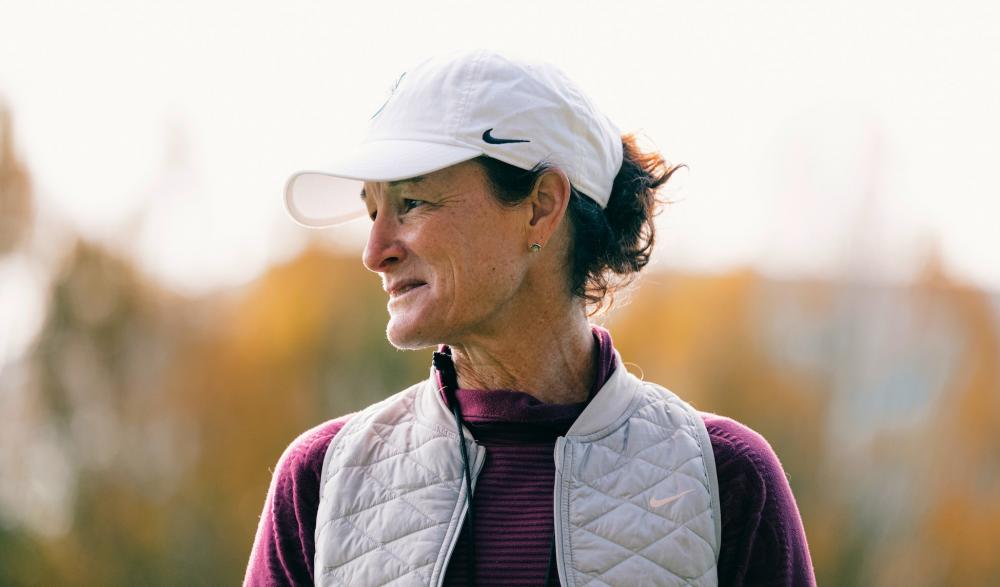
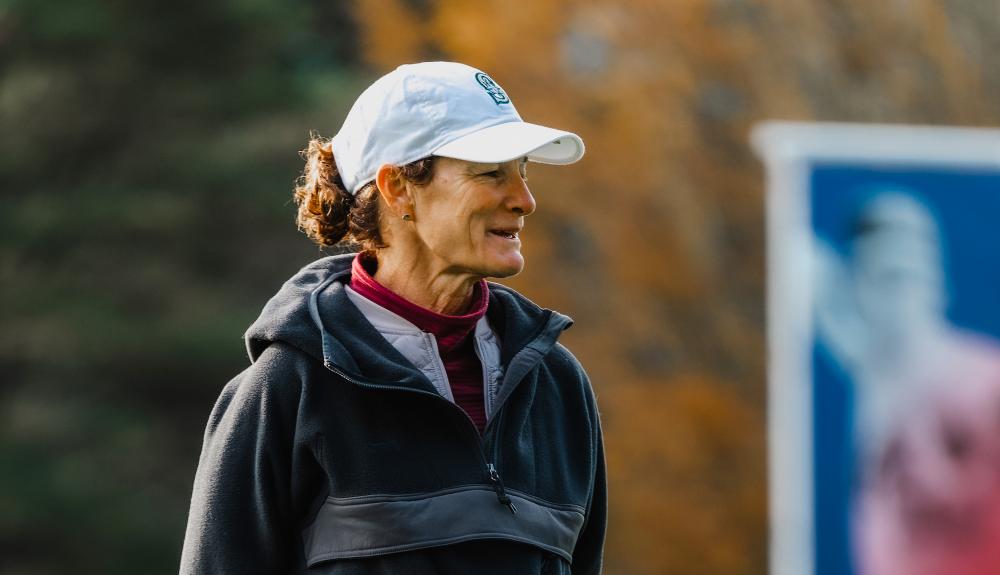
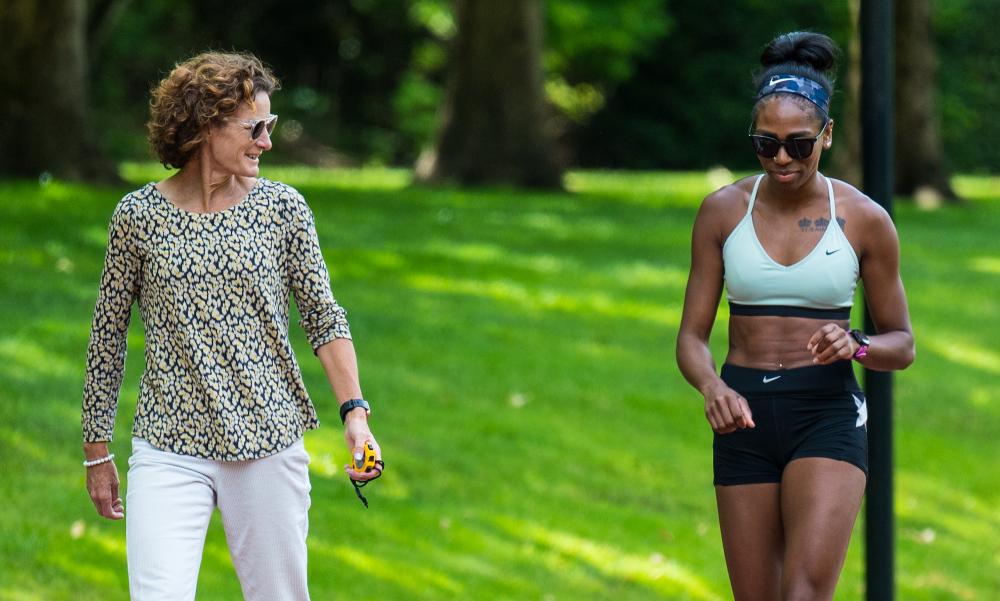
One Of Track's All-Time Greats FoundNew Home Coaching With UACA DyeStat story by Dave Devine Union AC photos by Tim Healy “I have begun to think of life as a series of ripples, widening out from an original center.” - Seamus Heaney (Paris Review interview, Fall 1997) ______________ It’s been more than two years since the big move. The Tokyo Olympic Games, an initial focus when Sonia O’Sullivan left her adopted home of Melbourne, Australia, in April 2021 to become an assistant coach for a then-unnamed Nike training group, have come and gone. The 2022 World Athletics Championships, held just down the road from O’Sullivan’s new home in Portland, Oregon, are in the past as well. Another world championship looms this summer, Budapest this time. There have been training blocks and altitude camps and European summer meets and national championships — all in the rearview mirror. Several times over. Twenty-six months since the legendary Irish distance runner agreed to come to the United States to accept an admittedly vague coaching role without knowing “fully what it was about,” and in some ways, she’s still trying to figure that out. So many things have changed. That training group, which was resurrected — at least in part — from the fragments of Alberto Salazar’s disbanded Nike Oregon Project and is headed by onetime NOP assistant Pete Julian, received a name about eight months after O’Sullivan joined the staff — dubbed the Union Athletics Club in December 2021. The team’s roster has shifted and turned since O’Sullivan’s arrival; original members retired or moved on, talented newcomers taking their place. The COVID-19 pandemic, which hung so heavily over everything from O’Sullivan’s decision to leave Melbourne to the complexities of safe competition, has receded, at least to a point where it no longer impacts every aspect of daily life.
Two years on, and so many changes. But one thing that hasn’t changed — from her days as a distance star traveling the circuit to her current vocation mentoring post-collegians — is this: the simple joy of finding a quiet coffee shop. The familiarity of the local place. The tucked-away spots. Small pleasures in life. This one, with its tall leaded windows, neat tile counter and exposed wooden rafters, was recommended by two of the women O’Sullivan coaches on the Union AC. They’re both Portland transplants, like herself, “but you know,” she says, “these young twentysomethings, they’re more attuned to the best new places.” She begins to detail her work with those twentysomething runners; a soundtrack of instrumental jazz in the background occasionally threatens to overwhelm her gentle, lilting brogue. Eventually, the conversation turns from small talk about the Penn Relays and the Philadelphia suburbs to a question that hangs over much of the last two years. How did you get here? Not simply here, to this coffee shop, but here to Portland. And also, here, in your career. Here, to this place in your life where you’re helping to coach a professional running team, where you nurture the careers of athletes who aspire to the same medals and titles you won two decades ago. “It’s a good question,” she says. Yes, there were the phone calls and the referrals. The recommendations and shared connections. Of course, there were the interviews and the Zoom calls and the contract discussions. The hasty housing arrangements and the booked flights from Melbourne to Portland. But those are explanations of how she got the job. How she physically traveled to this city. The bigger question still hangs in the din of that sun-splashed coffee shop. O’Sullivan hesitates a moment. Chuckles lightly, almost self-consciously. Indeed. How did she get here?
It began, improbably enough, with lamp posts and long jumping. O’Sullivan was born in Cobh, a seaport city on the southern coast of County Cork, Ireland. Her father, John, was a goalkeeper for the Cobh Ramblers, the town’s popular football club. It was, for Sonia, the first introduction to a life in sports. Her first awareness of the many small things that contributed to becoming a successful athlete. The preparation, the training sessions, the way he cared for his gear and his kit. All of it made an impression. And although Cobh — a Gaelicization of the English word “cove” — was a “sporty town” during her childhood, with plenty of parochial enthusiasm for the football, hurling and Gaelic rules teams, “there wasn’t very much for girls to do,” O’Sullivan says. “So, running was probably the only sport…” That early running was playful and spontaneous, sprinting between lamp posts as she hurried home for lunch during primary school. Sonia would race from one post to the next, then pause to catch her breath before setting off again. She’d give herself personal challenges, minor internalized goals — two lamp posts this time, first girl back after lunch — developing, gradually and inadvertently, a fierce interior competitiveness. When she eventually began running for the local team, Ballymore Cobh AC, the coach was a man named Pat O’Halloran whose primary experience was in sprints and jumps. So, that’s where she began. “We were influenced to do the sprints and the long jump,” O’Sullivan recalls, “but I wasn’t very good at that. I was hopeless; I could barely make the sand pit.” But one fortuitous morning, the team went to an open sports day at a nearby field. Among the events on the schedule was an 800-meter race — several loops around the grass. O’Sullivan entered the race, unsure of managing the distance, and sprinted away to victory. “It was like, oh wow,” she says, “if you go more than two laps I’m actually pretty good.” It was a revelatory moment for a young athlete, still finding her way. A transformative race on a rutted, grass field. “That was the first taste of winning then,” she says. “You just thought it was only the 100 meters and the long jump…we didn’t know much else beyond that.” After that modest achievement, O’Halloran realized he’d need to take a different approach with his burgeoning distance runner. But on the club’s track at Cobh Vocational School — a bitumen-surfaced loop that was allegedly 600 meters, but suspected to be something closer to 550 — the new approach simply meant O’Sullivan ran more laps. It was an accommodation that suited her fine; she loved running on that track. She came to know each curve and undulation, made meticulous notes in her training diary regarding splits and supposed distances. “No one really knew,” she laughs, “it was about three laps to the mile…sort of.” At some point she consulted those diary calculations and determined the distance she’d need to cover on the track to complete 3,000 meters — “five-and-a-bit laps” by her reckoning. Armed with that estimate, she set out to break 10 minutes in a time trial, and soared home under the mark. “I was all excited,” she recalls, “because you had to do that to qualify for the European Juniors, and I knew then I was pretty close. If I could do it on that track — it’s not flat, there’s a downhill at one point, and then an uphill on the other side…” She glances wistfully at one of the coffee shop windows. “Well, if I could do it there, I could do it anywhere.”
The Nike job was, like so many things in life, a matter of timing. O’Sullivan wasn’t looking to become an assistant coach for a professional group of runners in the United States. She didn’t seek out the position or contact the shoe company about the opening. She didn’t even know the job existed. She was, however, experiencing a familiar wanderlust, a simmering ache to travel again, just as the world lurched toward a second year of lockdown due to the COVID pandemic. Living in Melbourne with her husband, Nic Bideau, she was coaching at a local high school while Bideau mentored elite athletes at the Melbourne International Track Club. Australia had taken a decidedly strict approach to COVID isolation; competitive opportunities at the high school level were almost entirely eliminated. “It was all gone at that stage,” O’Sullivan says. An inability to see their younger daughter, Sophie — then a first-year student-athlete at the University of Washington, unable to travel home for the Christmas break — only magnified O’Sullivan’s desire to get moving again. “Because,” she says, “that’s what I do.” A lengthy career filled with international track meets and training base stints far from her native Cobh had conferred on O’Sullivan an itinerate spirit, a roving nature that ran counter to the constraints of pandemic travel bans. So, when Sophie’s coach at UW, Maurica Powell, contacted O’Sullivan about a coaching opportunity with Julian in Oregon, she found herself surprisingly open to the possibility. “She got in touch and said, ‘Would you be interested?’” O’Sullivan recalls. “And I said, ‘Maybe…’” A member of Powell’s staff at UW had already interviewed with Julian for the open position, but wanted to continue running at a high level and realized the Nike job wasn’t compatible with those aspirations. Powell thought of O’Sullivan next, and encouraged Julian to contact her. One of the first hurdles for O’Sullivan was receiving assurances that the new team wouldn’t be a thinly-veiled revival of Salazar’s shuttered Oregon Project. It was among the first questions she asked when she spoke with Julian by phone. How would the NOP history impact things? How would the association with the previous iteration be viewed more broadly? “I was reassured,” O’Sullivan says, “that this would be pure, simple training. We work hard and we get results. And it was a big thing, I think, to come up with a new name, to come up with a new brand, to kind of move away from — like, it was clear we weren’t replacing the Oregon Project.” Encouraged on that front, and otherwise convinced it was an opportunity worth investigating, O’Sullivan decided, somewhat capriciously, to pack her bags and see, as she says, “what it was all about.” When she landed in Portland, the training group was at an invitational in Eugene for the weekend. O’Sullivan was quietly welcomed to an Airbnb across from Nike’s sprawling Beaverton campus. It wasn’t, she discovered, a house or a condo or an apartment — it was more like a room in a house. “It was lovely,” she says, “but everything was in one small space — I guess like a studio. I remember being there and thinking, ‘What have I done?’” Unsure of how else to proceed, she booked a flight to Seattle and visited with Sophie for the weekend. When she returned the following week, her work began in earnest. Shortly after that Eugene meet, the team decamped to Park City, Utah, for a stint at altitude. Despite another departure so soon after touching down, O’Sullivan found the camp — with its shared housing and ample downtime — to be a rich environment for bonding with athletes who weren’t preoccupied by the distractions of home. She came up to speed quickly as the training began. “I was given responsibilities by Pete straight off the bat,” O’Sullivan remembers, “because he was flying in and out for sessions, but not all sessions. So, I was — well, I was learning as I was going.”
At a certain point, early in her teenage years, O’Sullivan grasped that she’d need more guidance than Coach O’Halloran could provide. The laps around Cobh Vocational track could only take her so far. She’d already found some success in the Community Games, learning how an ambitious athlete might carve a path from Cobh’s local meet to the county-level championship in Cork, and from there to the National Community Games Final in a town called Mosney, more than 300 kilometers from her home on the southern coast. “That was my introduction to winning races and qualifying to go to All-Irelands,” O’Sullivan remembers. But when she did reach her first All-Ireland final, despite the confidence she’d gained from her Community Games triumphs, she was, in her own words, “blown out.” “I just wasn’t ready,” she says. “I’d never done it before. You think you’re going to win, and you don’t.” She began turning over the questions in her mind: How can I make it back to All-Irelands, and win this time? Where will the fitness come from? How can I make the jump to the next level? “It clicked that maybe I needed a bit of a proper training structure,” she says, “rather than just turn up at the track and do a few laps with everybody.” She’d heard of a local man named Sean Kennedy, a former coach who had a reputation for rigorous training, but impressive results. There were horror stories about monster sessions and crushing hill workouts, but she didn’t let that deter her. “I called him up to ask him if he’d coach me,” she says, “and he told me he’d have to have a think about it.” She laughs at the memory now. Her persistence, his reluctance. Eventually, persistence won out; Kennedy began writing up training plans, two weeks at a time, and dropping them in the letterbox at the O’Sullivan family home. It was apparent, early on, that this new coach had a passion for the art and the science of distance running. He would attend clinics, scour results, read every book he could find on the subject. One of those books comes to mind immediately for O’Sullivan, based on the outsized influence it had on her coach and the workouts he created: Training Distance Runners, by David Martin and Peter Coe (father of Sebastian Coe). “This was his Bible,” O’Sullivan says. “He used to take all the different phases of training throughout the year from it.” But Kennedy wouldn’t simply crib plans from the book and assign them to his young charge, he’d take the time to explain the parameters of each workout, the underlying principles and reasoning behind every session. And although she didn’t always understand it at the time, “it stuck with me, all through the years,” O’Sullivan says. “So that’s always been my biggest influence in training — when I was still a teenager in school.” From those humble, somewhat muddled beginnings, O’Sullivan went on to become one of the greatest distance runners in Irish history. In 1987 she accepted an athletic scholarship to Villanova University, where she won five NCAA titles in cross country and track and field, including back-to-back cross country crowns in 1990 and 1991. She was the world 5,000-meter champion in Gothenburg, Sweden in 1995, an Olympic silver medalist at the same distance in the 2000 Sydney Games, and a two-time world cross country champion in Marrakesh, Morocco, winning both the short- and long-course races in 1998. She set Irish records at every distance from 1,000 meters to the half-marathon. And she became, to all of Ireland, simply “Sonia” — an athletics hero on a first-name basis with an entire nation. But despite those laurels and accolades, whenever she speaks of her running, she traces it back to that rutty, uneven track in Cobh. To those lamp posts, neatly-spaced on the way home from school. The grassy field where she first realized a gift for running. “It was a very small introduction to…I suppose how I’ve spent the rest of my life.”
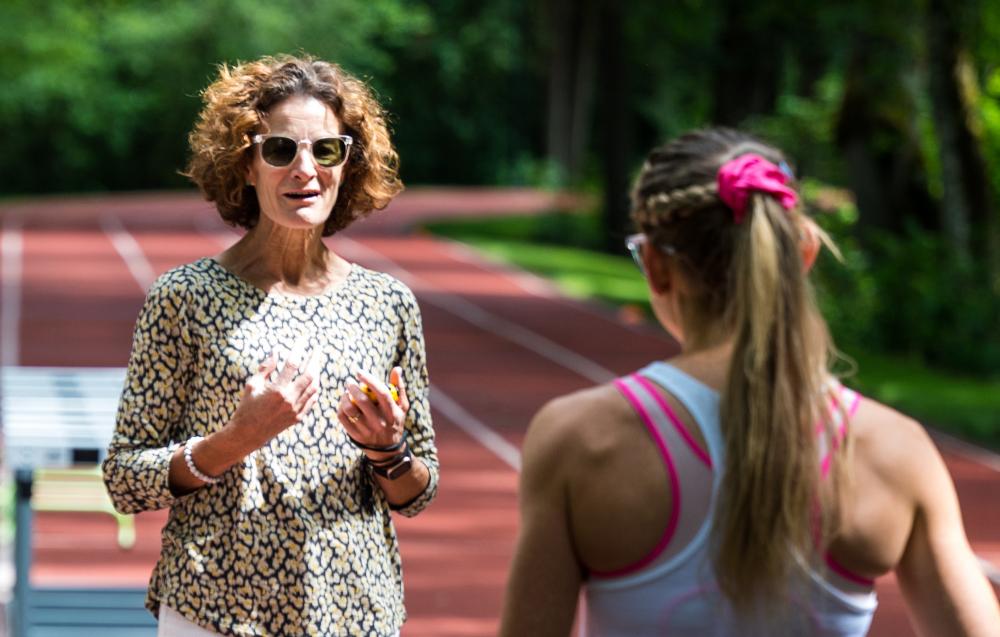
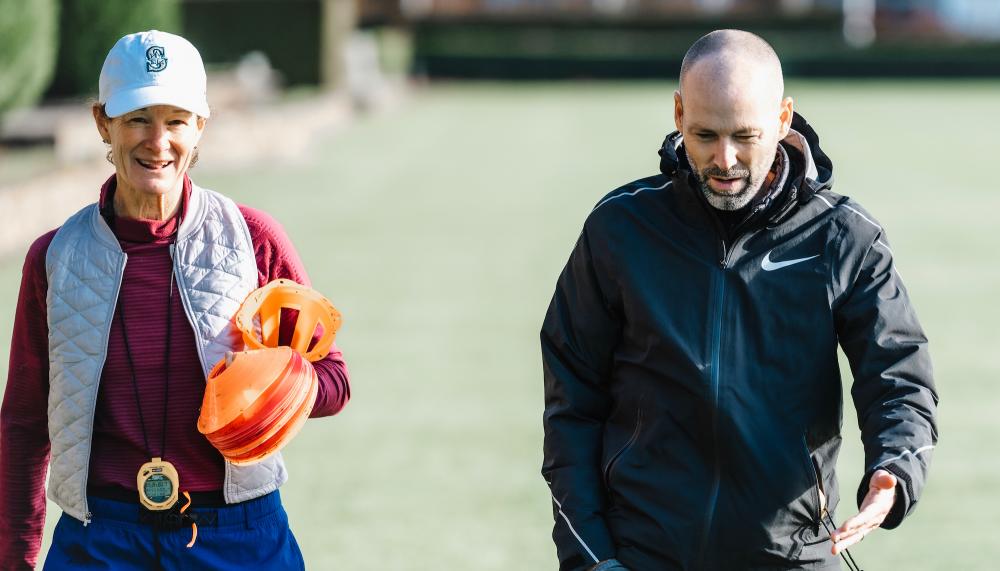
Over the shop’s insistent jazz, O’Sullivan circles back to the recent Penn Relays visit, her first to the Philadelphia area in almost a decade. It was a homecoming of sorts for the ‘Nova alum and six-time Penn Relays winner, but it was also a business trip in her capacity as Union AC assistant. There were, in fact, three distinct motivations for the trip: O’Sullivan was being inducted to the Penn Relays Wall of Fame; Sophie was competing in several relays with her UW teammates; and a pair of Union AC athletes, Michaela Meyer and McKenna Keegan, were entered in elite sections at Penn. While O’Sullivan took particular joy in Villanova’s heart-stopping triumph in the men’s 4xMile, and in finding her old friend, Marcus O’Sullivan (no relation) to congratulate the Wildcats coach on the win, the other collegiate relays found her torn between an allegiance to her alma mater and a newfound fidelity to the school in Seattle. “If Sophie’s running,” she admits, “then I’m cheering for UW, there’s no question about that. In the men’s’ races — even though UW was in there as well — I was cheering for Villanova.” But between that packed schedule of relays, her own Wall of Fame ceremony, and the races for Meyer and Keegan, it made for a head-spinning weekend. “It was a bit of a juggle,” O’Sullivan says, “because you don’t want any of (the commitments) interfering with the others. Especially when you have athletes...getting them ready for their race, you must be there primarily for that.” That act of juggling, finding balance among myriad responsibilities, is something she and Julian have worked on as they’ve established their roles over the last two years. Julian takes primary charge of the sessions, she says, writing training plans for each athlete every week. O’Sullivan interprets and helps to administer, asking questions and seeking clarification as needed. Each coach has their own philosophies, distinct mentors and influences that color their approach to training. O’Sullivan cites her husband, Nic Bideau, her personal coach in London, Alan Storey, and colleagues in the profession like Villanova’s O’Sullivan — “He’s huge, I’ve had a lot of training discussions with Marcus.” When the coaches meet to discuss an upcoming cycle, each brings those influences to the table. Julian then takes O’Sullivan’s input into account and creates an overarching plan. “He’s open for discussions about training,” she says, “but he has his template that he likes to use. Some of the things I discuss with him would certainly then filter into the training sessions.” As a mother to two young adults — she and Bideau also have an older daughter, Ciara, who recently graduated from the University of Melbourne — O’Sullivan has come to realize that her Union AC relationships also contain a layer of maternal concern. “You do have those connections…you want the best for them,” she says. “It doesn’t end at the track, whether things are going well or they’re going bad, you always have to check in to make sure that they’re okay.” She’ll often seek out places where she can have the greatest individual impact, connecting with specific athletes for additional support. “I think you align yourself with different athletes at different times,” she says, “whoever needs you the most. You work with everybody, but there’s always someone who will need you more than the others.” Those alignments, those relational attachments to her athletes, are among the reasons she finds herself still doing this work, two years after her initial trip to Portland. “One thing leads to another, for sure,” O’Sullivan says, “and then you make these good connections with the athletes...” In the end, she says, it’s the process of helping athletes advance from one level of success to another, finding a capacity for performance beyond what they might have imagined, that holds her here. “You get good at what you’re doing,” she says, “and then you take a step to the next level. And once you master that, you go to the next level. It’s the same thing in training…you can’t just keep running more. You’ve got to get better at the level you’ve gotten to first. I remember when I first broke 9 minutes for 3,000 (meters) at Villanova, and I thought I was going to die. It was so hard, but that was only the beginning.” Before Villanova, there was the 3,000-meter time trial on the track in Cobh, trying to break 10 minutes. And before that, a field — trying to run farther than 100 meters. Always a level to be mastered, and then the next challenge. There is a certain concentricity to it all. Like the lanes of a track, stacking neatly outward. A life of ever-expanding ovals, until the whole world was encompassed. Made bigger, simply by running through it. A life that has felt, at times for O’Sullivan, somewhat transient. Ephemeral and itinerate — “a lot of comings and goings,” she says. Roving, perhaps, but always with a constant center. A purpose and a place to land. Cobh to Portland. Cove to port. Like so many things in Sonia O’Sullivan’s life, all a matter of timing.
1 comment(s)
|




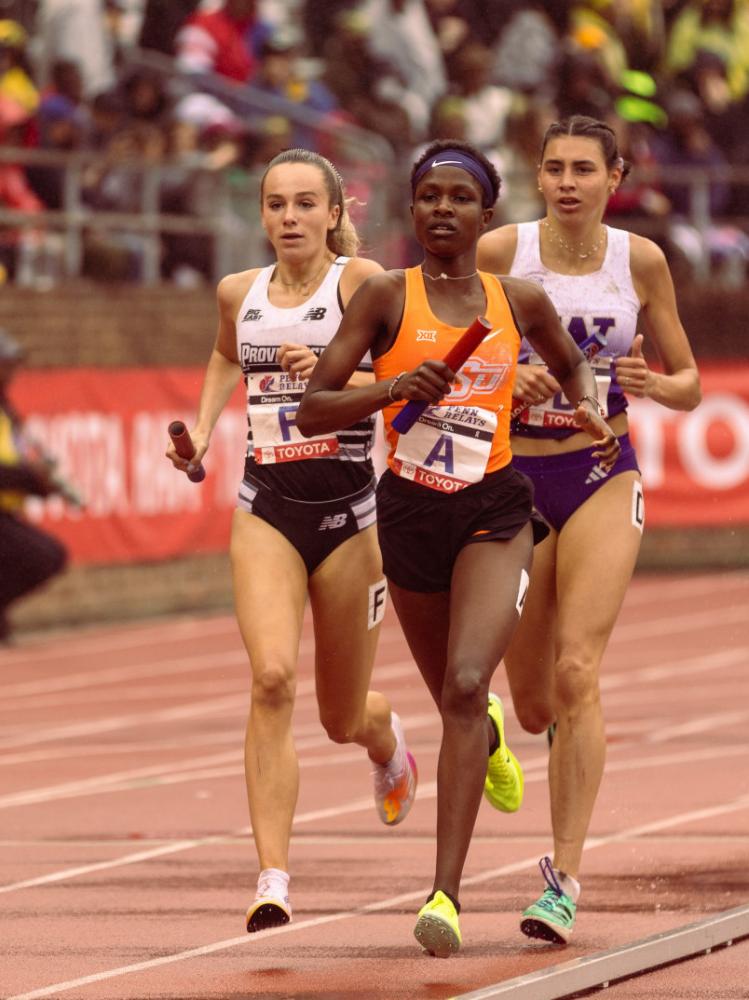
 O’Sullivan’s daughter, Sophie (left, photo by Micah Thornton), a first-year recruit finding her way at the University of Washington when O’Sullivan first considered the job, is now a standout junior, newly minted school record-holder and NCAA finalist at 1,500 meters.



