

Folders |
Backstage With Untold Cross Country History: 20 Years Since The Rise Of The StotansPublished by
Fayetteville-Manlius' Domination Began With Boys Sweep At Manhattan In 2004; Ten Year Anniversary Of NXN Sweep By Marc Bloom “You will remember this day later in life, this little memory, when you pick up your children from kindergarten, and you breathe in the air. You will remember that night when you were a kid and the world was perfect.” - Bill Aris, December, 2014 This evocative poetic insight, this affirmation of the innocence of youth blended with the enduring power of youth, this touchstone into the heartfelt communion of work and ethics and a coda, by then, to a decade’s worth of “Stotan” rejection of modernity and consumerism and cheap thrills — a nod to the purity that was preached and learned and summoned that afternoon and before, in the alchemic breathing of teen-age runners, runners who were different, not for the purpose of being different but for the purpose of seeking a higher plane of learning, learning that went back decades but was re-discovered, re-tooled, offered and accepted, by those who were not fast and strong but through the challenge of rejecting societal norms became fast and strong, stronger than anyone could have imagined, a strength of mind, body and spirit not to be equaled or even approached to the present time years after; this deliverance, borne of craziness, of wildness, of audacity, was expressed as a snowy blanket of early winter curtained Green Lakes State Park in upstate New York, presenting the setting of a natural wonderland for coach Bill Aris: teacher, preacher, provocateur, philosopher, psychologist, artist, student of the Great Works, Socrates of the running paths, Aristotle of the race course, to unleash his final words, elegiac in encapsulating the fullness of young lives, inspirational in distilling the moment to its essence, while his Fayetteville-Manlius High School cross country runners from the Syracuse area completed their final workout before heading out to Portland, Oregon, for the 2014 Nike Cross Nationals. Ten years later. Was it really perfect? In framing that moment as perfect — reaching into the depths of what he had tried to do year in and year out and seeing in that milieu something perhaps God-given, beyond custom, beyond boundaries, beyond the accepted and beleaguered teen-age life force — Aris saw that a certain perfection was imminent, it was coming, it could not be stopped, it was in and of the young, and the young when taught the hard lessons, the lessons they craved all along, the lessons that Aris knew were there, to be unearthed, dwelled upon, made grandiose if need be, with a consuming and honest commitment the kids had never witnessed, truths they’d never heard, yes, this was it, the way to find transcendent satisfaction, in order to be the best version of yourselves.
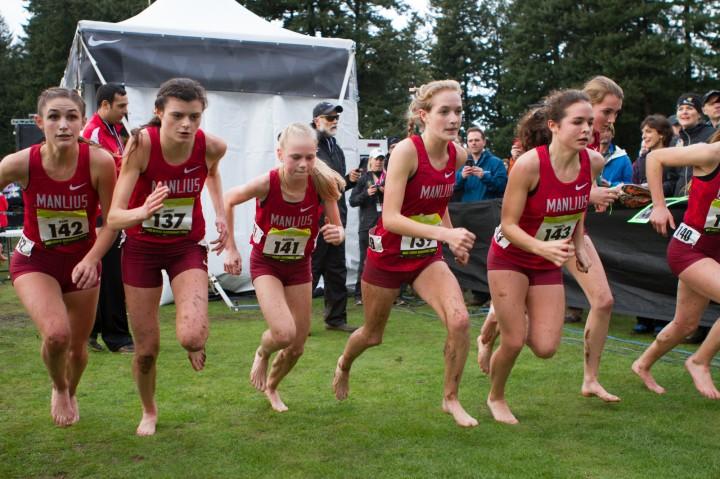
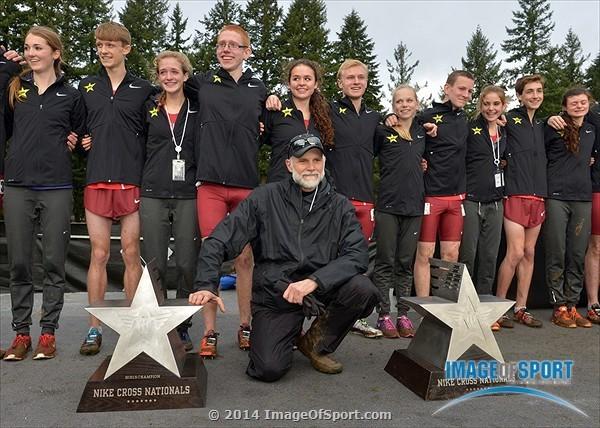
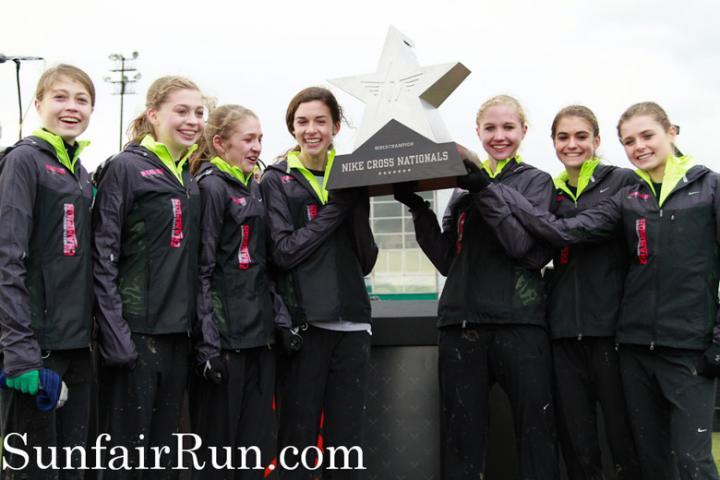
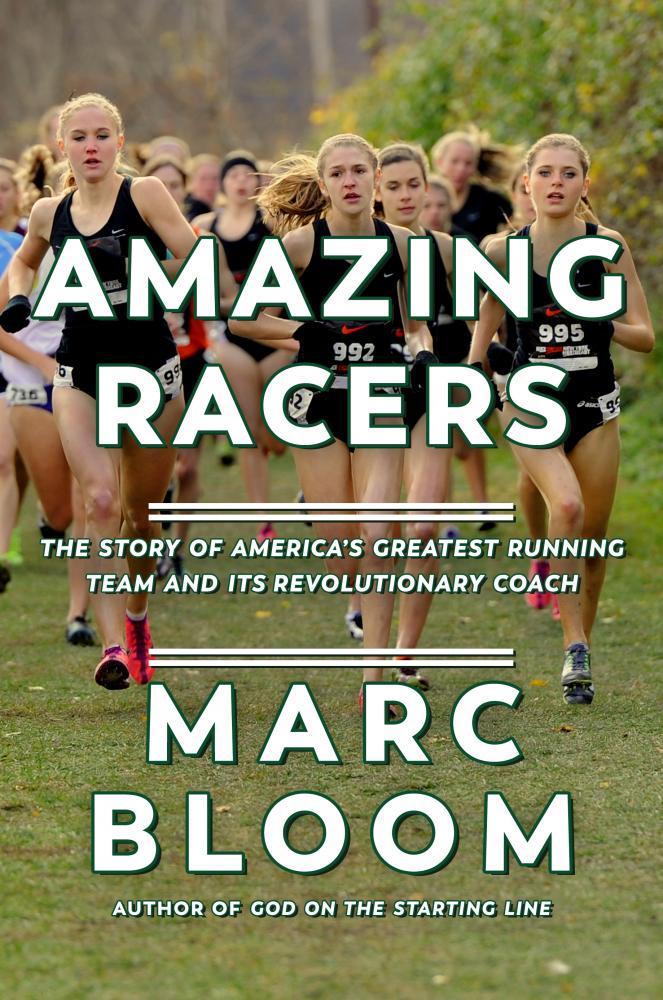
“The words just came to me,” Aris said when we spoke recently to recall that moment, and others, while commemorating the various milestones of Fayetteville-Manlius pre-eminence. “The snow had just started,” Aris said, as though it happened yesterday. “I looked at the kids, watched their clouds of breath. I was immersed in it, sensing their feeling. Everyone on the same page, running together, having fun, in their crescendo workout. I thought, this is special. This feels Heaven-like. This feels perfect.” Funny thing, while spending countless hours with Aris years ago to research my book about the team and his program-- “Amazing Racers,” which came out in 2019 — I never thought to ask how he’d come up with that lyrical formulation on the spot. While I would use Bill’s words as the epigraph for the chapter titled, “Poet Warriors,” about the 2014 Nike Cross Nationals, it occurs to me that perhaps a more provocative title for the book might have been, “When The World Was Perfect.” In Portland that season, on Glendeveer Golf Course, a form of perfection was indeed realized. First, the Fayetteville-Manlius girls would capture their eighth NXN championship in nine years — they would garner three more in a row for 11 in 12 years — with five scorers across the line in eleven seconds, one after the other, the tightest winning compression at the event to this day. The girls had no “stars” in the traditional sense but, it could be said, one over-riding star, the five girls as one, the luminous, collective light every coach seeks but few would dare imagine. The young ladies scored 70 points to triumph by 79. The boys race followed, with F-M completing the unprecedented team sweep, scoring 111 to win by 48, then the biggest margin of victory by a boys team at NXN. No school has achieved such combined gender dominance since. Only two other schools have ever been on both NXN podiums in the same year—Saratoga Springs of New York in 2005 (boys first, girls second) and Great Oak of California in 2015 (boys first, girls third). This season, based on the results so far, no single program has much chance of getting close. Like so many of the F-M milestones over the decade-and-a-half of their beyond-category performances, from the boys’ emergence out of nowhere in 2004 through the girls annually leaving their opposition gasping out on the race course while they did their victorious barefoot Kenyan cool-downs, every achievement, each one in and of itself, was hard to even imagine. In the current vernacular: scary. And some people were “scared.” After all, there was an outrageousness to F-M. For those who didn’t realize the program was not about more miles but more ideas — brazen ideas but some, frankly, at anyone’s fingertips — perplexity could devolve into fear about the incomprehensibility of it all. I mean, how many miles could you run? How many hills? How many everything? Hah. Now, when high school runners seem to be celebrated more than ever with a style of elitism that would make a true Stotan shield in defense, it seems a good time to pay homage to some of the better known F-M milestones, in particular: the 20th anniversary of how this historic era began in 2004 with a bunch of “nobodies” sweeping national power Christian Brothers Academy at Van Cortlandt Park in the Manhattan meet; the 10th anniversary of the 2014 NXN team sweep; and perhaps the most shattering “sweep” of all, when the F-M girls shut out the nation at NXN in 2010, defeating an all-star team when matched against the entire field. The Fayetteville-Manlius era (it might not yet be over yet, as we’ll see) and its make-up offer lessons worth remembering today, revelations of what surpassing excellence could be, and how it could be mastered. Speaking of sweeps and “zero compression” (how Aris spoke of it), in 2008, prior to winning NXN by 69 points, the F-M girls ran 3-4-5-6-7 in the New York Regional on the brutal Bowdoin Park course in Wappingers Falls with a 13-second compression. The harder the course, the more strung out the runners, right? Especially girls, one would think. Thirteen seconds. Put this race on a flat course and you might just have gotten an actual “zero.” “Heavenly,” said one of the girls on that team, Hannah Luber, when I’d spoken with her years back for the book. After college, at Iowa, Luber went on to teach and coach in Costa Rica and Guatemala. This longing to see the world, and reach beyond one’s environment to contribute, is an F-M post-grad hallmark. Just about any year, whether in New York or Portland, some version of an F-M sweep would occur, causing outright bewilderment over this re-invention over what young runners were capable of. In 2009, Fayetteville girls swept mighty Saratoga Springs (which needs no introduction) in the New York State meet with a perfect-15 score and 11-second spread; weeks later, the F-M lineup that won NXN sported a 17-second scoring spread with only 50 seconds from the first to the seventh girl. (Last year’s NXN girls champion, Air Academy of Colorado, had a 1 minute 45 second spread from 1-to-7; that’s typical.) Other I-can’t-believe-that examples cascade like snowflakes at Green Lakes. Take 2016. Heralded as one of the great California girls squads ever after running away with state Div I and winning the state merge of five divisions by over 50 points, Great Oak came into NXN expected to give Fayetteville a run for its money at Glendoveer Golf Course. Instead, F-M won its 10th championship by 140 points — 140 points — and by 36 seconds per girl. As if that were not enough, F-M placed all five of its scorers ahead of Great Oak’s first scorer to sweep the Californians. (Great Oak actually wound up third, as another California team, Davis, from the Sacramento area, placed four points ahead in second.) “Supernatural,” said Bill’s son, John Aris, who’d assisted his father in the early years, when I brought up the program’s beginnings and how the summer of 2004 led to immediate, scorching success that fall. John said, “The entire season felt scripted from Heaven.” There’s that word again: “Heaven.” “I still feel the chills,” John, 45, told me. John was young himself, not much older than the boys, when he helped incubate the program with the new and untested ideas his dad had formulated for teen-age runners. Like healthy eating. John’s role included meal preparation at the pivotal week-long 2004 summer training camp in the Adirondacks, based at the summer cottage of a team member. This was a first step in denying mass taste (pun intended) and launching the boys with a tapestry of mind-and-body nuggets from the Stotan canvas. I first heard the term “Stotan,” which combines the words “stoic” and “spartan,” two months later at Van Cortlandt when I witnessed what was probably the most shocking high school race I’d ever seen, even to this day. As the CBA coach, Tom Heath, recounted for my book, he was standing in his usual spot about a half-mile out when the five F-M boys whizzed by him before a single CBA Colt appeared. Like someone who’d just witnessed a battalion clear out a beachhead, Heath said to himself in disbelief, “It’s over.” Once the dust settled and onlookers were trying to digest Fayetteville’s 1-2-3-4-5 Manhattan meet finish against CBA., shattering the team time 2.5-mile course record that had stood for 33 years, I sat on a bench near the finish with Bill and his two co-captains wondering how five boys who could not qualify for the state track meet in June could not only defeat, not only run away from, but shut out one of the best teams in the country in October. It was then that Aris revealed his newfound Stotan philosophy of coaching the team—a way of life, really—adapted from the austere and enriching methods of the legendary Australian coach of the 1950s and ‘60s, Percy Cerutty, who’d made young Herb Elliott into an Olympic 1,500 champion and world record holder. The two young men, Owen Kimple and Jared Burdick, spoke proudly of applying Stotan ideas at the summer camp and the strengths they’d acquired--emotional as well as physical--while forming close bonds in which they ran for one another out of a brotherly “love.” Terms that would define F-M and soon be codified into the running lexicon, like “shared suffering,” “pain is the purifier” and “selfless-ness,” were mentioned as entreaties, whether gathered from Cerutty himself or the array of psychologists and philosophers Aris culled in his endless search for meaning: whatever theories and points of history excited his intellectual bones and led him to believe that they could excite his teen-age runners as well. The Stotan Creed, found in the Graem Sims biography of Cerutty, is at one with the Constitution: foundational, timeless, brilliant, bold, somewhat dense, and biblical in its call for personal reformation. It can be intimidating in accepting nothing less than complete adherence. Cerutty admitted, “It is not for weaklings.” The Creed favors strength and beauty, toughness and loyalty, commitment and erudition, purity, logic and an unending search for truth. One tenet asserts that the Stotan will “understand that Past, Futures, Fears, Death, Selfishness, Egoism, Pride, Envy, Hate and Prejudice can be replaced by Intelligence that controls emotion, dominates destiny, manifests completeness and exults in Life.” Quite a mouthful. Like the man posed, not for weaklings. Sitting with the trio at Van Cortlandt, where I’d first run myself more than 40 years before, I was struck by concepts I’d tried to emulate in my own life, and was immediately captivated by these new/old benchmarks, as interpreted by Aris, and how he would cultivate a belief system in his high school runners. From a transformative life-enhancing denouement I’d experienced a decade before, I’d learned about the power of the mind and how the concept of “belief” can be transcendent. I keep learning. As a result, I was in the ideal position to link with Aris on his running revolution — its psychological tapestry — and as I followed the team closely, that season and beyond, more and more of the F-M essence would galvanize me. I knew that one day I would have to tell the entire story. Like Cerutty, Aris, now 69, with two children and six grand-children, became an outsider, throwing convention on its heels, over-turning norms, giving cynics a field day. Cerutty, who lived the Stotan ideas as much as his athletes, was spurned by the Australian establishment. For my part, I’d always disdained conformity, feeling most comfortable, for better or worse, in a perpetual state of alienation. “Many people thought I was crazy,” Aris said. “I didn’t care one bit. We had fun. We had success. After all these years I’ll never forget it.” In a way, I had an indirect role in the Fayetteville-Manlius enterprise when, years before in the print heyday, I published my “Harrier XC” magazine. With all of its news and results, which could not be found anywhere else, buttressed by my own impactful innovation of National Team Rankings (beginning in the 1980s), high school cross country was uplifted to center stage, as groundwork for what would become Nike Cross Nationals. Consider for a moment how challenging those early rankings were before the advent of the internet. Meet results were practically locked away. How would I obtain them, and then compare performances on different courses, and at different distances, around the country? I rounded up “correspondents” in all 50 states (mostly coaches) who would snail-mail the results to me along with course information and their personal perspectives; and I took results over the phone while delving into training approaches and competitive style: how cross-country was contested in New Mexico, New Hampshire and all points in between. That was late 20th century “social media” for you. As I became a sort of national clearing house of all things cross country, I helped many meets expand their entries so that top teams in my rankings could find ways to compete against one another, taken for granted today. That’s how Great American in North Carolina started, for example. As the rankings propelled the sport, they were also the source of much argument. After all, it was great fun to debate which team was really No. 1. Seeing the promise of answering that question on the race course, Nike took the idea and ran with it, creating Nike Team Nationals in 2004. I was enlisted to work on the event, doing the rankings to select the teams the first two years before regional qualifying began. So it would be that my passionate interest in cross country would wind up being the playground for the rhapsodizing force that became Fayetteville-Manlius. As I covered the team from year to year, and spoke at length with Aris, it was clear, by the time of putting together the book after the 2014 sweep, that explaining how F-M “did it” would require casting a wide net into spheres of psychology, history, the arts, and more. That’s what Bill did in crafting his messages to the athletes. He created a mosaic of stories, lyrics, poetry, Cerutty tales, and whatever struck his fancy in the Green Lakes classroom, from Zatopek to Lydiard to the Kenyans, to the “White Moment,” a poetic commentary on peak effort by the Russian world champion weight lifter and novelist Yuri Vlasov, who wrote of the moment when “you contain all the power in the world, that you are capable of everything. There is no more precise moment in life than this, the White Moment, and you will work hard for years, just to taste it again.” Could a vision of such intensity take root in teens? When “Amazing Racers” was going to press in 2018, I had time to add a short postscript to the fall season, when, after the girls’ run of 11 NXN championships in 12 years, the team placed fourth in Portland. I spoke with Claire Walters, a junior, who’d led F-M with a fifth-place finish and was the second of all team runners across the line. Walters, currently a Div. III All-American studying theology in her senior year at Franciscan University in Ohio, told me she’d inscribed a message on her arm to use as a gut-check during the 2018 NXN competition, something Aris had expounded upon in the team’s pre-dawn shake-out that morning of the race. It read: “Love the pain. Seek ‘The White Moment.’” In reviewing the many F-M milestones, in addition to speaking with Bill and John, I reached out at random to several former Fayetteville runners who competed in 2004, 2010 and 2014, to see how those momentous experiences informed their current lives.
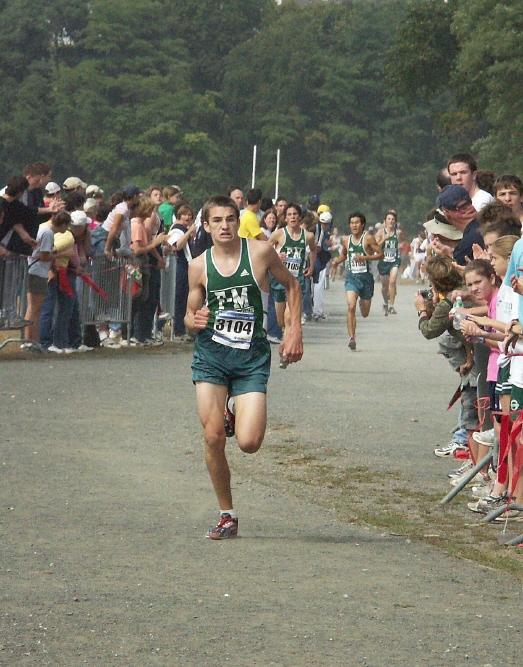
The 2004 F-M Emergence and CBA Sweep At the outset, Tommy Gruenewald, a sophomore on the 2004 squad, said he “was uniquely prepared to receive Bill’s treasure” as an enriching foundation to his young life, and that he has held to Stotan values ever since. “Bill was like a second father to me,” said Gruenewald, now 35 and working in real estate in Utah while serving as an assistant coach at Salt Lake Community College, a relatively new track and cross country program that won the JUCO women’s title last fall. He is married with four children. While at F-M, Tommy’s mother had passed away and he was looking for direction. Bill, as well as John, helped him get back on his feet with messages of clarity and hope. “Bill was always reading,” Tommy said. “He taught us what we didn’t know.” “I studied everything,” said Bill. “I went back to the ‘50s, to ancient times. I kept it all in my head.” “My dad’s style of communication captivated the athletes,” said John. Bill delivered his lectures on life and running — in effect, sermons — at every practice before the workouts got going. “That was the skeletal structure,” said John. “I saw my job as carrying the messages through and touching every kid.” Gruenewald, then a sophomore, led F-M across the line at Van Cortlandt in the sweep of CBA. The split was 12 seconds. Five boys who were barely known in Manlius, New York, were now on the national radar. It was John Aris’ 25th birthday. Tommy gave John his Manhattan meet first-place prize of a wristwatch as a thank-you gift. Fayetteville went on to the first NXN championship in December as co-favorite with York of Illinois, the bedrock program of high school cross country, known for its celebrated coach, Joe Newton, an innovator in his own right. The small-town, high-minded FM boys did not fare well in the pitched Nike campus fanfare and left their best race back in New York, winding up second, as York, the pre-eminent power in my Harrier XC rankings for 15 years, took the title. Gruenewald placed ninth at NXN that season and fourth in 2005 as F-M again placed second, this time losing a tiebreaker, and being relegated to third. Gruenewald would collect numerous titles and records in track and cross-country in his F-M career. He started his college running at Stanford and then ran for BYU. In work, family and coaching, Gruenewald said Aris’ teachings are always with him. “I try and be a voracious reader like Bill,” he said. “Bill engaged us with absolute truths and we reaped incredible benefits.” Gruenewald’s 2004 teammate, John Heron, a junior that season and the No. 4 scorer (in addition to Burdick and Kimple, the fifth scorer was Andrew McCann), is also coaching — as an associate head coach at Episcopal School in Jacksonville, Florida — while doing corporate consulting in human relations and leadership training. He keeps in touch with Bill, integrates Stotan ideas, and instructs his team, “Do the little things right and big things will happen.” To this day, Heron, 36, is buoyed by the initial overture of the Aris renovation. “It was my first cross country season after running track,” Heron recalled. “The seven of us sat on the infield after spring practice. When Bill pitched his plan, we all looked at one another, like, “If he’s in, we’re in.” Two decades after, Heron appreciates the Aris vision more than ever. “Bill had the courage. He took blind shots, to think that we were ready for it,” Heron said, of the Stotan ideas, which could be hard for kids to swallow. “That was Bill’s gift, his instincts for teen-agers.” Those instincts never proved more potent than that October day in the Bronx in 2004. “It still sticks with me,” said Heron. “Disappearing into the woods, seeing only teammates, hearing only the crushing of feet on the dirt trails, looking back--and there was no one else. It was surreal.” Heron uses the F-M book, and texts Aris relied on, to excite the Episcopal squad — like “Thinking Body, Dancing Mind,” by the psychologist Jerry Lynch. Through mid-season, the Eagles’ boys and girls were among the state’s top-ranked teams in class 2A. Heron, who did his college running at Coastal Carolina, also ran on the NXN F-M unit as a senior in 2005, placing 20th in the country as the squad’s third man.
2010 Girls NXN “Sweep” of the Entire Country The Fayetteville girls’ Stotan immersion began two years after the boys, in 2006, when Aris felt they were ready for it. While the concepts might have seemed more of a tough ask for girls, in fact, the girls had been itching to get a piece of the action after watching their male teammates thrive while hailing the new philosophy that propelled them. Indeed, the 2006 girls were much like the F-M boys of 2004. Sixth in the state meet in 2005, the F-M’s unheralded girls were victorious at state in 2006 over no less than the two prior NXN national champions, Saratoga Springs and Hilton. In Portland, F-M would triumph by 50 points. What happened? Stotan happened. The baby of the ’06 squad was Courtney Chapman, an eighth-grader. (In New York, and various other states, qualified middle school athletes are permitted to run varsity.) Chapman was an F-M scorer in every nationals from 2006 through 2010, finishing as high as eighth and seventh in the country in 2007 and 2008, to lead the squad. At 31, living in Manhattan and an executive with Bank of America soon to head up an office in London, Chapman, who ran at Villanova, now sees her high school distinctions as “less about the five championships” and “more about the hard work that went into it.” While skittish at first, coming out of basketball where she could barely run the court without plopping, Chapman wondered if Aris’ bold pronouncements about selfless-ness, humility and the potential he saw in her were attainable. But as with all the girls — every one of the dozens I’ve spoken with over the years — Chapman was invigorated by Aris’ unyielding gender equity: girls no different than boys, with the same doctrines and firmness, none of that condescending “be careful what you say to a girl.” As Bill liked to tell them, you don’t achieve excellence with sleepovers but shared suffering. Bill credits the parents for buying into his gender makeover and supporting their daughters when they spoke of pushing to levels that might have made Herb Elliott blush. “It was the highest form of respect I could give them,” Bill said. As Chapman has applied the F-M circuitry, inflected with keeping teammates’ egos in check, to her expanding role in managing corporate teams, so, too, has her 2010 NXN teammate, Heather Martin, who says now, “The values Bill instilled when we were younger translate to every aspect of my life.” Martin, 30, married, and living outside Washington, D.C., was probably the least likely F-M runner to make a nationals line-up. Martin was a 400 and 800 specialist. Later, at Georgetown, she ran the 400 on a Hoyas’ NCAA winning distance medley foursome. Aris converted her during the fall, and as a junior Martin was the fourth scorer in 2010, taking 16th in the nation. Martin, who also earned a master’s degree at Georgetown, works in sports marketing for Under Armour, overseeing its professional athletes and the races it sponsors. In the 2010 Race of All Races, Martin finished 24 seconds ahead of Chapman, the fifth scorer. In her first NXN, Martin came through for an ailing Chapman, whose status had been uncertain all season. A class spring trip to Europe in Chapman’s junior year was postponed till August because of the eruption of a volcano in Iceland, which halted air transportation. Chapman, the team leader, came home sick from the trip during the meat of summer training, couldn’t shake her bug, and pushed herself to make up for lost time. Aris worked hard to calm Chapman down and alleviate her senior-year sense of loss. “That’s the most I ever trusted Bill,” Chapman recalled. “Bill knew who I was.” In Portland, it was understood: “run for Courtney.” Demonstrating symphonic power and suffused with a radiant glow as though hallowed by the “supernatural” that John Aris talked about, the Fayetteville-Manlius girls delivered a team performance that, one can safely say, will never be equaled. Across the line: Christie Rutledge, 2nd (1 team point); Katie Sischo, 4th (2 team points); Jill Fanning, 6th (4 team points); Martin, 16th (8 team points); Chapman, 29th (12 team points). Fayetteville-Manlius, 27 points. The Rest of the Country: that is, top five team scorers from all other teams like an all-star team: 30 points. F-M team average time: 18:59. Top five all-star team: 19:03. Runner-up Saratoga Springs: 19:58. F-M put all five scorers ahead of Saratoga’s number 1. Third-place Saugus, billed as the greatest California girls team ever: 19:56. Fayetteville defeated the next two best teams in the country by virtually a full minute per girl. In “Amazing Racers,” in the 2010 chapter, I gave the last word to Sischo, in her mid-20s when we spoke in 2017. “We ran that race for years and years of Stotans,” she said. “And for Bill. He gave us so much, and we wanted to be able to give something back.”
2014 Boys and Girls NXN Team Sweep A new, more conventional race course and multi-purpose indoor Athletes’ Village added that much more creature comfort to the high-stakes national event. The girls ran first. The undefeated Stotans had won the New York Regional decisively over Saratoga but still had their sole NXN loss, from 2013 — second by 12 points to Wayzata of Minnesota — to make up for. It was not so much the defeat itself but the rare spell of hurtful discord among different team factions that even Bill Aris’ psychological brinkmanship could not quell. The 2014 squad’s tighter emotional embroidery was solidified by four-time finalist Annika Avery, whose subdued enforcement carried the day. Currently a Ph. D candidate in Environmental Life Sciences at Arizona State, Avery, 28, feels the perseverance and sense of discovery she encountered at F-M have helped fortify her academic rigor, which began at Cal-Berkeley where she competed briefly for the Golden Bears, stopping after studies became her priority. In Portland, the history-making, close-to-zero compression, in which Avery was the second girl across the line, owes its origins, she said, “to having the confidence in high school to be respected as a strong woman, instilled in a philosophy we practiced daily.” As empowered young women yearning for competitive intimacy, the athletes took Aris’ metaphorical motivation to heart,” said Avery, who stays active with swimming, bicycling and running. “We were told, ‘Don’t let the string break,’ or ‘Don’t let the fist open.’” The Stotan athlete just ahead of Avery was senior Olivia Ryan, whose freshman sister, Sophia, was No. 3 and Jenna Farrell No. 4. The quartet placed, 46th, 47th, 48th and 49th, within four seconds. Has team running ever been sweeter? Samantha Levy was the fifth scorer seven seconds behind Farrell in 58th. The team points were 11-12-13-14-20. The fist, the string, the heart and soul, all as one. When we spoke, Levy, 26, told me she called up those memories while competing for Johns Hopkins in the Div. III cross-country nationals. In 2019, in particular, Levy found herself fighting for points in which she had to dig deeper than ever with the title on the line. A nearby teammate faded and Levy, a senior, was left to secure the victory, “no matter how much it hurt,” she said. In what she called her best collegiate race, Levy placed 17th as the first Hopkins finisher and the Blue Jays prevailed over Washington University of St. Louis, to triumph by 13 points. In fashioning a promising career in public service, Levy, who is married and still runs daily, attributed her world view to “being a Stotan — that’s how I try and live my life.” Levy received a master’s degree from the Johns Hopkins School of Advanced International Studies and is now immersed in the study of Mandarin Chinese while preparing to depart for a major Chinese city to work as a foreign service officer in the U.S. Consulate. In China, she will join her husband, also taking on a diplomatic post. Likewise, Adam Hunt, a three-time NXN finalist and the No. 4 F-M scorer on the ’14 boys’ team, told me, “I liked how Bill made Stotan relatable to other things in life and how everyone was held accountable.” Hunt, 28, a special education teacher and coach in the Buffalo area who ran at U-Buffalo, joined up with the National Guard, where he became an executive officer for a calvary troop that has been deployed overseas. His assignments have included advising Ukrainian armed forces along the Polish border in the war with Russia. Feeding off teammates and the enduring legacy of the Original Stotans of 2004, Hunt made a big leap from junior to senior year, when he finished NXN on the heels of F-M No. 2 Bryce Millar (the NY regional winner) and No. 3 Kyle Barber, reducing the front-four split in Portland to 23 seconds. Peter Ryan was the first man in at 15:40, 15th in the country, and Riley Hughes completed the scoring as fifth man. Ryan, a Yale graduate who has hiked the Appalachian Trial (2,200 miles) both ways and is currently hiking the Pacific Crest Trail (2,653 miles), was one of four siblings to thrive at F-M — three of them in the 2014 sweep, with the aforementioned Olivia and Sophie. Nick Ryan led the F-M boys at NXN in 2011 and ’12. Hughes, a three-time finalist, took pride in the boys and girls training together, recalling that liberating union in his memory of Aris’ lyrical team presentation in the snow. A Ph. D candidate in the Department of Pharmacy at Weill Cornell Medical College in Manhattan, Hughes, 27, did his college running at Marist and ran last year’s New York City Marathon in 3:05 on modest mileage. With the 2014 team sweep accomplished, when the 14 boys and girls arrived home in Syracuse, Bill Aris gave the victors a concluding benediction. “Bill sat us aside in the airport,” Hughes recalled. The Fayetteville-Manlius “perfect world” had unfurled, touching each runner personally and in unison, and the coach addressed them with oracular finality: “Before you walk back to your families, sit here for a moment and remember, this is the last time all of you will run a cross country race together. Look at each other, savor it, let it all sink in.” Looking Ahead: Hopes For Stotan Renewal Fayetteville-Manlius last made NXN in 2019, with the girls placing seventh. Then, 2020 and 2021 were the Covid years, which hurt the program and of course many others. With community stature and year-around youth lifestyle imbedded in competing sports like soccer, lacrosse and field hockey, F-M has seen fewer athletic youngsters take an interest in cross country and its numbers shrink. This fall’s team has about a dozen mostly young boys and 10 girls, led by former state champion Izzie Sullivan, now a senior. The girls stand an outside chance of contending for the second NXN auto-qualifying berth. Bethlehem should be the heavy favorite. F-M finished third in its section and did not qualify for this weekend's state meet. In light of the feeder problem, John Aris has gotten back into coaching with an FM Youth Running team, now in its second year. Kids from 3rd to 8th grade run together a few days a week, even in winter wearing headlamps. John, who works in commercial construction management, has about 20 youngsters, boys and girls, and a number of blue-chip prospects. His eighth grade boys have been dominating middle-school races and he has an eighth-grade girl outrunning the opposition by close to a minute. John’s sixth-grade son has already run a 19-flat 5k on the roads. Bill Aris has much to look forward to. John is teaching the kids about Stotan, the parents are on board, the numbers are growing and the times are getting faster. Does anyone have a cottage in the Adirondacks to offer? # Marc Bloom’s career spans 60 years. In addition to “Amazing Racers,” his books include, “God on the Starting Line,” about his coaching experience at a Catholic school. In 2022, he was inducted into the Van Cortlandt Park Cross-Country Hall of Fame. |

 When I first heard that sacrament of grace and eloquence years ago, my heart swelled and my eyes grew misty. I was stopped in my tracks, as it were.


