
Folders |
The St. James Academy VA Rises To Prominence With A New Education Model, Ambitious Athletics GoalsPublished by
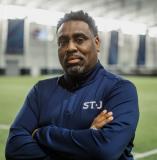
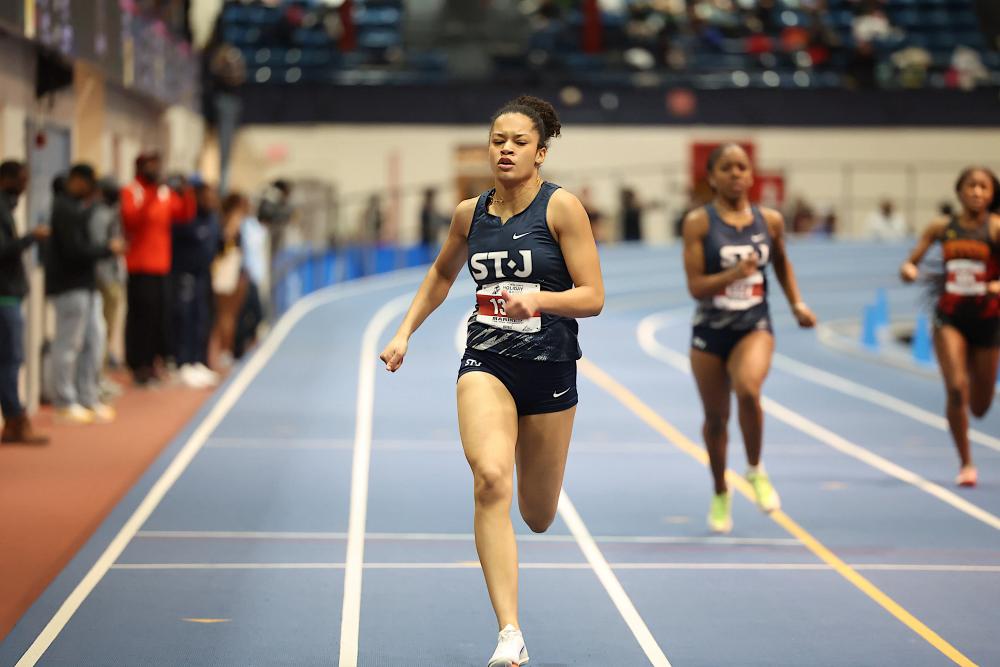
In His First Year At The New School, Coach Maurice Hutton Is Building A Potential National Powerhouse In Track And Field By Oliver Hinson for DyeStat ALEXANDRIA, Va. — On a brisk February morning, a bus pulls up to the back entrance of Flippin Field House on the sprawling campus of Episcopal High School in northern Virginia. Dozens of high schoolers pile out and scurry inside, eager to escape the cold. Within a few minutes, they’ve split off into at least half a dozen groups, each warming up slightly differently to prepare for the demands of the day. A year ago, this high school track and field team did not exist. In mid-March, 14 of its members — roughly a third of the entire team — placed in the top six of a championship event at New Balance Nationals Indoor. This weekend, the Strivers will be represented at the Wavelight All American Track Classic in Columbia, S.C. WATCH THE WAVELIGHT ALL AMERICAN TRACK CLASSIC APRIL 9-11 ON RUNNERSPACE+ A year ago, they all wore different logos. Now, they all wear the logo of the St. James Academy. The St. James name isn’t new to DMV locals. When it opened as a sports complex in 2018, it was heralded as a first-of-its-kind institution. Founders Kendrick Ashton and Craig Dixon thought big, and they delivered to the tune of 450,000 square feet of facilities that would make some professional sports teams blush. There’s a FIFA regulation-size soccer field, an Olympic-length swimming pool, two hockey rinks, four full-length basketball courts, a restaurant headed by a celebrity chef, and plenty more. It would almost be quicker to list the things it doesn't have. What it didn’t have at first, though, was an education component. According to Elyse Graziano, the Academy’s Chief Sports Officer, it was always a part of the founders’ vision, but it took years to put in place. From the time Graziano joined the company in 2021, part of her job was getting the Performance Academy off the ground. In August 2024, the Academy welcomed its first batch of 40 student-athletes, but they didn’t compete at the scholastic level; that didn’t come until the following fall. For the first year, they focused on individual skill training and tested a unique education model — a model that sets the Academy apart from nearly every school in the country. In its current form, The St. James Academy most closely resembles college preparatory schools like IMG Academy in Bradenton, Florida. Like IMG, St. James challenges traditional norms of learning; while the public school model often keeps students in classrooms for seven to eight hours per day, student-athletes at the St. James are in class for about half that time. What about those other four hours, though? Graziano notes that the students aren’t missing much. The curriculum is mostly focused on core classes that the NCAA requires, and rather than taking electives that aren’t required, students can focus on the coursework that will have them ready for college. “When you break it down,” Graziano says, “other public and private schools aren’t really actually learning more than four hours in a day, either.” With the resulting extra time, the student-athletes can train twice a day and be home before dark. “You come in at 8 (a.m.), you leave at 4 (p.m.), you’ve practiced twice and you’ve done all your schoolwork,” says Maurice Hutton, the director of track and field. For nearly a decade, Hutton, better known as “Coach Moe,” led public schools like Massaponax and South County to elite results. In five years at South County, his teams won four VHSL state titles. In 2023, he was named the Nike Coach of the Year. Hutton wanted more success than he could find in the public school system, though. With limited resources and support, there was a ceiling to what he could accomplish. “The public school system can do a much better job of taking care of their coaches,” Hutton says. At South County, his days often started at 6:30 a.m. and lasted 13 hours. He worked in the building during the school day to earn a paycheck, but like most public school coaches, he only received a stipend for his coaching. Then, like the rest of northern Virginia, he heard about the St. James, and he knew he was the man to lead the track program. “Maurice is definitely a visionary” Coincidentally, Graziano also knew Hutton was the man for the job. She had already known Hutton from his days leading the MVP Track Club, a youth organization in Springfield. Hutton rented the St. James fieldhouse on Saturdays and Sundays at 6 a.m., and while Graziano set up the facility for winter league lacrosse games, she watched Hutton and his group from afar, admiring the fact that he could convince families to show up at the crack of dawn for indoor track practice. “It was easy to imagine that everything he built at South County, everything he built throughout his career as an elite track and field coach,” Graziano says, “he could bring that to the St. James.” That’s why Hutton finds himself here, at Flippin Fieldhouse, at 8:30 a.m. on a Tuesday. When he walks in, he finds two of his athletes who missed the bus that morning and had to receive rides to practice. He has a quick chat with them about team standards. The athletes he coaches this year will be the first ones to some day represent the St. James Academy on the collegiate level, and he cannot stress the importance of that enough. “I don’t want the college folks calling me, telling me that my kid is always late to practice, late to the bus, late to study hall,” Hutton says. “Being on time is important. We’re instilling that now.” He takes stock of his athletes as they warm up. Today’s practice will have almost 10 different groups. Each athlete has different needs depending on a number of factors, from whether they competed the prior weekend to how they’ve stacked up against teammates in prior workouts. “It’s a mixed hodgepodge of different things,” Hutton says. “It’s finding out what their strengths are and aiming for those strengths versus just throwing them in a workout and watching them struggle through it.” Individualization is everything for Hutton. It’s what allows him to coach champions, and it’s what turns coaching into a full-time endeavor for him. Last night, Hutton worked until about midnight creating a spreadsheet to keep this morning’s workouts organized. After practice is over, he’ll have a meeting with all seven of his assistant coaches, in which they’ll review their observations from practice and discuss entries and logistics for the upcoming weekend. From there, he moves to what he calls “third-floor meetings” with Graziano and other administrators. Most of those meetings, Graziano says, are about putting out day-to-day fires, but Hutton always saves some time for long-term discussions. “Maurice is definitely a visionary,” Graziano says. “He always reserves a bit of our conversation to talk about, you know, what are the plans for building a track at the St. James?” The complex already spans across more than 10 acres of prime DMV real estate, but ironically, the one piece it doesn’t have is a track. Rest assured, Hutton wants that to be addressed in the future. Hutton expresses urgency when he speaks; he knows that by succeeding, he will not only prove the excellence of his program but show what can happen when coaches are properly taken care of. Hutton is a firm believer that every coaching position, no matter the level or sport, should be full-time. “It’s a full-time job,” Hutton says. “When you look at the amount of hours you spend, you’re usually spending more than 40 hours a week when you add up meets and training with these kids.” Even without teaching duties, Hutton estimates he works about 10 hours a day. On the surface, that’s not much less than his workload at South County, but the glaring difference is that all of his hours are devoted to his athletes. “It’s night and day,” Hutton says of the differences between his current and past positions. “There’s no comparison. The way you’re able to operate and still maintain a healthy, balanced work life is unmatched.” “It’s a crazy position for me to be in as a coach” When Hutton took over the program, coaches from around the DMV noticed. Tyrell Taitt, a former NCAA champion at N.C. State and a coach at multiple DC-area schools, knew from the moment he heard about the St. James that he wanted to be involved. “I was excited to see what a program like that could produce,” Taitt said, “and I definitely think (Hutton) is the guy that could lead that because he thinks outside the box.” Taitt has worked with a number of high-level coaches, but he says Hutton stands out from the rest because of his systematic approach. “Everyone knows what their job is,” Taitt says, “and I think they do it at a high level because he demands it of them.” Danielle Gray, a former cross country coach at American University, VMI and Stevenson University, came aboard in December 2025. Like Hutton, she found herself lacking in “support from above” in her previous positions, and she came to realize just how rare that support can be, even at the collegiate level. “It’s always the same few (programs) that are really successful, right?” Gray says. “And those jobs at the college level don’t really open.” To put it bluntly, she says, she was tired of losing — and then she heard about the St. James. Like Taitt, she realized that Hutton was taking all the right steps to build a successful program, and she wanted in. Now, Gray has the opportunity to build a program from the ground up. In its current form, the boys and girls track teams at the St. James are sprint-dominated, and as the head cross country and distance coach, she has to build the distance program to balance what Hutton has created in the sprints. She’s not interested in taking small steps, either. Right off the bat, she wants to create national record breaking relay teams in the 4x800 and distance medley relays. If she wants to win, she says, she has to aim big. She recognizes the significance of being able to say that, too. “It’s a really neat idea to say, ‘we can go after a national record soon,’” Gray says. “It’s a crazy position for me to be in as a coach.” “You have to get outside your comfort zone sometimes” The final step in building a program like this one — and the most important step, according to Hutton — is creating buy-in. For this morning’s practice, Hutton can do all the work he wants in crafting workouts and letting everyone know what their jobs are, but that work means nothing if the athletes aren’t bought into the program. Of course, that starts with getting them to join the program in the first place. Amir Duff, a junior long sprinter, joined the St. James after two years at North Point High School in Waldorf, Md. Right off the bat, he loved the freedom he had in his academics. The Academy has a flexible attendance policy, so after coming back from a long weekend at a track meet, he can stay home and rest on Monday. He can also move through his coursework as quickly as he wants and in whatever order he wants — if he feels like completing a unit of English one day and a unit of math the next day, he’s free to do so. On the track side of things, meanwhile, he says there’s nothing like training with Hutton. “I remember when I first came to the school,” Duff says, “we went outside and did straight 150’s. We did six all-out 150’s. That was an experience.” Duff says that “you have to get outside of your comfort zone” in Hutton’s program, and it’s paid off for him. From last indoor season, he’s dropped his personal bests from 35.33 to 33.51 in the 300 meters and 50.66 to 47.94 in the 400. For Nicole Duff, Amir’s mother, seeing Amir get to fully embrace his competitiveness and be around other high-level athletes was a major selling point in joining the school. Some families can be skeptical of the unconventional learning model, but Nicole, who works in education, says she saw many of the same changes happening during the COVID-19 pandemic, and she says the increased independence has helped Amir prepare for what college and the “real world” will look like. “We weren’t intimidated by the model,” Duff says. “We welcomed it.” Steve Oliver, the father of Skylar Oliver, an eighth grader at the St. James, echoes the same sentiments. “Me and my wife were blown away by it,” Oliver says. “Even with the schooling and training… (she is) able to get out of school at 4 (p.m.) and, you know, be a kid again.” For Skylar’s part, the experience has been extraordinary. “At the St. James, it’s like a family,” she says. “I think it’s different from any other school… our staff really cares about our recovery and our mental health.” *** After this morning’s practice is done, the athletes will hop back on the bus and head to the St. James for their four hours of classwork. Around 2, they’ll have their second practice of the day, and then they’ll be done — free to be kids. Hutton, of course, has a long day ahead of him — reviewing practice, meeting with coaches, planning travel, and whatever other fires he needs to put out. But it’s all worth it. When Hutton pulls up to the 450,000 square-foot campus in Springfield, he’ll have the same reaction he did the first time he ever saw it. “Every day I walk in,” Hutton says, “I’m reminded, ‘you’ve been blessed with one of the greatest opportunities you can ever come up with.’” More news |