
Folders |
Before Curtain Fell on 2020 Track Season, Thomas Boyden Demonstrated How Promising This Spring Season WasPublished by
Two Weeks Later, The Snow Canyon Invitational Feels Like 'A Gift' Skyline UT's Thomas Boyden Ran 4:05.16 For An All-Time Utah Best In the 1,600 Meters And Edged Stansbury's Carson Belnap, 8:50.65 To 8:51.99, In The 3,200 By Doug Binder, DyeStat Editor Photos Courtesy Jim Ballard Thomas Boyden sat in his usual spot in the Skyline High (Salt Lake City) cafeteria and was eating lunch when he got a text from the meet director of the Texas Distance Festival. The Saturday event that Boyden had been training for the past month was canceled. By the morning of Thursday, March 12 everything was changing in a hurry and the ballast propping up high school track and field was beginning to crumble. The night before, Rudy Gobert of the Utah Jazz had tested positive for the Coronavirus (COVID-19) prior to tip-off in Oklahoma City against the Thunder. The NBA season was quickly stopped. High school track and field athletes around the country soon learned that New Balance Nationals Indoor in New York City was nixed and began scrambling to cancel flights and hotel reservations. Boyden made a quick decision to pivot rather than pout. He brought up RunnerCard, Utah’s go-to meet registration and results site, on his phone, to see if there was another meet he could get into. He found one, 300 miles away and starting the next day: The Snow Canyon Invitational in St. George. Maybe that one is still on. Boyden went to his coach, Thomas Porter, and told him the news. The Texas meet wasn’t happening. There would be no way to test what they had been working on throughout the winter, training that had Boyden in sub-14 minute shape for 5,000 meters. Boyden asked his coach if he could possibly squeeze into the Snow Canyon meet instead. Yes, as it turned out. Porter made the call and entered Boyden in the 1,600 meters Friday afternoon and the 3,200 meters Saturday morning. Boyden, a Stanford recruit, checked in with the group chat that connects about 80 of the top boys in the state, and informed Carson Belnap of Stansbury and Easton Allred of Corner Canyon that there was an opportunity to race, still, in St. George. Belnap, who was due to fly to New York that day, switched gears and decided to sign up for Saturday’s 3,200. In might not be NBNI, but a matchup with Boyden was an opportunity he couldn’t pass up.
Boyden’s senior year had already taken wild swings between prosperity and despair. He had broken 15 minutes on the tough 5,000-meter layout at Eagle Island (Idaho) to win the Bob Firman Invitational in September and also took third at the Desert Twilight Invitational in Arizona with an impressive time of 14:39.7. But a slew of college visits late in the season wore him down and he collapsed under the weight of expectations – his own and others’ – at the Utah state cross country championships. Boyden slipped and fell after the mile mark, and then tried to chase down the leaders and went down again – and didn’t finish. “At state I had the worst day of my whole life as far as racing,” Boyden said. “I tried putting that in the background, but then at Foot Locker I didn’t perform the way I knew I could, and I got 12th. I kind of thought, ‘Dang.’ But it wasn’t too bad.’” After Foot Locker, Boyden shut down his running for a couple of weeks. Porter, his coach, sought a re-boot. “Break him down and start this over again,” he said. “I said, ‘Let’s get some good miles under your belt.’” The invitation to come to Texas and race an early season 5,000 meters against a top field that was to include Foot Locker champion Josh Methner of Illinois, fueled Boyden’s winter training. “Once we started to do work on the track, Thomas was (running) stronger than ever,” Porter said. “I actually thought, ‘Do I need to put the brakes on here?’ But he’s already committed (to Stanford), he’s running really well, so let’s go and have some fun with this.” Porter knew full well where Boyden’s training had taken him. As a former college coach at the University of Utah, he had three men run under 14 minutes for 5,000 meters. Boyden was doing the same workouts. “My best workout was 6x800,” Boyden said, rattling off each interval by memory. “It was 2:07, 2:04, 2:03, 2:07, 2:05, 2:04.” Boyden’s mother Sarah drove him to St. George on Friday, March 13. By the afternoon, the NCAA would pull the plug on the Indoor Track Championships for all three divisions, as well as March Madness.
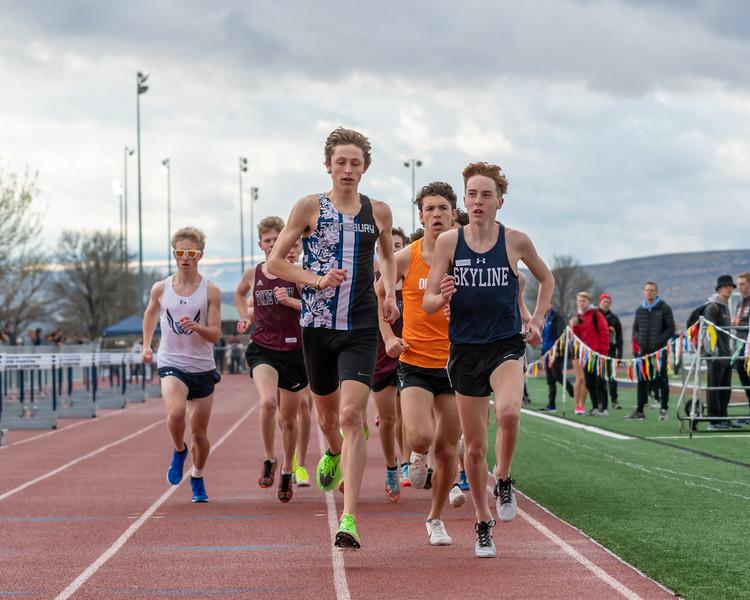
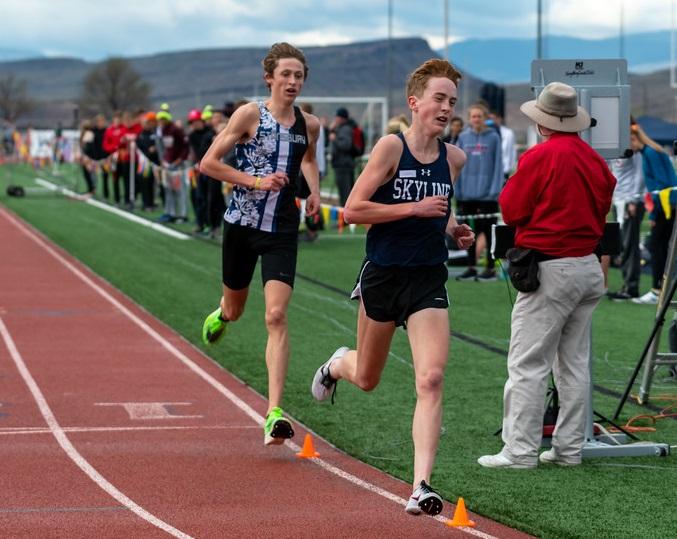
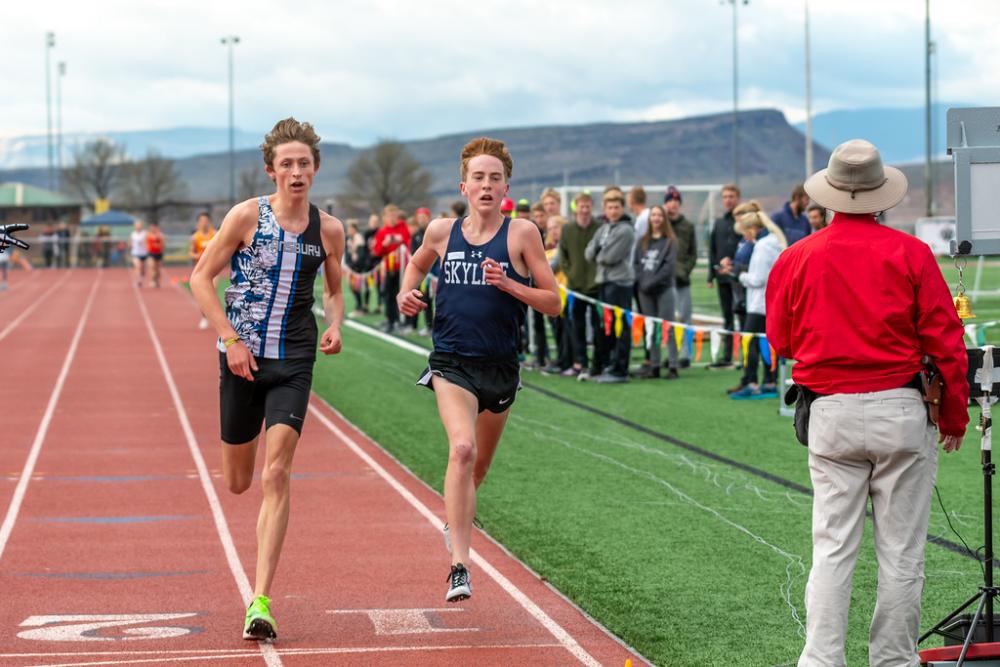
St. George is 2,000 feet lower than Salt Lake City and at 2,700 feet elevation has one of the lowest tracks in the state. A fast time was possible. “An hour before the race, it stopped raining, which was really good,” Boyden said. “I had no idea what I could do, but I had run a 4:13 or 4:14 time trial at 5,000 feet.” His coach, who couldn’t get away from his classroom that Friday, thought he could possibly match his 2019 best of 4:11.13, perhaps touch 4:10. “I went out and hit 60 (seconds) for the first lap and I was at 1:59 at 800,” Boyden said. “I was feeling really good. Then I hit 3:01. I didn’t die on the last lap. But I got distracted by the massive PR and looking at the clock. I was smiling the whole time as I approached the finish line.” Boyden quickly dialed Porter. “He was still out of breath as he was calling me and I hear him say ‘I broke it!,’” Porter said. “I wasn’t quite sure at first what he meant.” Boyden’s finish time of 4:05.16 was the fastest time ever by a Utah prep athlete in a 1,600-meter race, an all-time state best that eclipsed Casey Clinger’s 4:06.22 at the 2017 BYU Invitational (albeit at higher altitude). The state’s fastest all-time full mile, 4:02.72 by Ben Saarel at the 2013 adidas Dream Mile, was run at sea level. For Boyden, the record-breaking result was something of a shock. He cooled down and went back to his hotel and later met up with Belnap, who made the trip down to get ready for the early Saturday 3,200. “We talked about taking it from the gun,” Belnap said. “Going out strong and consistent, sharing the work.” Belnap, like Boyden, had been through a whirlwind couple of days. The BYU recruit had intended to compete in the mile at The Armory in New York and when he found out late Wednesday that it was canceled, he stayed out with friends until 4 a.m. “I figured, ‘Screw it, I’m not going to race for a while,’” Belnap said. “But then, when I saw they were going to suspend school and all races after the weekend, I thought I better do it.” Belnap hastily made plans to stay with his brother in St. George. Saturday morning it was cool and brisk at the track. The sun shone brightly and kept the runners from getting too cold as they warmed up. Boyden’s mind was still pondering his 1,600 from the day before and he was riding a wave of euphoria. Belnap, who had been dealing with some tendonitis in his knee but felt he was in ‘good shape,’ went to the line with a sense of purpose. This was no ordinary early season race. “I had that feeling, that this could be my last race of high school,” he said. “I ran it like it was the state meet, or nationals, pretty much. “Like it was the last thing.” Porter, Boyden’s coach, suggested he try to run under nine minutes. Boyden told him his legs "didn't feel too torn up." With Boyden slightly out in front and Belnap at his right shoulder, the two sped away from the field and put themselves under nine-minute pace. At four laps, the midway point, Boyden and Belnap were at 4:28. And they kept grinding. At the bell, Boyden had a couple of meters on Belnap, but the gap closed again on the final backstretch. With 200 to go, Boyden found another gear and was able to accelerate to the finish – clocking 8:50.65. He had closed in 4:22. Belnap, who won the Utah 4A state cross country title on the way to placing ninth at Nike Cross Nationals, ran 8:51.99. It was a lifetime best in the event by nearly a minute. “I wish I would have won, but I was happy with it,” he said. The two fastest times in the country, run in perhaps the final track meet in the United States of the 2020 outdoor high school season – or at least for the forseeable future – mean something important to both runners. Boyden has kept up his training these past two weeks. He does two track workouts a week (his school’s track is still open) and he’s kept up his mileage, hoping there is another meet when the pandemic cools off. He’d love a chance to race the nation’s top guys again, to see if I he can go sub-four in the mile. “It’s been really hard. There is a weird emotional pattern,” Boyden said. “Is this real? It takes a while to grow into it. I’ve come to the realization this might not be good the rest of the year. But I’m still training, for myself, to improve my fitness for college.” Belnap has slowed down some. “I’ve backed off quite a bit,” he said. “I got a stomach infection and was on heavy antibiotics for a while. I’m feeling a little bit better (this week). I started running again. I’ll build my miles back up.” Porter wishes he could have taken a personal day and gone to St. George, to be there for Boyden’s big double. “When Thomas started running as a ninth grader, he looked like he was 8 or 9 years old,” Porter said. “He could always start out a race strong, but could not finish strong. By the end of sophomore year (cross country season) he was 40th. And then the next spring he goes to 4:22 (for the 1,600). “And then he grew four inches.” In the handful of months since the state cross country meet, he had made significant gains -- strength, widsom, maturity -- yet again. Porter said Boyden has become the most impressive high school runner he has ever coached. It hurts not to see him through to the end of the season, working on a daily basis in person. In a season of so much loss, the Snow Canyon Invitational performances show that, if nothing else, something meaningful did happen in the 2020 outdoor track season. At least eight states have shut down spring sports for the remainder of the academic year. Utah is one of the states that hasn’t yet called it. “I look at it as a kind of gift,” Porter said. “(And) not just a gift for (Boyden), but for the whole sport. There was something in this dark cloud, something positive that happened before this went down, something great that no one was expecting.” More news |