


Folders |
Backstage With Untold Track and Field History: Sergey Bubka, Ukraine And The Fight For FreedomPublished by
Probing the Artifacts ****** A Place Aspiring To Peace Is Now Engulfed In War: An Athletics Odyssey By Marc Bloom for DyeStat Photography by Duomo It was some 30 years ago this month when, with a Russian visa in hand, my track and field travels put me on an Aeroflot flight from Moscow and deposited me onward to a bordering country without the second nation’s required entry visa—an incoherence emblematic of the region and pinprick of its fractious history and culture, an ever spinning Eastern European landscape of secrecy, confinement and intrigue that reeled the mind then and now. Despite lacking proper papers, like something out of “Casablanca,” I disembarked without a challenge onto an eerie airstrip in the dark of night. No lines at customs. No customs at all. Just hop off the plane. After the long journey, my feet were planted in a place seething with suspicions that is now witnessing the innocent bloodshed of thousands staining the streets. Memories of that quotidian time strike the heart, a reminder that the human capacity for destruction is never extinguished.
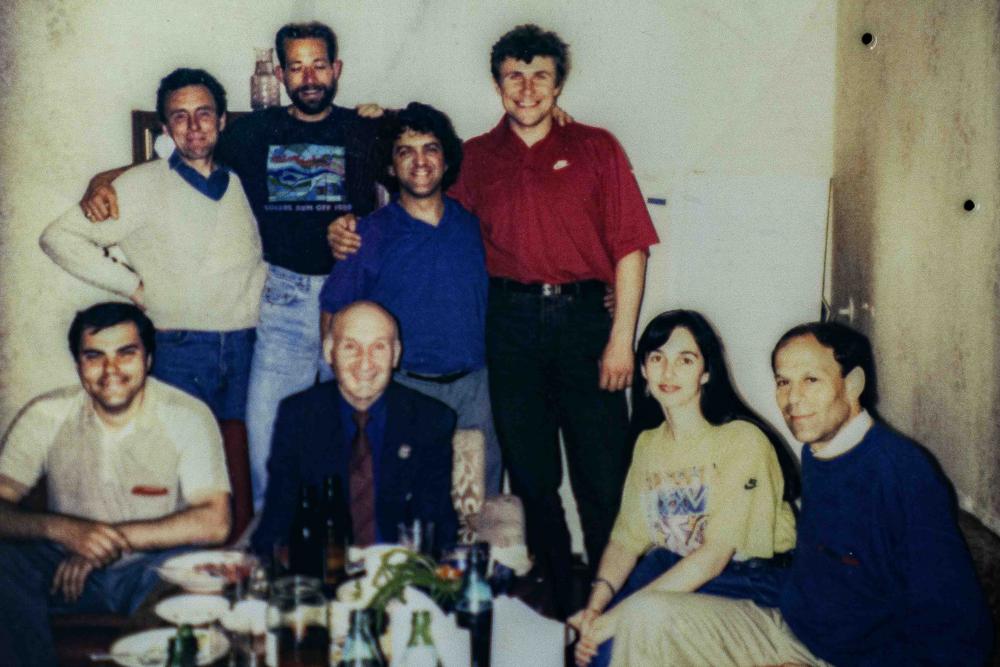
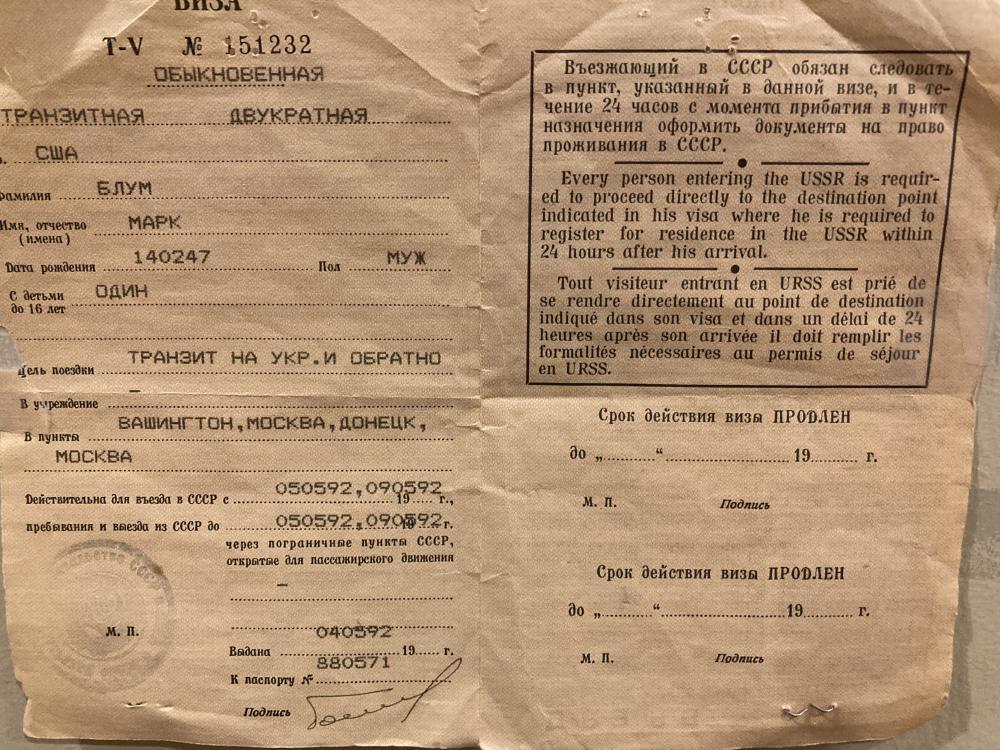
Pictured above is my visa allowing travel into Russia in May, 1992, a year after the Berlin Wall fell and the USSR dissolved. Also shown above is a group photo taken in a hotel room of a recently emancipated former Soviet republic. The hotel, where I and colleagues boarded, was a onetime headquarters of the K.G.B., the spy agency of which Vladimir Putin was once a proud member. If you’re a track and field fan who’s been around awhile, you might recognize the muscular looking gentleman standing at back in the photo. He’s currently the second-highest ranking track official in the world. Then, at 29, he was amassing world titles and world records by sprinting down a 40-meter runway with a 17-foot fiberglass pole in his hands. My first trip to the former Iron Curtain coursed from Newark to London to Moscow to one last stop touching down at an airport that is now destroyed; to a part of the world currently under siege, to a city that at the time most people could not find on a map—a place then of bread lines and babushkas, where the 20-foot pole vault was born. The country was of course Ukraine; the region was the Donbass in the eastern sector where Putin’s military is now focusing merciless attacks on the populace; the city was Donetsk, the home of one of the greatest track and field athletes ever, the pole vault master Sergey Bubka. The Donetsk we knew is now gone. At the time of my visit, it was almost a decade before the ravenous dictatorship of Putin would assume control of Russia and—seizing upon toxic differences among some of its citizenry, rabid regional alliances and a spy’s paranoia—plant the groundwork for his future territorial demands on the independent state of Ukraine. As I write this in late April—two weeks away from Russia’s May Day parade marking its defeat of the Nazis in World War II—heartbreaking words like these jump out at me from The New York Times: “Russian missile kills mother and infant” in Odessa, which anchors Ukraine’s south at the mouth of the Black Sea, a spot rich in culture, navigational brinkmanship and, in better times, as vacation playground. The mother’s mother—the babushka—also was killed in the attack. Another: “Before dawn, two young girls, aged 5 and 14, were killed when their home in the Donetsk region, near the eastern border with Russia, was destroyed…” Atrocities. As we contemplate the daily horrors, this word is being used to describe Ukraine’s devastation. It’s a word with consumptive weight, buried, ready to be called up at a terrible time, when children are butchered by enemy soldiers barely old enough to shave. For the past 75 or 80 years, since the War, “atrocities” has been the term to describe war crimes, genocide and the Holocaust. Language fails—has failed—to capture the barbaric acts wrought by evil doers, so we need a term that serves as code. We say “atrocities” in talking about the one million-plus Jews murdered in Ukraine during the war: 34,000 massacred during just 36 hours in 1941 at a place called Babi Yar, outside the capital of Kyiv, and buried in a ravine the size of several football fields. For a long time, it was said, the ground moved. Who can explain it? Who could describe it? “Atrocities” will have to do. It should be noted that in Russia’s early strikes, the Babi Yar memorial, one of many observing the Holocaust crimes in Ukraine, was partly destroyed. Bubka was born in Luhansk, also situated in the Donbass, in 1963, the son of a Red Army sergeant. Bubka was Russian, part of the Soviet empire. At 15, when his parents separated, Sergey moved to Donetsk with older brother Vasiliy, also a pole vaulter. They shared a cold-water flat and fended for themselves. Sergey acquired a coach and was a quick study. He would capture the pole vault gold medal at the first World Championships of track and field, in 1983, at Helsinki. Bubka was all of 19. He cleared 5.70 meters, or 18’8 ½”, on his first attempt. As Bubka went on to dominate the event with a certain flair for the dramatic—the next year, at 20, he broke the world indoor and outdoor records seven times and achieved the event’s first 6-meter vault, 19’8 ¼”—his prestige, power and financial underpinning enabled him to find ways to teach others and promote pole vaulting. He would establish the Sergey Bubka Sport Club of Donetsk, grooming young vaulters, and in 1990 create an annual indoor pole vault-only meet, called the Pole Vault Stars, also in Donetsk, at the Druzba Palace, an ice hockey hall. Bubka himself won the inaugural competition, vaulting 6.05 meters, or 19’ 10”, another of the 35 world records he would set, indoors and out, in his 20-year career. Bubka’s influence also brought world events to Donetsk, like the 2013 World Youth Games, which saw the emergence of the 16-year-old American high school middle-distance star, Alexa Efraimson, who notched the 1,500-meter bronze medal behind a pair of Ethiopians.
Bubka’s ascent paralleled his region’s sharp political resentments. In 1991, when the Soviet bloc broke apart, he achieved history’s first 20-footer, 6.10 meters, at an indoor meet in San Sebastian, Spain. Then, in effect, a citizen of a new country, Bubka traded in the blood-red colors of the Soviet Union for the azure blue and lemon yellow of Ukraine. Out with the old: a war-like palette; in with the new: springtime in Donetsk. Bubka, traveling the world, was an emblem of freedom. There’s an imposing bronze statue of Bubka in Donetsk, pole in hand, erected in 1999, some would say as commanding as Michelangelo’s “David” in Florence. One day Bubka was Russian. The next day he was Ukrainian… but perhaps in some ways still Russian too. That duality—where Russian and Ukrainian loyalties lie in the swirling winds of history and conquest—is as much a catalyst as any for the tragic events the world has been witnessing since the Russian invasion began in Ukraine’s western sectors, including Kyiv, on Feb. 24. Imagine living in a place where nationhood changes on the dime: where family and friends lose trust in one another; imagine a different language and mores imposed on you; the confusion and fear and anger of what life holds in store for you and your children. Imagine existence dictated by bombs and social media. Vulnerable people are easily victimized by bombast and lies. It’s happened in many countries including our own. It happened in Nazi Germany. Hitler’s greatest weapon was not artillery, but propaganda, constructed with wicked effectiveness by Goebbels. “Evil,” Kafka wrote, “is whatever distracts.” Now it’s Putin, whose cunning has convinced Russians that they must defend against latter-day “Nazis” in Ukraine—the Ukraine whose gallant and fearless president, Volodymyr Zelensky, a heroic symbol to the world, is himself Jewish and lost many relatives in the million-plus victims slaughtered two generations ago. A heroic figure in his own right, carrying the weight of his new nation with each pole plant, Bubka’s Pole Vault Stars received early momentum when he continued winning “his” event with world indoor records of 6.11 meters (20’ ½”) in 1991 and 6.15 meters (20’ 2 ¼”) in 1993. In his record attempts, Bubka was known for “slicing the baloney thin.” A hundredth of a meter here, a hundredth of a meter there… that is, about a half-inch or so at a time. Leave room for more records and more rewards. Bubka was married with two young boys and other family in the household. There were mouths to feed. While the meet prospered with corporate sponsorship and Bubka as cultural benefactor, the event came crashing down after 2014, amid the political dissonance of Putin’s preposterous claim that Ukraine was a part of Russia and never should have declared its independence after the Soviet Union dissolved. Within Ukraine’s Russian-leaning segments, especially in the east, this assertion did not fall on deaf ears, and soon fighting would break out. Druzba Palace was destroyed. Russia and Ukraine, with their Slavic origins, shared a co-mingled history that went back centuries. While Ukrainians voted overwhelmingly to separate from Russia after the break-up of the Soviet Union, dissidents remained, especially the aged with their Old World ties, memories of hardship and links to the costly Russian defeat of the Nazis during World War II. A 90-year-old Ukrainian Jewish woman who survived the Nazi onslaught was recently shepherded out of the war zone to safety in of all places—Germany. Expressing the mixed allegiances of the region, she spoke of her childhood in the Soviet Union. “Moscow was the capital of my homeland,” she told a New York Times reporter, “It is hard for me to believe that my country is now my enemy.” Ukraine’s leading poet asserted that Ukraine had never really broken free of Russia, that Russia had co-opted Ukraine’s history and would never allow a Ukrainian nationalism to stop Putin’s imperialist ardor. Ever the spy who remained out in the cold, Putin’s ridiculous rap that Ukraine was guilty of “Nazi” crimes in the East, and that the Western world was out to get him, served as his pretext for war. Zelensky, 49, who grew up in central Ukraine, dismissed this claim for the absurdity that it was. He said that the Donbass was dear to his youth. He would hang out with friends in Donetsk, a city of one million known as a coal mining center, and cheer for soccer teams at Scherbakov Park, near the track stadium where I would watch Bubka practice the pole vault. Nationhood, argued Zelensky, is cultivated not by stale history but by personal connections in the here and now. Ukraine’s most revered athlete—the muscular man who carried his pole like a torch, helping to steer comrades in the right direction—worked toward that.
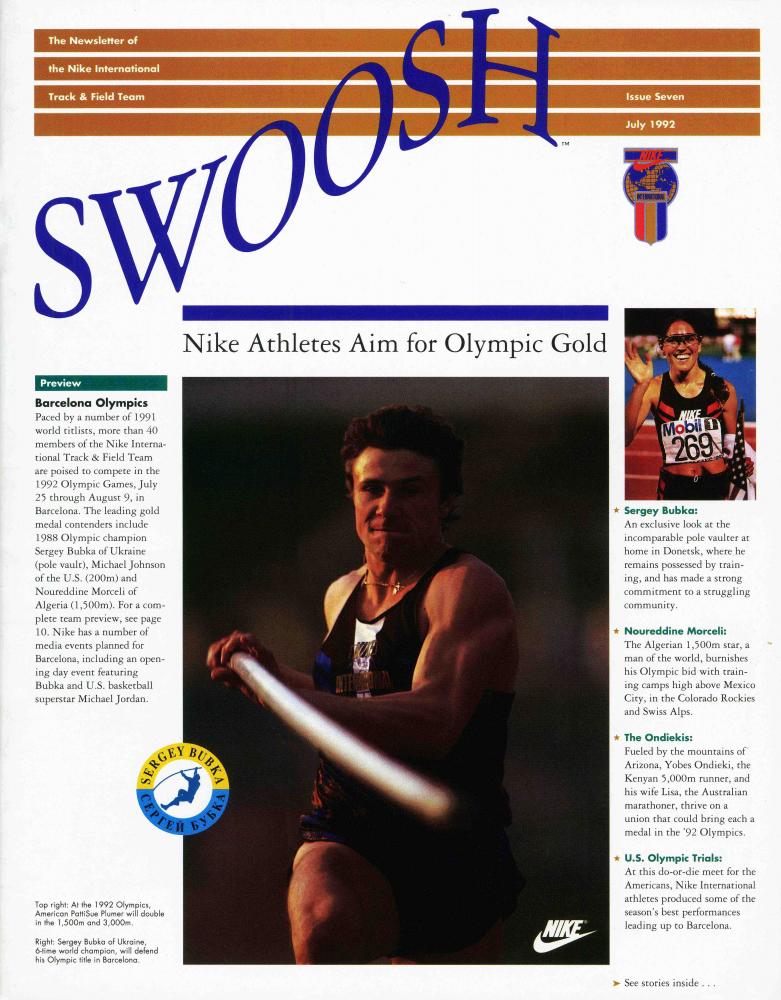
While the convergence of politics, finance and media confer world bodies and their global events with an aura of omnipotence, these powerful groups hold little sway in the larger world, where men and their machines, frankly, don’t give a damn. Bubka’s reign as both world indoor and outdoor record holder lasted for 30 years, from 1984 to 2014, a record unto itself (not to mention his six straight world outdoor titles, plus four more indoors), reasons why many in the sport consider Bubka the singular performer of track-and-field. His last indoor mark of 6.15 meters (20’ 2 ¼”) was set at—where else?—Donetsk’s All Star meet in 1993. His last outdoor mark of 6.14 meters (20’ 1 ½”), in Sestriere, Italy, was achieved in 1994. It took another 20 years for the indoor mark to be eclipsed, when the 2012 Olympic champion, Renaud Lavillanie of France, jumped 6.16 meters (20’ 2 ½”) at—yes, again—the 2014 Donetsk event. It’s rather obvious that Donetsk is (rather, was) to pole vaulting what Boston is to the marathon. While Armand Duplantis, the latter-day Bubka, has broken the world indoor record four times capped by its current standard of 6.20 (20’ 4”) set at the recent World Indoor Championships in Belgrade, Serbia, Bubka’s world outdoor record stood for 21 years until “Mondo” vaulted 6.15 meters (20’ 2 ¼”) in Rome in 2020. And that’s where the record stands now, with every expectation that’s Mondo’s magic will soon push it skyward. In 2014, the demise of Bubka’s All Star event--a prized civic endeavor with at least 300 children enrolled in the sporting club’s pole vault school—was, after all, a minor casualty, considering the human toll in Putin’s first, testing war against Ukraine. Called a “humanitarian disaster” by Marie Yovanovich, the former American ambassador to Ukraine, Putin instigated “Russian-separatist” uprisings in Donetsk and Luhansk while also taking control of the Crimea in the South with its proximity to key shipping routes in the Black Sea. In effect, in the east, Putin unleashed a civil war in Donetsk and Luhansk, where Russian forces and Ukrainian military attempting to hold their ground have been fighting for eight long years in what was considered an initial stage in Putin’s future bid to annex further Ukrainian territory and perhaps the entire country. The conflict has claimed upwards of 14,000 Ukrainian lives and destroyed everything in its wake while uprooting countless citizens. A Ukrainian journalist, telling of her mother’s reluctant decision to give up her life and friends and leave Donetsk in 2014, said she had no choice. “In Donetsk,” she wrote in an Op-Ed, “Russian-backed forces tortured detained civilians.” These forces had the gall to call themselves, “The Donetsk People’s Republic.” I traveled to Donetsk in a party of four. At the time, Nike grouped its marquee track and field athletes around the world with a marketing concept called, “Nike International,” promoting products with the star quality of its sponsored performers. The roster, some 50 men and women, a tapestry of athletes from 17 countries, included the likes of American sprinter Michael Johnson, Australian marathoner Steve Moneghetti, Kenyan distance runner Yobes Ondieki, Finnish javelin thrower Seppo Raty and Larissa Berezhnaya, a Ukrainian long jumper. To enhance Nike efforts in the early nineties, I and two colleagues, the photographers Steven Sutton and Paul Sutton, who led the international sports photo agency, Duomo, created a publication we called “Swoosh,” (see photos) to report on the athletes. I had collaborated with Steve and Paul, brothers from New York, on many projects through the years and we formed a seamless trio. The magazine came out three or four times a year, was sent to thousands of athletics’ journalists and others, and was made available at world and Olympic events. Considering the project’s raison d’etre, one provocative feature of every issue, devised by our Nike liaison Keith Peters, who accompanied us to Donetsk, was a summary translation of various stories in four other languages printed on different stock paper within the magazine. When we arrived at Moscow’s Sheremetyevo International Airport, there was no guarantee we would even wind up in Ukraine. We had no Ukrainian visas and were relying on Bubka’s pull—his Sport Club was “hosting” us—to do the rest. To insure our safety (people were jailed for less), a Bubka confidante ferried us by yellow school bus to a smaller airport for domestic travel. Then we had to get past security police who looked the other way—either because they loved the pole vault or were paid off handsomely by a certain reputed athlete—while the four of us pushed ahead of outraged passengers. Then we had to call up our high school track speed dashing on the jet way to be first on the flight, which, we were told, made one trip a day and was always overbooked. It was every man for himself. We were quite a sight—the Ugly Americans indeed, made worse when we arrived at Donetsk’s Prokofiev Airport (which would be destroyed in 2014 during war in Donbass) and had the audacity to stand and lean in for departure ahead of the crew. The insult was palpable. The policy was: pilots off first, then flight attendants, then us common folk. Finally, travel-weary after almost 24 hours en route, we piled out of the plane and into the waiting arms of Bubka’s entourage, alight on the runway, to shepherd us into our week’s stay as witnesses to Bubka-style training immersion; and, if I may say so, leavened by a visitor’s naïve assumption that all was right in the new independent nation of Ukraine. Keith had made an earlier trip to Donetsk in mid-winter with Nike top executive Steve Miller, along with several top vaulters, to Bubka’s all-star meet to insure that NBC was able to put together its up-close-and-personal feature for that summer’s Barcelona Olympics telecast. There was a lot of Nike marketing muscle riding on the Games. Bubka could be almost as big as the USA basketball Dream Team.
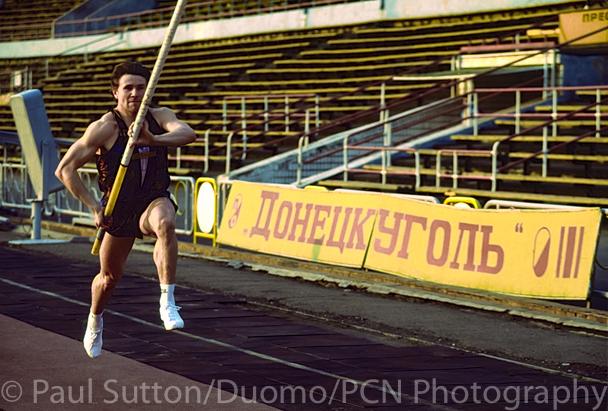
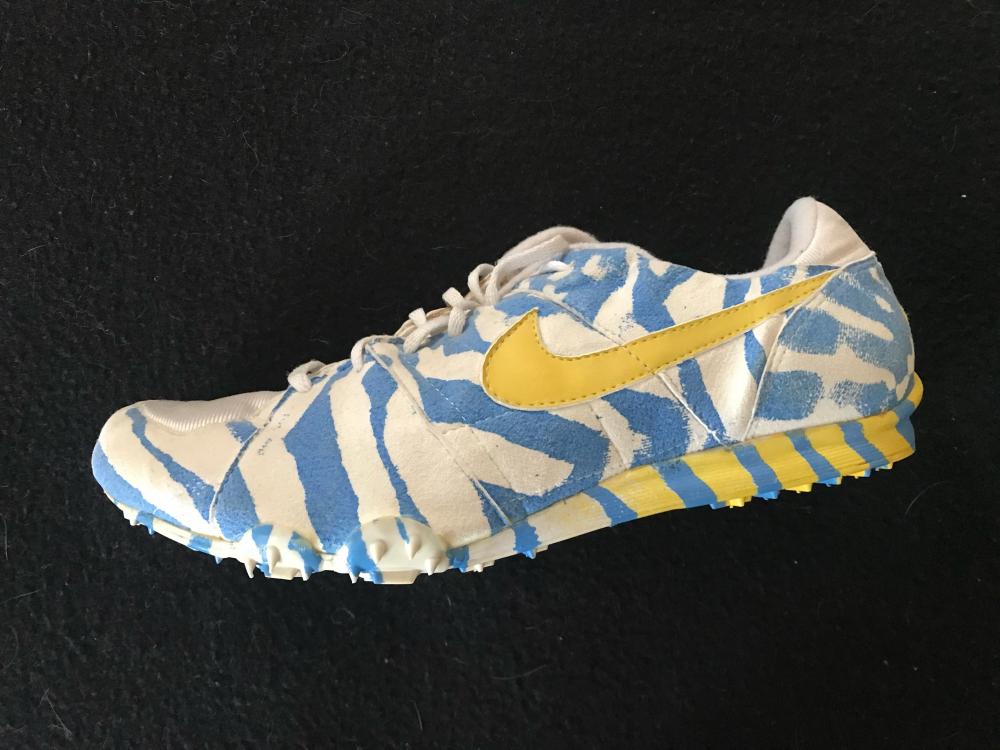
We proceeded to shadow Bubka, first from the primitive track made of loose rubber squares where he sprinted and drilled, hurdled and high jumped, and of course vaulted, while track kids ran the stadium steps and a 400 hurdler worked the turn. Then: to his makeshift weight training station inflected by connecting a pipe to a pair of concrete-filled can grips for a barbell and chest press. And finally to a gymnastics studio where Bubka flipped and leaped and dove around apparatus more common to diminutive, lighter than air performers offering hand gestures that paid homage to ballet. Bubka, 6 feet and 176 pounds, had perfected control of his size and power, caressing his pole like a cue stick, and not seeming to waste an ounce of energy in any skill he approached. He summoned a kind of refined aggression. He joked and smiled broadly, with a self-effacing demeanor and easygoing pride, following his coach’s instructions to the letter while hinting at responsibility for what he could sense then but barely express. “It’s good to be home,” he told me in his excellent English, having recently returned from a training camp in Spain. “My friends, my language, my people,” he added. Then he shrugged. “Some problems… but it’s okay.” I peppered Bubka and his coaches with questions and scribbled notes while Steve and Paul snapped away. Keith brought a prototype Nike vaulting shoe for Sergey to inspect and try out. All of us felt privileged to be in Bubka’s private domain as the first Western contingent to observe the intricacies of technique, speed and power that made the man. It was clear from the outset that as Bubka segued from one training venue to another he left no aspect of athleticism untouched. Indeed the pole vault may be the most complex and consuming event in track and field. When Bubka hurdled, he alternated lead legs. When he sprinted 60 meters in full sweats and training shoes, from a standing start, he clocked a world-class 6.68. When his coaches placed a 120-kilo weight (264 lbs) on his shoulders, Bubka jumped up and down with it 20 times. In the gymnastics studio, he did handstands walking around. He climbed the ropes using only his arms in the moment it takes to sneeze. When it was time for a massage, the therapist took a quick measure of Bubka’s physique: biceps 14 ½”, chest 44 ½”, waist 34 ¼”, quads 23 ½”, calves 17 ¾”. Bubka’s supple dimensions spoke out. “The muscles are elastic,” the therapist concluded. “They can ‘play.’” In the mornings, Keith and I ran before breakfast along the banks of the Donets River, secured today by Russian troops positioned for their continuing assault on the east. Then, Donetsk was a scene of placid conformity. Young girls in matching blue-and-white outfits gaily walked off to school. Parks and gardens glowed with spring planting. A national soccer match was coming up at the track facility and laborers mowed the field to a fine edge while women in platoks painted the wooden perimeter. In the evenings, dinner at the Bubkas’ apartment, spacious but nothing fancy, was a feast of Ukrainian delicacies prepared by Bubka’s mother, with track talk well into the hours and plenty of vodka on hand. There was also talk of those “problems,” the struggle to bridge communism with something better, perhaps a hybrid for a while—a bold quest for a society hard-wired to the past. “All conversation is about food, clothing,” said our Donetsk guide, a young woman employed by Bubka’s club. “People no longer talk about culture or sports. It’s a pity.”
How long would it take for the problems of an emerging nation fraught with uncertainty to escalate to war? What marshaling of resources would be necessary when a fiendish foe with a history of barbarism in one neighboring region after another would stop at nothing—not even atrocities? When the bloodshed in Donetsk began in 2014, Bubka’s mother, a steely babushka, was among the elders who stayed put. “She refused to leave,” Sergey told Keith when they saw one another at that year’s world junior meet in Eugene, Oregon. Ironically enough—and maybe it was no coincidence—that pivotal year of 2014 was the same year of Russia’s Sochi Winter Olympics, which turned into the biggest Russian doping scandal of many going back to the era of the Soviet Union and its puppet, the German Democratic Republic, or East Germany. Sport and politics have always been entwined in currents of history and during the Cold War athletes were “pawns in the game,” to borrow a Bob Dylan phrase, suffering incalculable harm, especially in track and field and swimming. None of the East German-Soviet bloc women’s track records still on the books mean anything, but national chest-thumping and the illusion of superiority were enough for criminal agents infiltrating athletics to sacrifice young people’s health and future well-being. Is it any wonder that Putin served as a K.G.B. operative in East Germany from 1985 to 1990? While Soviet bloc athletes were typically shielded from western media, I got close enough to see the GDR women and their “unnatural” visage, at events like the 1983 U.S.-East German dual meet in Los Angeles and 1985 World Cup in Canberra, Australia. These innocent youngsters were physically re-tooled by the notorious Dr. Mengeles of Iron Curtain sports. At Sochi, Putin and company did Cold War audacity one better with state-sponsored collusion of the highest magnitude. After it was found that dirty urine samples of numerous Russian medalists were switched with clean ones, among other subterfuge, at least 46 medalists were stripped of their honors and Russia was banned from future Olympics until the country could prove it had cleaned house and revamped its doping controls. It was another day at the office for Mr. Putin. Russia remains a sporting pariah to this day. Finished with our assignment, the four of us bid our adieus, departing an unstable Donetsk, ripe for devious intervention considering Ukraine’s Kremlin-leaning leadership over the years—five presidents before Zelensky, all beset by scandal—and its wellspring of corruption. How long could a country at the epicenter of historical conflict hold together when one leader resigns, another is impeached, a third flees the country? Ukraine is bordered by eight nations each with its own problems and a mere puddle jump away from the whole of central Europe. Being Jewish, I could not help but contemplate while in Donetsk that the trauma of central Europe, and Ukraine as well, during the War, was my trauma as well. Ukraine, as other nations, had citizens who were complicit in Nazi crimes, as well as those who risked their lives to save Jews. On the job, I kept these as private thoughts but wondered then, as many Jews do now about current events in Ukraine, and the people crying out in desperate need, who among the good souls that I met in Donetsk with Bubka could have had family on the wrong side of history, and who of their relatives might have followed their better angels. What’s more, Steve and Paul were the sons of Holocaust survivors from Poland. Their parents met in the Łódź Ghetto. They were sent to concentration camps. They managed to survive and met again in their hometown of Lodz after the war. They married, came to the U.S., started a new life, had a family and lived into their 90s. The Suttons’ father, Leon (born Lova Szmuszkowicz), is showcased in a Holocaust photography collection at the Museum of Fine Arts in Boston. The photos were taken at great risk by another survivor, passed on to Leon and then to Paul, who saw to it through a photography dealer of old works that they find a proper home. In Donetsk, I never asked my friends how they felt being that close to Holocaust atrocities, to the ground still moving, as it were. You just can’t talk about some things at random. We were there for Sergey.
In the months after our visit, Bubka notched consecutive victories in Italy, France, Holland, Sweden and Switzerland. They included the second of his four 20-footers for the year. The Olympics were ready for him on a silver platter, or, make that gold. But that season there was some strange pole vault karma in the air, above the crossbar. A ballyhooed “Dan-and-Dave” Reebok promotion centering on U.S. decathlon stars Dave Johnson and Dan O’Brien fizzled at the Olympic Trials in New Orleans when O’Brien no-heighted in the pole vault and placed 11th. Johnson won easily. In Barcelona, in the pole vault final Aug. 7, Bubka passed the first three heights, missed his first two attempts at 5.70 meters, 18’8 ¼”; then he passed on his third attempt. For all his experience, Bubka was having trouble with the wind, pole selection and the strictly enforced two-minute time limit between jumps. He took his last attempt at 5.75 meters, 18’ 10 ¼”, missed, and was out of it. No clearances. Sergey Bubka had no-heighted at the Olympics! The gold medal went to the Russian Maxsim Tarasov with his countryman Igor Trandenkov second. Both men vaulted 5.80 meters, or 19’ ¼”, a height below all but one of Bubka’s 22 competitions for the year. Bubka told reporters that the “fast” clock between jumps unnerved him and that he did not use a “hard enough pole.” Afterwards, at the hotel, I saw Bubka and just nodded. Nike’s Steve Miller tried to console him. This was not the Bubka I knew three months before in Donetsk but, honestly, I thought little of it. I’d met and gained from meeting the man in full, whose toughest challenges were yet to come. Perhaps Bubka’s competition against the Russians carried some greater meaning. The large, boisterous nation to the north, rarely predictable, always implacable, could never be taken for granted in the conclave of peacemakers, nor in its potential for deceit or conquest. But, remember, Zelensky, elected in 2019 with 73 percent of the vote, had hung out with friends in Donetsk. “I’ve been there dozens of times,” he said. “I’ve seen people’s faces, looked into their eyes.” Oh, those eyes: Bubka’s eyes, the eyes of a Ukrainian. They tell you so much. # Marc Bloom’s personal perspective on track-and-field history will appear periodically. His latest book, “Amazing Racers: The Story of America’s Greatest Running Team and Its Revolutionary Coach,” about the Fayetteville-Manlius dynasty, was named 2019 Book of the Year by the Track and Field Writers of America. More news |





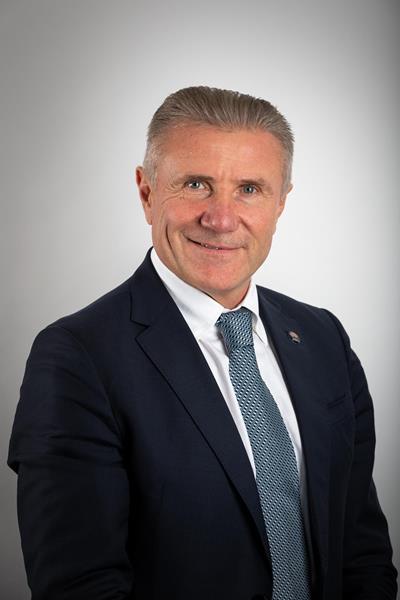
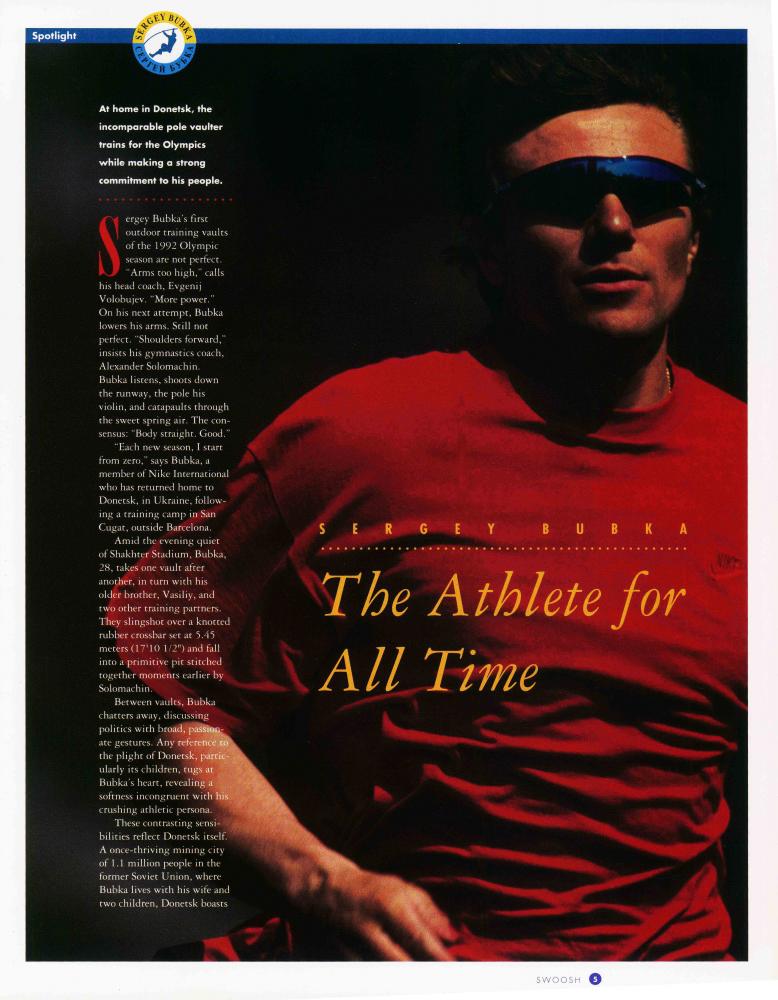
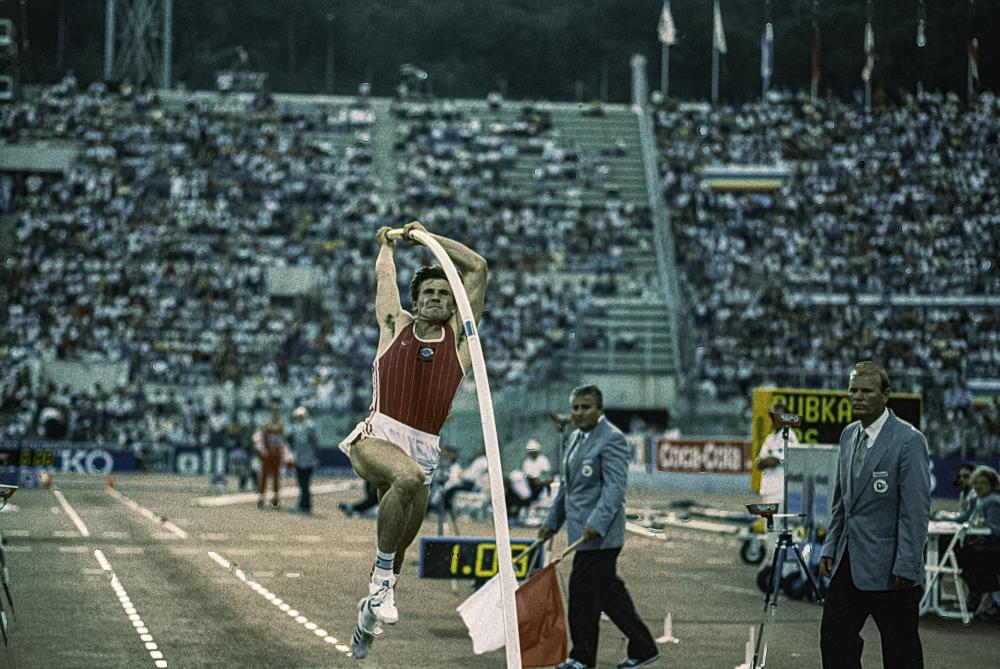
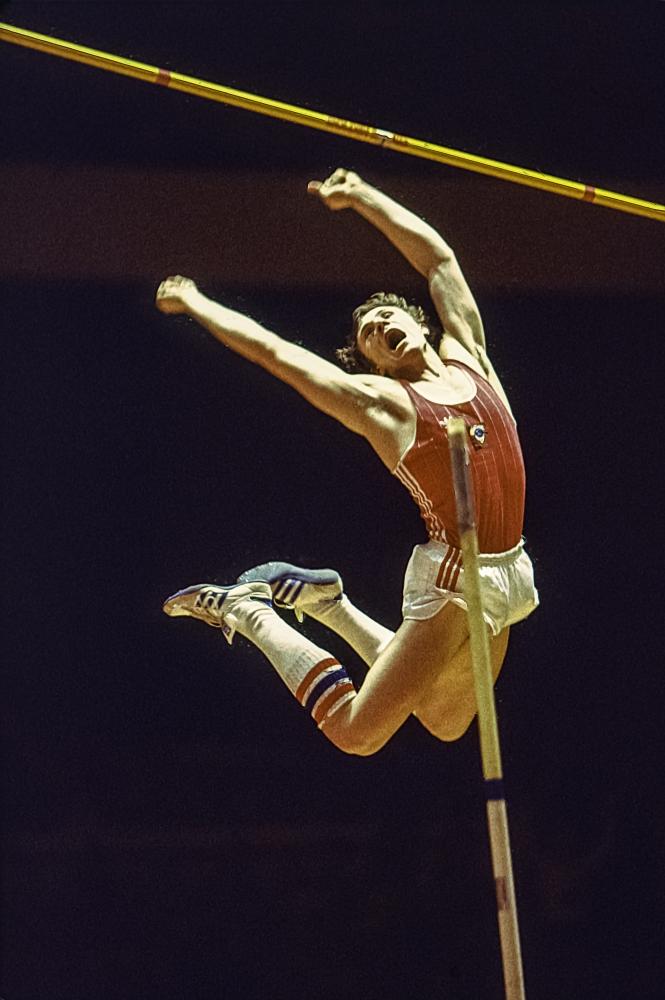


 In his recent public comments, Bubka, 58, senior vice-president of World Athletics and also president of the Ukraine Olympic Committee, declared his love of country and commitment to supporting his people. “Like any Ukrainian, I can’t sleep,” said Bubka. “I will defend our country with all the means at my disposal, using all my international connections.”
 Bubka as well. At practice, his conversation skipped from upcoming meets to Ukraine’s runaway inflation and high unemployment. Walking the streets, taking a sampling of the Zeitgeist, I saw a tense Donetsk citizenry unable to pay for gas jam onto trams at all hours and converge on vendors who popped up with a fresh batch of cucumber.
 We left Bubka in the prime of his career as he moved on to final preparations for Barcelona. He’d won the 1988 Olympic gold medal in Seoul on his final jump of a six-hour competition, 5.90 meters, or 19’ 4 ¼”. At the 1991 World Championships in Tokyo, competing in pain with a heel injury, Bubka also triumphed on his last vault, clearing 5.95 meters, or 19’ 6 ¼”. Afterwards, the silver medalist, Istvan Bagyula of Hungary, told the press, “It is not possible to beat Bubka, even with his injuries.”