


Folders |
Backstage With Untold Track and Field History: A 1964 Meet Program And A Snapshot Of The SportPublished by
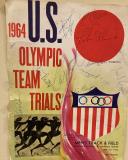
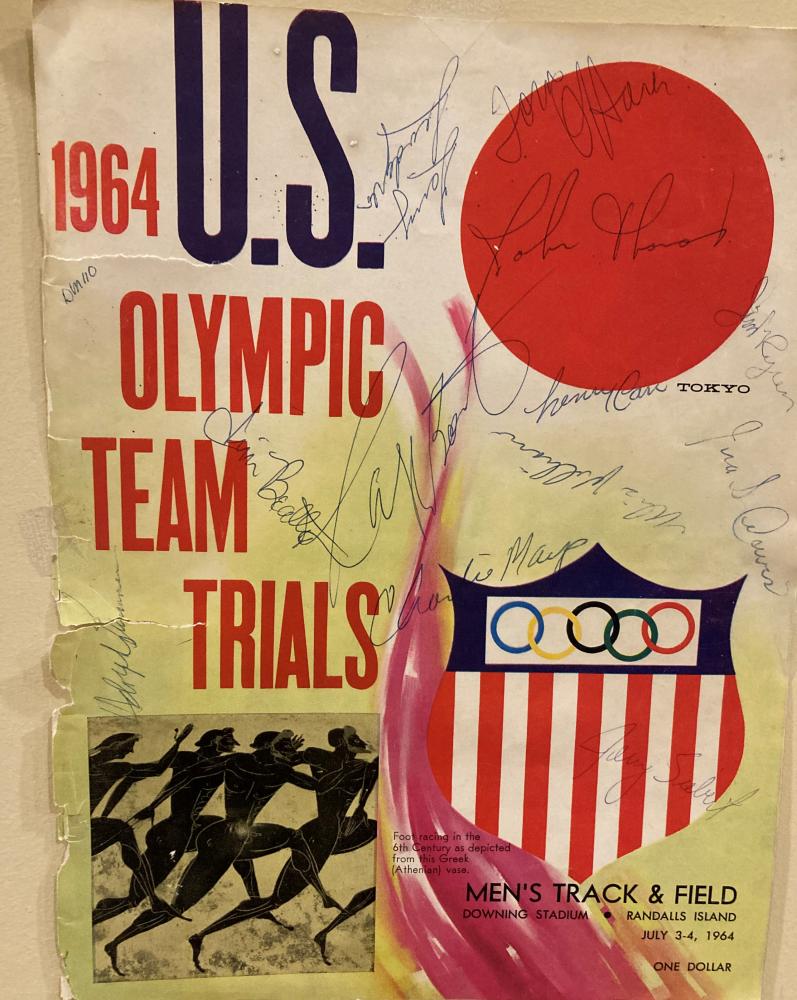
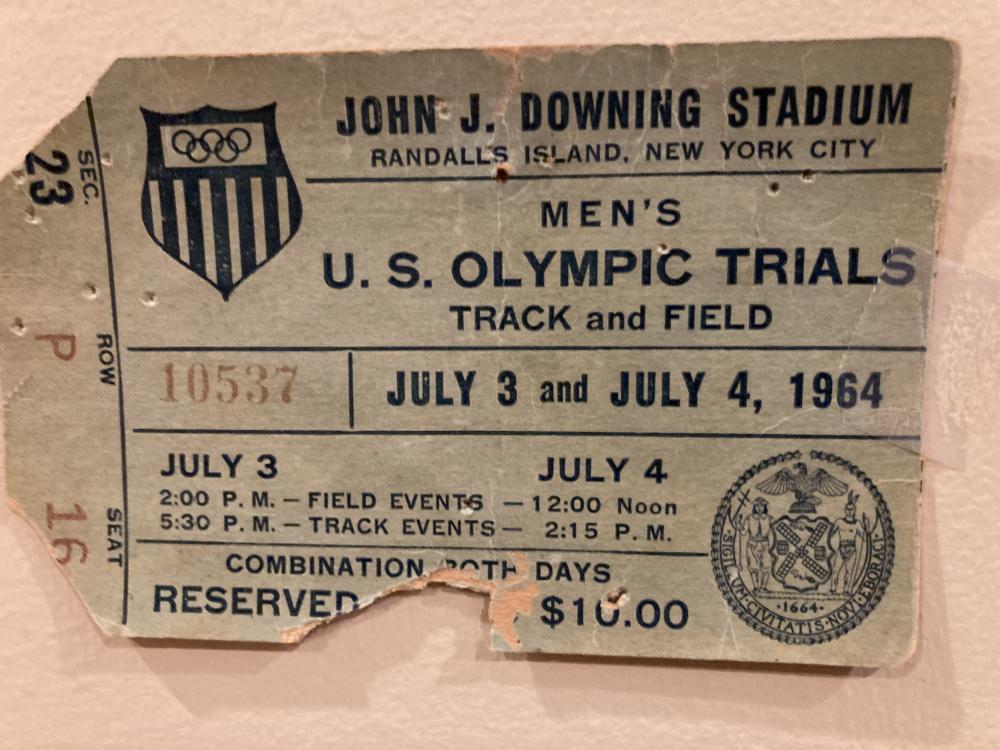
Probing the Artifacts ****** Teenage Track Adulation Finds Its Calling At The 1964 'Semi' Trials By Marc Bloom for DyeStat When I collected the autographs seen above on the cover of the meet program for the 1964 men’s U. S. Olympic Track and Field Team Trials — the “Semi-Trials” in New York — the athletes qualifying at Randalls Island for the final Trials six weeks hence in Los Angeles, and then making the team for the Tokyo Games in October, did not know that one of their key benefactors, a kid from Brooklyn, had sat in adulation on July 3 and 4, in John J. Downing Stadium, hard by the Tri-borough Bridge, in section 23, row P, seat 16, witnessing, at least symbolically, what his financial largesse had wrought. Jim Ryun. Gerry Lindgren. John Thomas. Adolph Plummer. Henry Carr. Jim Beatty. Tom O’Hara. Et al. Up close and, well, if not personal, close enough to see, in the flesh, the American stars I’d read about — the teenage phenoms along with the veterans, the record breakers, the Olympic medal threats. The boyish faces of some … the Southern drawl of others. Black folks who’d come up the hard way, like Plummer, who was born in Brooklyn, took up running in the Air Force, became an NCAA 440 champion at the University of New Mexico and set a world record for the “quarter” on his home track, 44.9, in 1963. Irishmen with their milky skin like O’Hara, who started running in second grade racing his sister to school in Chicago and went on to set a world indoor mile record of 3:56.4 in 1964, a mark that stood for ten years. This close to track royalty. Ryun and Lindgren would have been enough. There is no way to overstate their impact that year: Ryun, as a junior, delivering the first high school sub-4:00, a 3:59.0 in California. It took 58 years, until this very season, for the junior-class record to be broken. Lindgren — his prodigious mileage of more than 200 a week not yet known — running an 8:40.0 indoor 2-mile the prior winter, in a succession of high school records that tore 43 seconds off the mark of a Queens boy I’d seen set it the previous year at Madison Square Garden. With each Lindgren indoor mark, from 9:06 to 9-flat in ‘63 to 8:46.0 and the 8:40 in ‘64 (which took 49 years to come down at hands of Edward Cheserek, and then by less than one second), my high school track teammates and I would trade phone calls in disbelief, as a high school 9-minute 2-mile was inconceivable to us — we who had no runners under 10 minutes, few that there were in the entire city of New York (or elsewhere) at that time. “Did you hear what Lindgren just ran?” became a weekly shock. With his twig-like 5’6”/118-lb. frame and rather sickly countenance, it seemed a stiff breeze off the nearby East River could blow him over. We didn’t know then that these all-American boys, Ryun from Topeka East in Kansas and Lindgren from Rogers High of Spokane in eastern Washington, conveying clean images we counted on, surely pure of heart, and with power in their legs yet to be defined, suffered an anguish all their own that had propelled each one to greatness. Ryun would reveal what an out-of-touch, bashful teen he was, good at nothing, no girlfriend even for crying out loud, until he found himself in running. Lindgren had to run, even in the middle of the night, to get out of the house and away from his abusive father. We knew not of such things then. Not that we wanted to know. These guys were our heroes, and we liked our heroes simple and clean. We fell on their every stride.
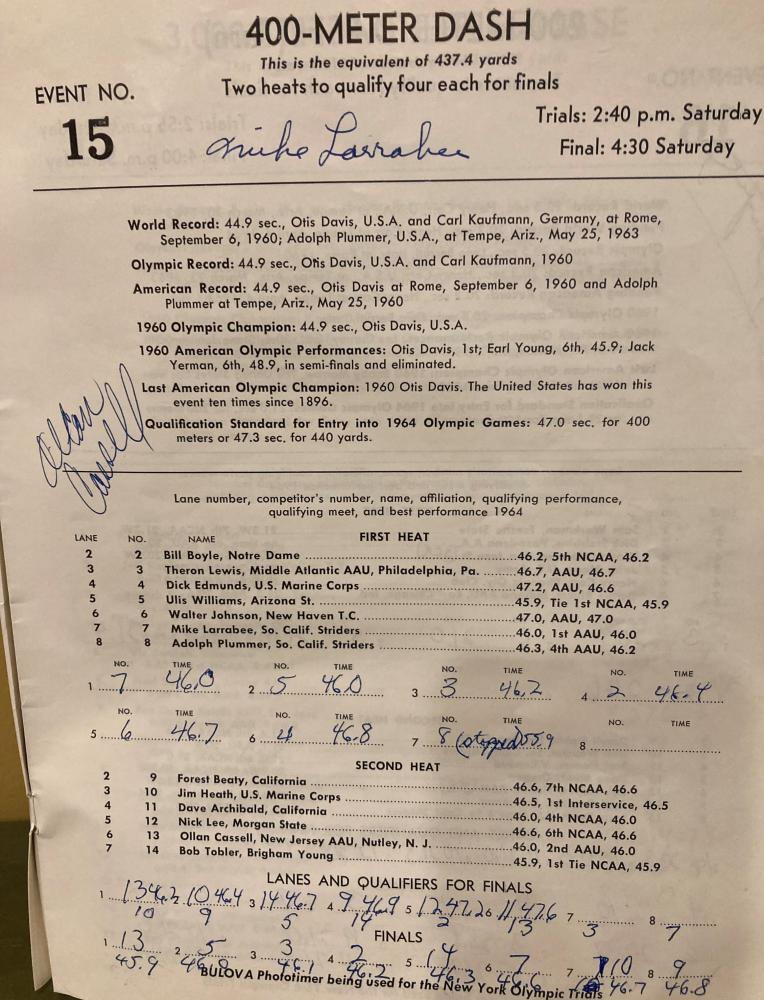
The top six at the Semi-Trials would move on to the final Trials, Sept. 12-13, in Los Angeles. Semi-Trials winners would automatically make the U.S. team as long as they competed in L.A. The Olympic track and field events began on Oct. 14. In addition, there was only one 10,000 meters Trials race, in Los Angeles, but there were two qualifying events for the marathon — the AAU championship marathon over the hilly Yonkers, N.Y., course, and the flat Western Hemisphere Marathon in Culver City, Calif. The women’s Trials (they had no Semis) would be held Aug 6-8, back at Downing Stadium. At the time, the only women’s running events at the Olympics were the 100, 200, 400, 800, 100 hurdles and 4x100 relay. There was not even a women’s 4x400 until 1972! The field event menu was a bit more generous, with the high jump, long jump, shot put, discus and javelin and, for the first time, pentathlon (with a 200, not the 800 until 1980). With the men’s and women’s one-off Trials held together at the same site since 1976 — for the last 12 Olympics (I’m including the 1980 boycott year) — it might seem like the layered ’64 set-up was an anomaly. Not the case. Taking the measure of Olympic history going back to 1896, multiple qualifying meets were the norm. Even the next time around, in 1968, a Semi-Trials was held in Los Angeles with a final Trials 10 weeks later near Lake Tahoe, at Echo Summit, Calif, whose 7,382-ft elevation was a virtual match for that of the Olympics site in Mexico City. (Likewise, the ’68 marathon Trials were staged in high-altitude Alamosa, Colo.) As a high school quarter-miler, I tracked down several of the one-lap favorites for signatures. In addition to examining the cover, go to the inside of the program and see autographs on the 400-meter page from Mike Larrabee and the Semis event winner, none other than Ollan Cassell, the future controversial and combative executive director of the AAU. (I would have a few journalistic tangles with him in later years but we always remained on good terms.) Cassell, representing the Houston Track Club (the program had him as “New Jersey AAU”) ran 45.9 at the semis, made the team in L.A., but was eliminated in the heats at Tokyo. Who would win the Olympic gold medal? It was Larrabee, a Californian who’d starred at USC, seventh in the semi-trials and first in the final trials. In Tokyo, Larrabee ran 45.1 for the victory. Cassell did come away with a gold medal leading off the U.S. world record 4 x 400 relay, with Larrabee on second leg followed by Ulis Williams and Henry Carr. Time: 3:00.7.
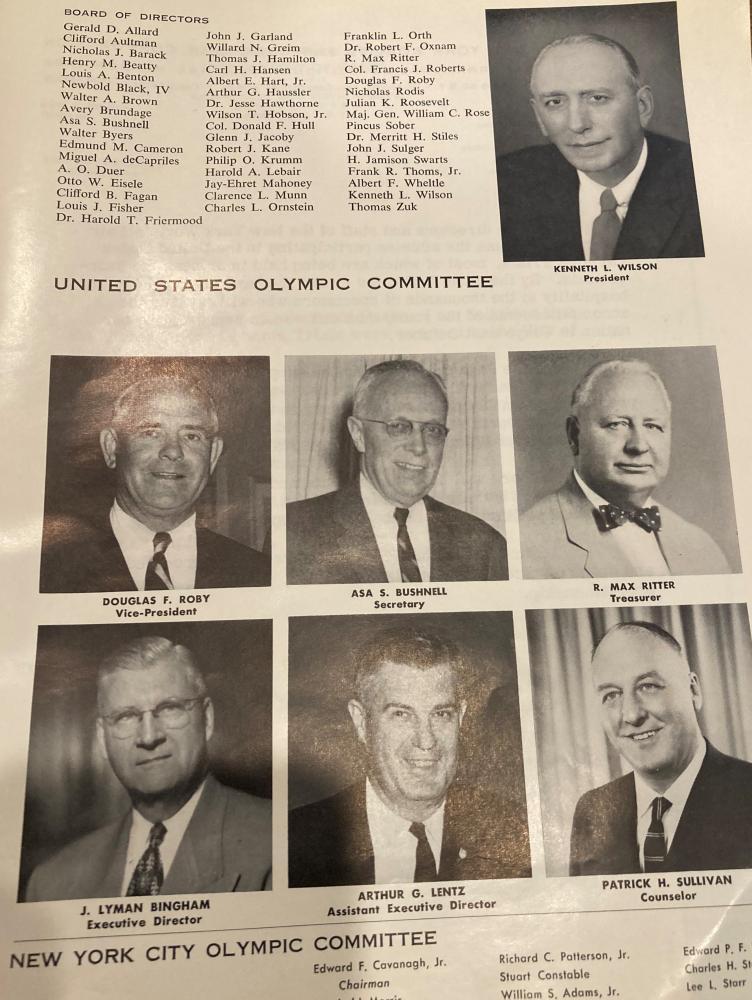
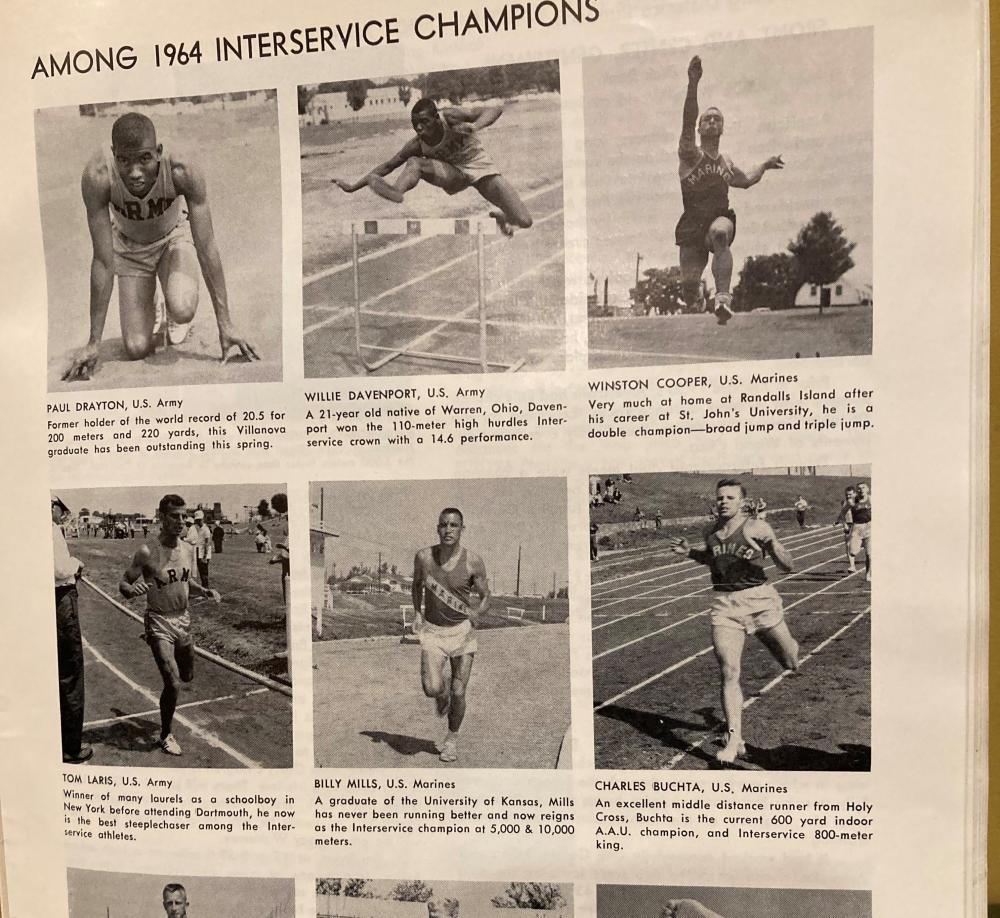
Cassell, Larrabee, Williams and Carr. Trivia question: what 17-year-old track fan from New York collected all four autographs from these 400 runners at the Semi-Trials assuming this quartet would win the gold in world record time three months later in Tokyo? Okay, okay… but I’d say there was something more than good karma at work. As a studious young track nut, I knew my stuff. I was no stranger to Downing Stadium, where most of the New York City high school outdoor meets were held. For us, it was Van Cortlandt Park in the Bronx for fall cross-country, the Armory in upper Manhattan for indoors and Downing Stadium for outdoors. It was a terrible trip to Randalls Island from the outer boroughs by subway, bus, walking; few teams had the luxury of yellow school buses. I’d made that excursion just weeks before to conclude my high school track career at the Public Schools Athletic League — the PSAL — city championships. Some career! My trusty little track diary from that era tells me I was one of 17 members of my team, Sheepshead Bay, to compete. Since I was not good enough to run the championship 440, or deserved to be added to the mile relay foursome, I was dumped into the 880 relay and proceeded to record the slowest split of the quartet, 24.6. But I had a great excuse: “tired from 94-degree heat.” Oh, me. I actually wrote that. Our school’s only all-city performance was a sixth-place 21’3” long jump by a long-and-lean redhead named Tom Seery, who got a look at an up-and-coming kid from Jamaica High with legs born to leap — the runner-up, Bob Beamon. Synthetic “all weather” tracks, for the most part, were still years away (never mind anything like the Mondo we have today); and Downing had standard issue cinders, showering athletes with a dusty curtain when our heavy “Kangaroo” spikes sent loose track particles airborne, a badge of honor when you left the arena coated in crud as though having gone to battle. At least we had starting blocks. Downing Stadium opened in 1936 with the name Municipal Stadium and seating for 22,000. It was christened on July 11 and 12, before a capacity crowd, by hosting that year’s men’s final Olympic Trials featuring Jesse Owens and the squad that would compete at the Berlin Games in Nazi Germany, collecting 15 gold medals. During that same period, the new facility would also play host to “Negro League” baseball games and through the years was a major site for soccer, football, rugby and Gaelic football. The 1991 USA nationals were also held at Downing, and noted for Leroy Burrell’s 100-meter world record of 9.90; and, once refurbished in 2005 at a cost of $42 million, courtesy of billionaire Carl Icahn and renamed Icahn Stadium, the site has played host to various world-class events like the recent New York City Grand Prix. At the time of the ’64 Semi-Trials, Downing seemed very much a threadbare operation—something like the “old” Armory before that historic house was re-constituted in the mid-‘90s. The locker rooms were vintage post-War, like out of a Jack LaLanne workout demo. Décor was absent. Its track history was buried in its cinders. When I competed there, parades of team members would trudge their last link dragging duffle bags over the Tri-borough walkway from the 125th Street subway stop in Harlem, bands of kids going off to a track sequestered on a remote plot of land apart from the city proper. Randalls Island was another world. It was known for its psychiatric hospitals and asylums. It had police and fire training operations. You could throw some beach chairs in your trunk and drive over for a picnic, but at your peril. Its out-of-the-way-ness made it fertile territory for mobsters seeking ideal burial grounds for their rubouts. Speaking of illicit figures, remember the climactic seen in “The French Connection,” in which the detectives played by Gene Hackman and Roy Scheider corner the drug dealers on one end of the Tri-borough, and a gunfight ensues deep in the caverns of an abandoned building? That was Randalls Island. The meet program that I saved all these years offered no paean to urban legends, only the legends of the track. A glossy work of almost a hundred pages, it featured articles by the notable sports writers of the day: Arthur Daley and Frank Litsky of The New York Times, Jesse Abramson of the Herald Tribune and Frank Dolson of the Philadelphia Inquirer among them. Stan Saplin, the Trials chief announcer and something of a media “decathlete” with the many outlets he would represent (the Armory’s Media Center is named in memory of Stan), wrote a touching piece on attending the ’36 men’s Trials at Downing as a young man, just making the opening event on the first day after getting stuck in traffic. In addition to Downing’s unveiling, July 11, 1936 marked the opening of the Tri-borough Bridge (now called Robert F. Kennedy) and 200,000 people hit the span in a celebratory crush, as Saplin told it, along with various dignitaries led by President Franklin Delano Roosevelt himself. In the program, the sport’s significant developments were heralded by authorities of the day. Dick Bank, track expert at ABC, weighed in on the latest distance running innovations like Swedish “fartlek,” the long mileage program of Arthur Lydiard in New Zealand and Percy Cerutty’s sand-dune training in Australia. Bank presciently forecast Bob Schul’s 5,000 chances for Tokyo but, alas, made no mention of Billy Mills of the U.S. Marines in the 10,000, pictured one page earlier highlighting his recent victories in the Inter-service “5” and “10.” The Trials technical advisor, Irv Kintisch of Manhattan College, boasted of fiberglass vaulting poles, lightweight shoes, upgraded measuring tapes and the Bulova photo timer. Speaking of future technology, Kintsch wrote, “The end is not in sight.” Surely not, considering the upgraded information transmission at the Trials “carried electronically” by Sony “walkie talkies.” The program offered a window into the sluggish pace of track and field’s evolution. True diversity was a long way off. From U.S. Olympic Committee executives to the meet’s top management, mostly old white men were in charge. In fact, not one of the more than 200 meet officials, from timers and judges to clerks, marshals and event chiefs, was a woman. It’s true that the women’s Trials would be held at the same site in August, but, still, how far could you take separate but equal, even in 1964? Yet, it was nice to find a potpourri of former Olympic greats among the officials “on the ground,” as it were. The steeplechase technical inspector was 1952 Olympic steeple champion Horace Ashenfelter. Eulace Peacock, six-time AAU pentathlon champion, worked the “broad jump” (as it was named on the officials’ page) and triple jump (thankfully, no “hop, step and jump”). John Woodruff, 1936 Olympic 800-meter gold medalist, served among the inspectors. The 1912 Olympic 1500 silver medalist and former world record holder, Abel Kiviat, was a press steward. And then there was another inspector, Frank Hussey — Francis Valentine Joseph Hussey — who won an Olympic gold medal at age 19 on the U.S. world record 4 x 100 foursome at the 1924 Olympics in Paris. In Paris, Hussey had run lead off against Abrahams of the runner-up British squad. It was the U.S. in 41.0, the Brits in 41.2. And, 40 years later, these Olympic sprint lead-off rivals were practically in the same place at the same time as American championship meet officials! Did Mr. Abrahams remain in the States another week to witness the Semi-Trials and renew acquaintances with Mr. Hussey? I’d like to think so. Speaking of Olympic-medaled officials, let’s include Games Committee member Ray Lumpp of the New York Athletic Club, a 6’6” shooting guard on the winning USA basketball team at the 1948 Olympics in London. As a front man for the A.C., Lumpp was mired in controversy for the club’s racist policies. Of all people, Lumpp would be in charge of ’64 Trials housing, placing athletes — presumably white ones only — at the A.C. The club’s notoriety would cause the demise of its 100-year-old indoor meet at Madison Square Garden in 1969, after a ’68 meet protest and boycott by black athletes. While the program, which sold for one dollar, stands the test of time as a document of track and field history, its objective was to generate some income as well, part of the USOC’s overall fund-raising to send the American squad of some 346 athletes in 19 sports, plus the coaches and officials, to Tokyo. The organization headquarters was then housed in a suite on Park Avenue and led by wealthy businessmen with Mad Men connections. I counted 20 full-page ads, mostly for automobiles, airlines and salves for aching muscles, but one stood out to me from a major sponsor: a leading cigarette company later convicted of racketeering in the tobacco scandals.
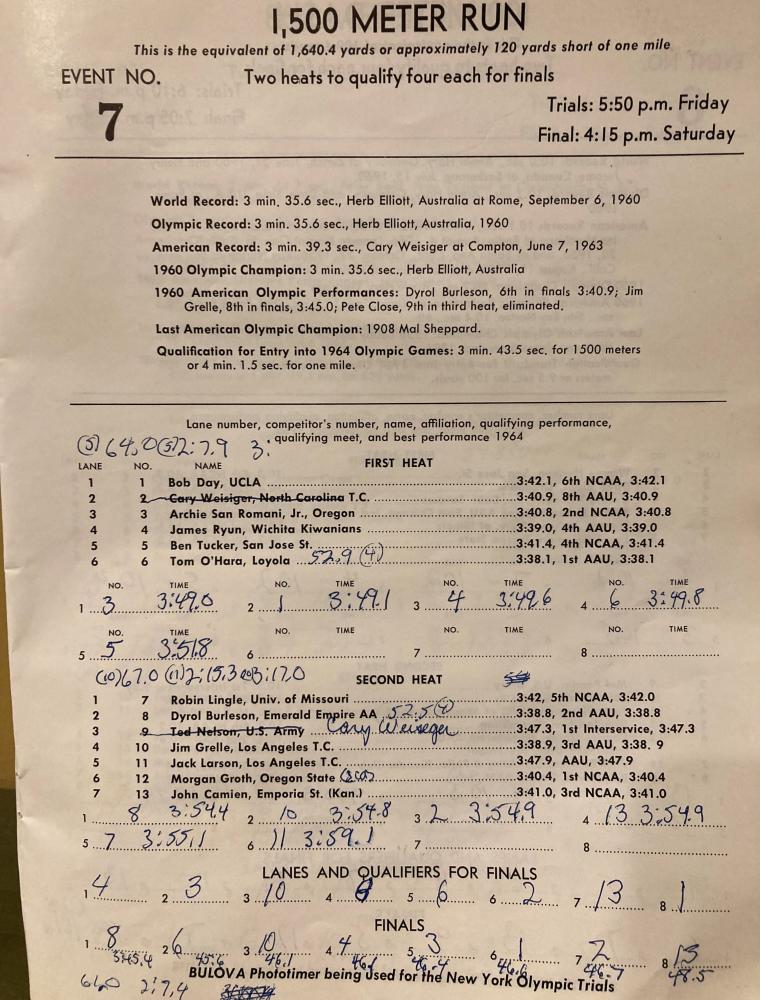
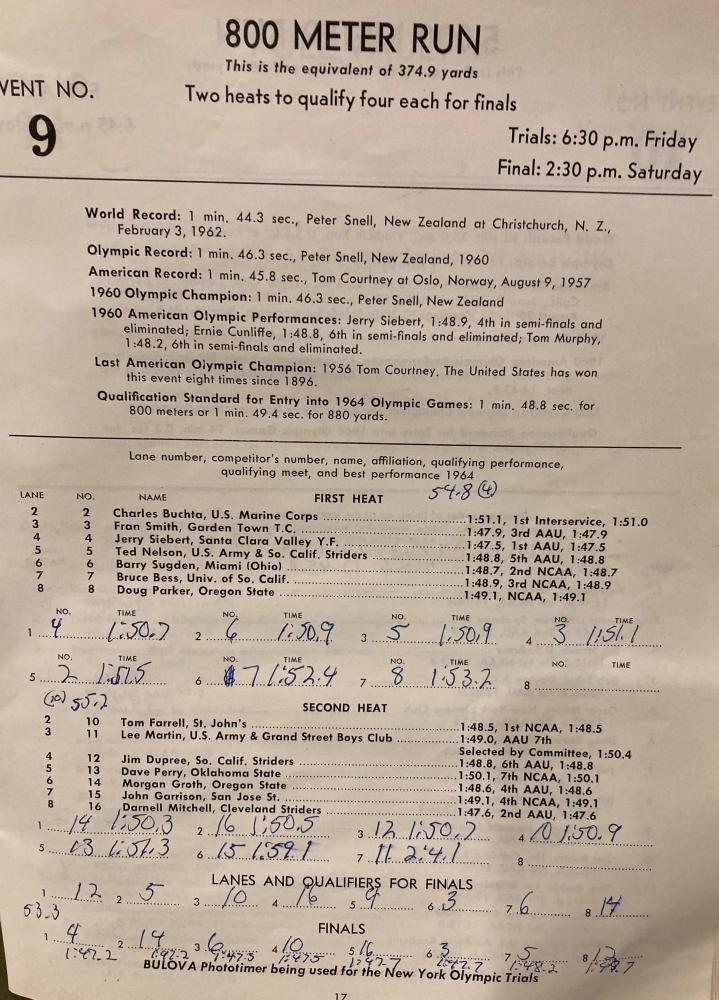
If there was ever an indication that I would spend my life immersed in track and field, it was my notations, legibly to my surprise, of every single Semis result with place and time, height or distance, from not only the finals but the heats as well. In the 800, for example, I listed the eight runners in the first heat, and seven in the second, with race number, place and time, along with the 400 splits, plus lanes for the 12 finalists, and of course the final results: number-4 Jerry Siebert of the Santa Clara Valley Youth Village, in 1:47.2, by inches over Morgan Groth of Oregon State, also 1:47.2. The 1960 Olympic bronze medalist at Rome, Tommy Farrell, took fourth. Similarly, for the discus, I listed every one of the 42 throws by the seven contestants, including fouls (and noting a couple of scratches). The victory went to the world record holder, New Yorker Al Oerter, 201’11”, who at Tokyo would capture the third of his four straight Olympic titles. With all my score keeping, was I like the baseball fan of yore with a scorecard and small pencil, charting every play, hit and miss with jargon-y symbols, so engrossed in having a complete accounting that he couldn’t appreciate the lyrical essence of that seamless double play or throw from deep in right to nail the speeding base runner diving into third? I don’t believe so. Even then, I managed to juggle my stats with a close viewing, a knack that would serve my journalism in the years to come. I attended the Semis with a high school track teammate and, for 10 bucks, we sat past the finish into the near turn, 20 rows up, good enough for a couple of teen-agers just happy to be in the magical world of America’s top runners. I was sorry to see the young Ryun suffer a bad day in New York. In his historic 3:59.0 mile, he’d finished eighth in a “pro” field (no one was officially paid then) with a 56.2 last lap, then ran a 3:39.0 for fourth in the AAU 1,500, equivalent to about a 3:57 mile. The kid was still 17; fact, he’d just turned 17 in late April. Every Ryun race re-wrote the book on age records. But in front of my starry eyes, Ryun hung behind a slow pace and kicked for all he was worth to place a disappointing fourth in 3:46.1 for the 1,500. While his last quarter was a scalding 53.3, Jim Grelle, 27, held him off for 3rd and Dyrol Burleson won. To make the team six weeks later in L.A., Ryun, after churning out PR workouts like 20 quarters in 62 seconds, came through as he had to, reversing the order with Grelle to take 3rd as Burleson (age 24) and O’Hara (22) placed one-two. At 17 and a half, Ryun was going to Tokyo, the youngest track and field Olympian in modern U.S. history. At the Games, Ryun placed last in his 1,500 heat, running “his worst race ever” (said his mother), and his first Olympics was over. O’Hara didn’t make the final either. Burleson wound up 5th in the final as Peter Snell of New Zealand triumphed convincingly while also capturing the 800 for the second straight Games. After Tokyo, a Wichita Eagle editorial, commenting on its favorite teen-age son, announced, “The world has not heard the last of this amazing Wichita athlete.” Indeed. Ryun and Snell would meet in San Diego the next year in a mile race that would live on as a reference point in track annals. For his part, Lindgren continued to belie his feathery appearance with some big-time chops, first in the annual U.S.-Soviet dual meet, a nationally-televised Cold War confrontation begun in 1958. The recent high school graduate buried his veteran Russian counterparts with a shot-heard-round-the-world 10,000-meter victory in 29:17.6 in 90-degree temperatures at the L.A. Coliseum, about seven weeks before the final U.S. Trials on the same track. Lindgren blasted his last 200 in 30 seconds to defeat the first Russian by 22 seconds and the next one by 94 seconds. Being undefeated in three 10,000s, winning the final Trials in 29:02.0, and with a 13:44.0 in his only 5,000 attempt (the 13th fastest performer ever; like a U.S. high school kid today running 12:48), it was no shock to see Lindgren take the lead in Tokyo despite perhaps the greatest field ever assembled: Mohamed Gammoudi of Tunisia, Ron Clarke of Australia, Murray Halberg of New Zealand, Mamo Wolde of Ethiopia. They were all there. Lindgren hit the first 1k in 2:42, a ridiculous 27-minute pace when the world record, by Clarke, was 28:15.6. Lindgren held the front through 3k, at 8:20, still sub-28 tempo. After Lindgren finally gave way and wound up a still admirable ninth, well… you know what happened next: Clarke poured ahead and all hell broke loose on the bell lap. Gammoudi ran for his life, a dazed Clark searched his soul for what went wrong, and the American nobody Billy Mills sprinted through lapped-runner traffic with maniacal serenity to capture the gold medal. None of the Track & Field News international expert panel had picked Mills for the top six. After crossing the tape, a Japanese finish line official approached Mills and asked, “Who are you?” This is where I tell you how I played a role in that historic victory. As a youth, I literally bought into the USOC’s big push for public support. American officials even enlisted the Tokyo medal contender Jim Beatty to pen a sales pitch disguised as an Olympic preview for the Semis program, titled, “The Soft American Gets Tough.” Beatty gave the most play to the “spirit and drive” of distance runners, especially the marathoner Buddy Edelen, who’d set a world record of 2:14:28 in 1963. Unfortunately, by the time of the Semis when the article came out, Beatty himself was injured. In 1962, Beatty, who started out in sports as a 118-lb. amateur boxer, ran the first indoor sub-4:00 mile, 3:58.9 in Los Angeles. That summer in Europe, Beatty set five American records in 16 days, dropping his mile time to 3:56.3. While Beatty remained hot through the winter of ’63, lowering his world indoor record to 3:58.6 at Madison Square Garden, an injured right foot requiring 22 stitches later that year threw his plans into disarray. He ran the 5,000 at the Semis, was a dnf, appealed to officials to be allowed into the final Trials, was accepted and placed well back in 5th as Bob Schul and Bill Dellinger (would-be Tokyo gold and bronze medalists) tied for first.
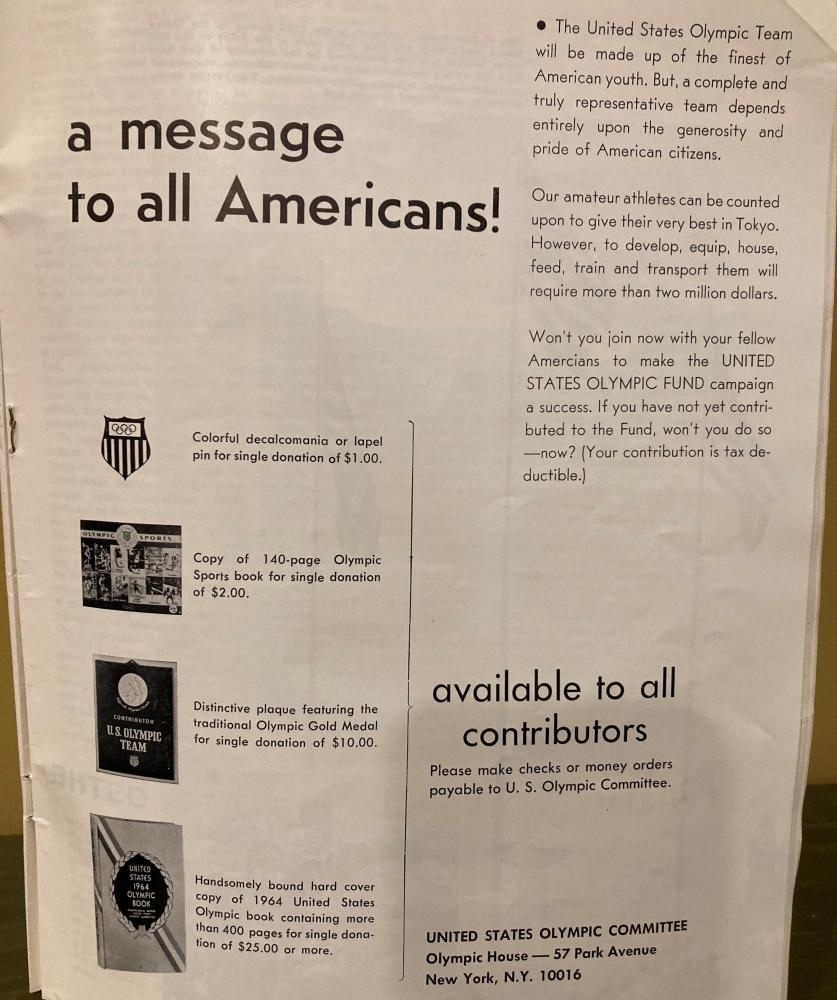
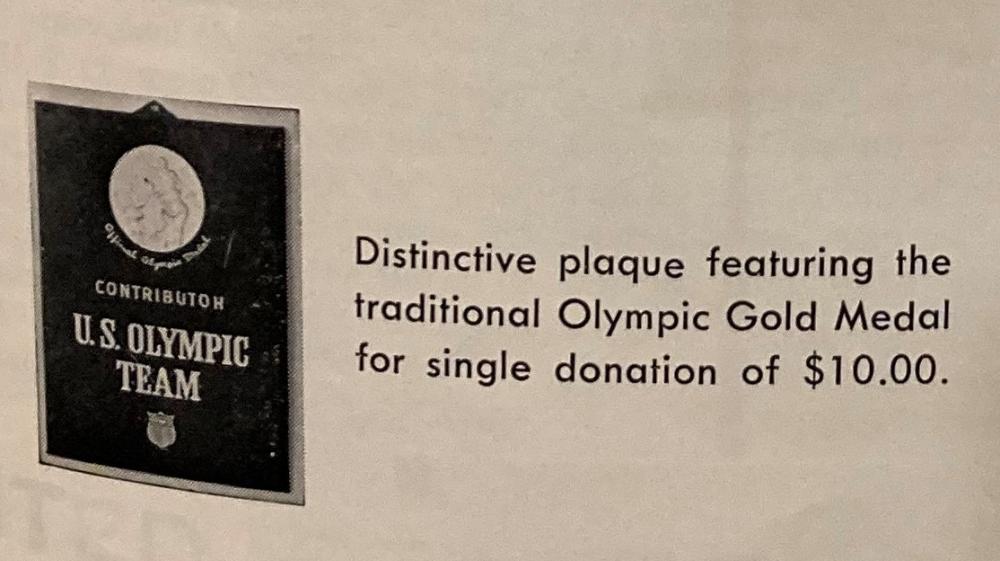
I got an idea. Glance at the Semi-Trials house ad above with its “message to all Americans.” See the “contributor” plaque sporting a replica of a gold medal, available for a $10 donation. My meager allowance was already stretched thin. But why not go around to my high school track team members, collect 25 cents a man, and send our generous donation to the United States Olympic Committee. And that’s what I did early in the spring of ’64. I hit on 40 teammates, who willingly chalked up a quarter apiece from their loose change. The school sent a check, and soon enough a nifty little package arrived with the plaque, the exact one from the program ad, which I had seen months before in a flyer. I could not have been more excited or proud. The coach hung the prize in the school trophy case amid various awards I could never hope to earn. About 30 years later, I was seated next to Billy Mills at the awards banquet of the Foot Locker high school cross-country nationals in San Diego. Before Mills, special guest for the weekend, made his presentation of the Tokyo 10,000, with its dramatic footage, I leaned over to Billy, who by then I’d known for some time, and told him, “You know, I did my part to help you win the gold.” He gave me the broad Olympian smile he’s known for and an endearing look of incredulity. When I told him the tale of the $10 contribution, Mills laughed and, considering his former indigence as an amateur athlete, said, “I needed that.” # This is the second installment of Marc Bloom’s personal reflections on track and field history. The first can be found here. Marc’s latest book, “Amazing Racers: The Story of America’s Greatest Running Team And Its Revolutionary Coach,” about the Fayetteville-Manlius cross-country dynasty,” was named 2020 Book of the Year by the Track and Field Writers of America. More news |

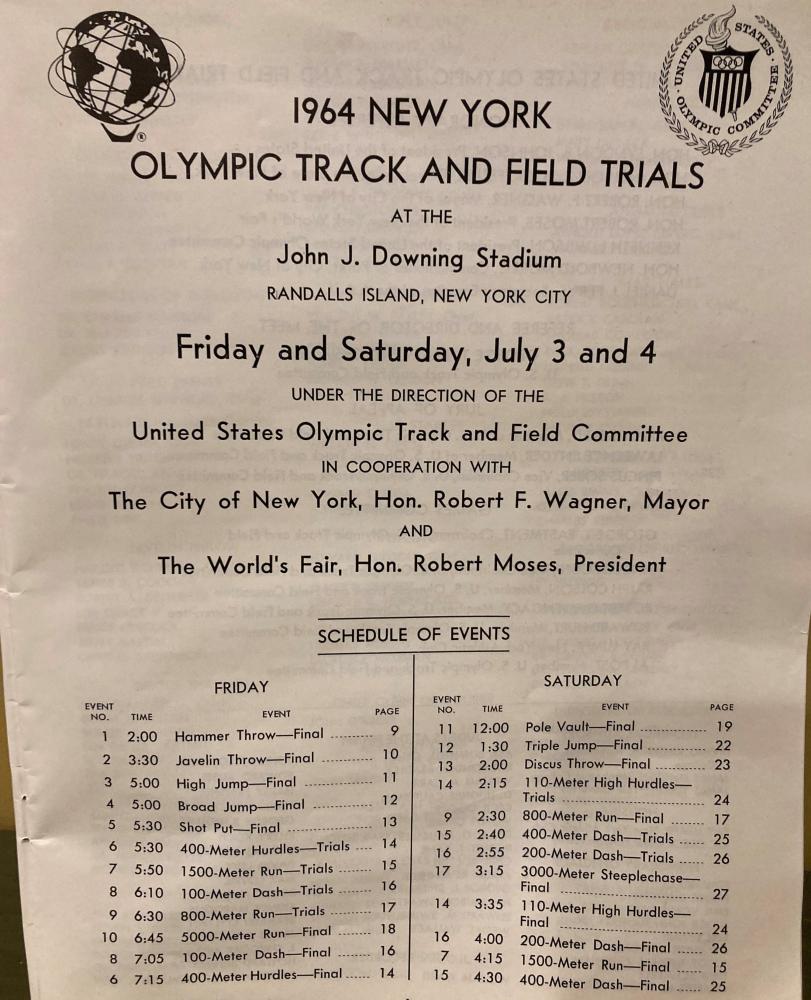

 “The Road to Tokyo,” as it was dubbed, presented a series of championships and qualifying events in close order the likes of which had rarely if ever been seen. To make it into the Semi-Trials, athletes had to win at the Inter-service Championships June 5-6 in Quantico, Va., or be among the top six at the NCAA Championships in Eugene, June 18-20, or top six (not counting NCAA qualifiers or foreigners) at the AAU meet, June 27-28 at Rutgers University in New Jersey. The AAU also hosted a distinguished visiting official from England who was in the business of track surfaces —1924 Olympic 100-meter champion Harold Abrahams, later of “Chariots of Fire” fame.
 Plummer (pictured, with Ulis Williams, right), representing Southern California Striders, never made it to Tokyo. Hampered by arthritis in his left knee, he was last in his Semi-Trials heat, practically stopping with 30 meters to go and jogging across the line. “There goes ten years of my life down the drain in one race,” he told Track & Field News.

 As a high school junior running my first track season in ‘63, I witnessed Beatty’s 3:58 race at the Garden and was immediately hooked. Pleas for athlete support touched my patriotic fervor and I wanted to feel a part of the American Olympic effort.